


The Golden Age of Islam
The Golden Age of Islam, also known as the Islamic Golden Age, was a time of great growth in knowledge and culture. It lasted from the 8th to the 13th century. Many areas, like science, art, and culture, significantly improved.
The Abbasid Caliphate was at the heart of this growth. They made Baghdad a hub for learning and thinking. The Islamic civilisation shone brightly, spreading knowledge far and wide. It had a significant impact on human progress.
We learn about the amazing things done during this time. It shows how knowledge and sharing ideas can change the world. The Islamic Golden Age symbolises the power of learning and cultural exchange.
Key Takeaways
- The Islamic Golden Age was a period of significant cultural and intellectual growth.
- The Abbasid Caliphate was crucial in establishing Baghdad as a learning centre.
- Advancements during this era had a lasting impact on science, art, and culture.
- The Islamic civilisation thrived, influencing the broader world.
- This period is a testament to the power of knowledge and cultural exchange.
The Historical Context of Islamic Enlightenment
To understand the Islamic Golden Age, we must look at the early Caliphates and their effects. Before this golden time, there were big political and social changes. These changes helped set the stage for the future advancements.
Political Landscape Before the Golden Age
The Caliphates grew from 622 to 750 CE, a key time in Islamic history. This period saw the rise of different Caliphates. Each one helped the Islamic world grow and get stronger.
Early Caliphates and Their Impact on Society
The Rashidun Caliphate (632–661 CE) and the Umayyad Caliphate (661–750 CE) shaped the Islamic world. The Rashidun Caliphate, based in Medina, led the early expansion under the Prophet Muhammad’s companions. The Umayyad Caliphate, in Damascus, expanded the empire further and set up a more complex system.
This expansion spread Islam and helped in cultural exchange and knowledge sharing. A unified system of governance and Arabic as a common language were key. They helped pave the way for the intellectual and artistic achievements of the Islamic Golden Age.
Looking back, the early Caliphates were key for learning and thinking. The start of the Abbasid Caliphate in Baghdad marked a new era of enlightenment. This era saw many Muslim achievements in various fields.
The Birth of The Golden Age of Islam
The Islamic Golden Age began in the 8th century with the rise of the Abbasid Caliphate. It was a time of significant cultural, scientific, and philosophical growth.
The Establishment of the Abbasid Caliphate
In 750 CE, the Abbasid Caliphate started, bringing stability and wealth. The Abbasids took over from the Umayyads, moving the capital to Baghdad. Baghdad became a centre of learning and thought.
Baghdad: The City of Peace and Knowledge
Under Harun Al-Rashid, Baghdad flourished as a centre of knowledge. The city had the famous House of Wisdom, a place for translating and keeping ancient knowledge.

The House of Wisdom was crucial in the Islamic Golden Age. Scholars from all over flocked here, and they translated many classics into Arabic, paving the way for new discoveries.
| Key Features | Abbasid Caliphate | Umayyad Caliphate |
| Capital | Baghdad | Damascus |
| Notable Institutions | House of Wisdom | None notable |
| Period | 8th – 13th century | 7th – 8th century |
The Abbasid Caliphate and Baghdad’s rise marked a new era in Islamic history. It had a profound impact on the world.
Scientific Breakthroughs and Innovations
The Islamic Golden Age was a time of significant scientific progress. Muslim scholars made major contributions in science, philosophy, and culture. Their work laid the groundwork for future discoveries.
Advancements in Mathematics and Astronomy
Mathematics saw giant leaps forward during this time. Muḥammad ibn Mūsā al-Khwārizmī was a key figure. His book “Kitab al-mukhtasar fi hisab al-jabr wa’l-muqabala” introduced new ways to solve equations. This changed mathematics forever.
His work was so important that we now call the “algorithm” after him. And “algebra” comes from his book title.
Astronomy also made significant strides. Astronomers found new ways to track the stars and accurately measured the Earth’s size. Omar Khayyam was one of these pioneers. He helped lay the foundation for future discoveries.
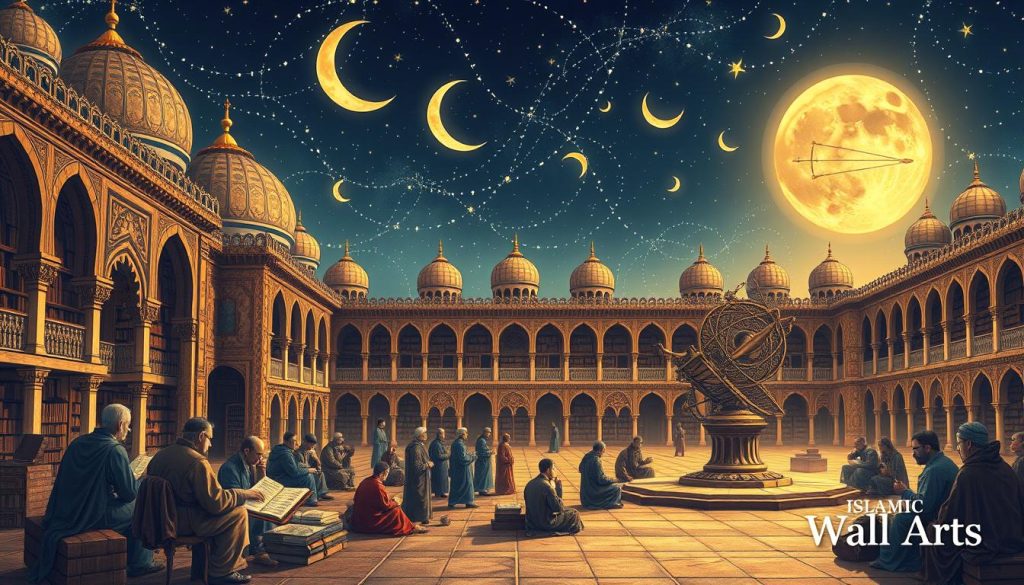
Many vital figures emerged during the Islamic Golden Age. Al-Khwārizmī and Omar Khayyam were among them. They made significant impacts in their fields.
- Muḥammad ibn Mūsā al-Khwārizmī: Known for his work in algebra and the development of algorithms.
- Omar Khayyam: Contributed to developing analytic geometry and made significant astronomical observations.
These scholars and others helped shape science and culture. Their work was later shared with Europe. It showed the lasting influence of Islamic scholarship during this time.
The House of Wisdom: A Beacoeatly impactedn of Learning
The House of Wisdom was set up in Baghdad during the Islamic Golden Age. It was a key place for learning. Scholars from different cultures came here to study and translate ancient texts.
The Translation Movement Under Caliph Al-Ma'mun
Caliph Al-Ma’mun supported the House of Wisdom, making it a hub for translation. Scholars worked together to translate texts from Greek, Persian, and other languages into Arabic. This effort helped save knowledge that might have been lost.
The work at the House of Wisdom went beyond just translation. Scholars also analyzed and expanded the texts they worked on. They made big contributions to fields like math, astronomy, medicine, and philosophy.
Scholars and Their Contributions
Many famous scholars were part of the House of Wisdom. Al-Khwarizmi, for example, greatly improved algebra and geometry. His work gr math in the Islamic world and beyond.
| Scholar | Field of Contribution | Notable Works |
| Al-Khwarizmi | Mathematics, Astronomy | Al-Kitab al-mukhtasar fi hisab al-jabr wa’l-muqabala (The Compendious Book on Calculation by Completion and Balancing) |
| Hunayn ibn Ishaq | Medicine, Translation | Translations of Galen’s works |
| Al-Kindi | Philosophy, Mathematics | Fi al-Falsafat al-Ula (On First Philosophy) |
The work of these scholars shows how important the House of Wisdom was. Their efforts not only saved ancient knowledge but also led to new discoveries and ideas.
Islamic Philosophy and Theological Developments
During the Golden Age, Islamic philosophy flourished. Scholars worked with Greek texts, creating a rich tradition. This era saw significant steps in Islamic thought, with Greek ideas playing a key role.
The Influence of Greek Philosophy
The Abbasid Caliphate’s translation movement made Greek philosophy well-known. Thinkers like Ibn Sina (Avicenna) and Ibn Rushd (Averroes) were crucial in understanding these works. Their ideas shaped both Christian and Muslim non-religious thought.
Greek philosophy’s impact went beyond just translation. It sparked a lively debate that mixed Greek ideas with Islamic theology. This mix led to new schools of thought and famous thinkers.
Primary Philosophical Schools and Thinkers
Many vital schools and thinkers shaped this era. Ibn Sina, for example, made significant contributions to metaphysics and epistemology. Ibn Rushd’s work on Aristotle also profoundly influenced Islamic and Western philosophy.
| Philosopher | Major Contributions | Influence |
| Ibn Sina (Avicenna) | Metaphysics, Epistemology | Islamic and Western Philosophy |
| Ibn Rushd (Averroes) | Commentaries on Aristotle | Scholasticism, Western Philosophy |
| Al-Kindi | Introduction of Greek Philosophy to Islamic Thought | Early Islamic Philosophy |
The Islamic Golden Age's philosophical growth enriched Islamic thought and influenced Western philosophy. Muslim philosophers' works were later translated into Latin. This had a big impact on European scholars during the Renaissance.

The legacy of Islamic philosophy is still felt today. Scholars continue to study medieval Muslim philosophers. Their philosophy, science, and theology work shows the Golden Age’s intellectual richness.
Literary and Poetic Excellence
The Islamic Golden Age was a time of cultural mix, which led to a burst of literary and poetic talent. The era saw big steps forward in writing, creating a rich cultural legacy for future generations.
The Evolution of Arabic Literature
Arabic literature changed a lot during the Islamic Golden Age. The translation movement and support from the Abbasid Caliphate were key. The House of Wisdom was crucial, translating essential works from other languages into Arabic. This helped start a new wave of writing in Arabic.
Arabic poetry became a proper art form during this time. Poets like Al-Mutanabbi and Abu Tammam were celebrated for their skill. They wrote about everyday life and the most profound thoughts, showing the culture and knowledge of the era.
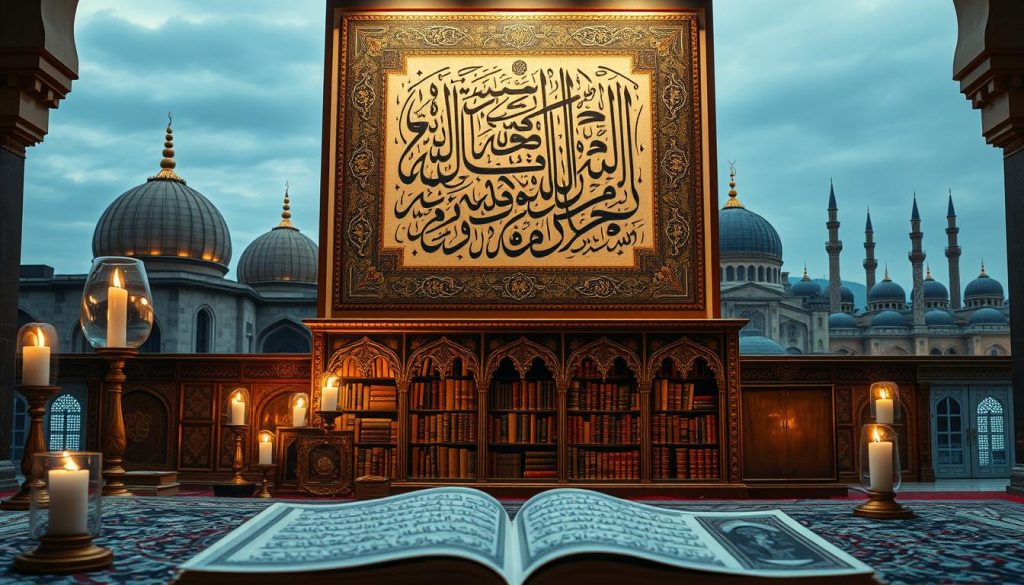
The Islamic Golden Age
The Islamic Golden Age was a time of significant growth in knowledge and culture. It was marked by the rise of Islamic art and literature. This era saw the work of famous poets like Rudaki and Ferdowsi.
They mixed old Persian stories with Islamic themes. This created a unique style of poetry.
Persian poetry’s influence went beyond literature. It played a significant role in the Islamic world’s culture and faith. Ferdowsi’s The Shahnameh became a national epic. It told stories of Persia, inspiring many other works.
The Islamic Golden Age was a time of outstanding cultural and intellectual achievement. The literature and poetry from this era are still admired today. They offer deep insights into the human experience.
Artistic Achievements and Architectural Wonders
The Islamic Golden Age was a time of great creativity. It saw a rise in Islamic art and architecture. These works showed the spiritual and cultural values of the Muslim world and left a lasting impact on human history.
Islamic Calligraphy and Decorative Arts
Islamic calligraphy was considered a sacred duty, as it recorded the Quran. During this time, calligraphy evolved with styles like Kufic and Naskh.
Decorative arts, with intricate patterns and arabesques, decorated mosques and palaces. These designs were not just for looks but held deep meanings.
The decorative arts showed the infinite and God’s unity. They mixed local traditions with Islamic art, creating a rich cultural mix.
Architectural Innovations and Iconic Structures
The Islamic Golden Age brought new architectural ideas. Arches, domes, and minarets were used. These features not only looked great but also showed technological progress.
| Architectural Element | Description | Example |
| Arches | Used to span openings and support structures | Great Mosque of Cordoba |
| Domes | Symbolised the heavens and added grandeur | Dome of the Rock |
| Minarets | Used for calling the faithful to prayer | Al-Azhar Mosque |
Looking at these architectural marvels, we see the genius of the Islamic Golden Age. Its legacy still inspires artists and architects today.
Social Developments and Cultural Exchange
The Islamic Golden Age was marked by deep social changes and wide cultural exchange.
Religious tolerance was a key feature of this time. It allowed people of different faiths to live together and add to society. This tolerance was not just acceptance but active participation that built a multicultural society.
Religious Tolerance and Multicultural Society
In this era, a cosmopolitan culture emerged. Muslims, Christians, Jews, and others shared knowledge and ideas. This mix was great for growth in intellect and art.
Cultural exchange was boosted by the presence of various groups. This led to a rich mix of traditions and new ideas.
Trade Networks and Cultural Diffusion
Trade networks were key in spreading culture during the Islamic Golden Age. Merchants and traders moved goods and ideas across lands.
| Region | Key Contributions | Cultural Exchange |
| Middle East | Advancements in mathematics and astronomy | Exchange of scientific knowledge with Europe |
| North Africa | Development of Islamic jurisprudence | Spread of Islamic legal thought to Spain |
| Central Asia | Preservation and translation of classical texts | Transmission of Greek philosophy to the Islamic world |
The table shows the big contributions of different regions during the Islamic Golden Age. It also shows the wide cultural exchange that happened.
In conclusion, the social changes and cultural exchange of the Islamic Golden Age were crucial. They shaped human history and left a lasting impact that still affects us today.
The Spread of Knowledge to Europe
The Islamic world’s blend of old and new knowledge paved the way for Europe’s Renaissance. This knowledge transfer happened through different paths. Islamic Spain, or Al-Andalus, was key in bridging the Islamic world and Europe.
Islamic Spain (Al-Andalus) as a Cultural Bridge
Islamic Spain was a place where Muslims, Christians, and Jews lived together. They all contributed to scientific, philosophical, and literary progress. This mix of cultures helped spread knowledge.
Key institutions like the House of Wisdom in Baghdad and Al-Andalus’s libraries played a big role. They translated important texts into Arabic, which was then translated into Latin and other European languages.
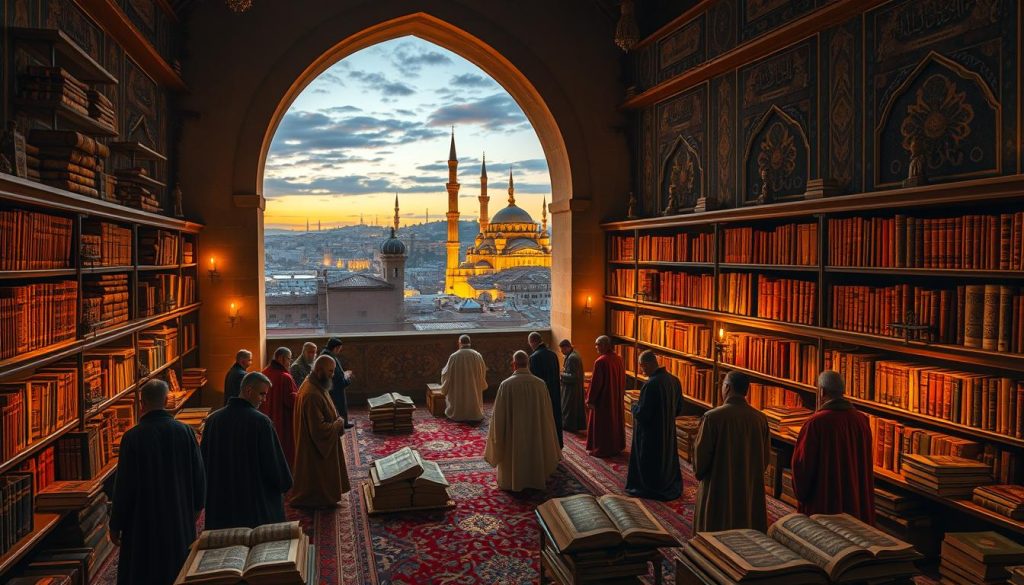
The spread of Islamic knowledge to Europe had a significant impact. Scholars like Gerard of Cremona went to Al-Andalus to learn. They brought back knowledge in mathematics, astronomy, and medicine.
This new knowledge sparked a revival in European scholarship. It set the stage for the Renaissance. The influence is seen in many areas, including:
| Field | Islamic Contribution | European Impact |
| Mathematics | Introduction of Algebra and Arabic numerals | Advancements in arithmetic and problem-solving |
| Astronomy | Accurate astronomical tables and observations | Improved navigation and understanding of celestial bodies |
| Medicine | Comprehensive medical texts and surgical advancements | Enhanced medical education and practice |
The legacy of the Islamic Golden Age still affects modern Europe. It shows the power of cross-cultural exchange and the quest for knowledge.
The Decline of the Islamic Golden Age
The Islamic Golden Age’s decline was complex, with many factors at play. This era, celebrated for its Muslim achievements in science, art, and more, faced internal struggles and external threats.
Internal Factors Contributing to the Decline
Several internal factors led to the decline. These included:
- Economic stagnation and the decline of trade
- Political instability and fragmentation
- Decline in intellectual curiosity and innovation
As the Abbasid Caliphate weakened, regional powers sought independence, leading to political fragmentation. Without a unified leader, the Islamic Golden Age’s hallmark was lost.
External Challenges and Invasions
External threats, like the Mongol invasion, also played a significant role. The Mongols sacked Baghdad in 1258, destroying key learning centres. This was a massive blow to the Islamic world.
The Mongol invasion had a profound impact:
- Destruction of cities and infrastructure
- Loss of lives and displacement of scholars
- Disruption of trade and cultural exchange

The Islamic Golden Age declined due to internal weaknesses and external pressures. Understanding these factors helps us see the challenges of keeping cultural and intellectual progress.
Conclusion: The Enduring Legacy of Islamic Civilisation
The Islamic Golden Age was a time of great achievements in science, art, and culture. The Islamic world’s impact on human progress is still felt today.
Many scientific, literary, and artistic breakthroughs came from this era. The translation movement was key. It helped spread ancient knowledge to Europe, setting the stage for the Renaissance.
Today, the Islamic world stands as a symbol of human achievement. It shows what can be done through knowledge, innovation, and cultural exchange. Remembering the Islamic Golden Age teaches us the value of understanding and celebrating different cultures.
FAQ
What was the Islamic Golden Age?
The Islamic Golden Age was a time of great progress in the Islamic world. It lasted from the 8th to the 13th century. This period saw significant steps forward in culture, science, and philosophy.
What were the significant factors that contributed to the rise of the Abbasid Caliphate?
The Abbasid Caliphate grew strong for several reasons. The Umayyad Caliphate weakened, and many leaders and thinkers supported the Abbasids.
Who were some of the key figures in the development of Islamic science?
Important figures like Al-Khwārizmī and Omar Khayyam were key in Islamic science. They made significant contributions, mainly in maths and astronomy.
What was the significance of the House of Wisdom?
The House of Wisdom was a major place for learning in the Islamic Golden Age. It played a big role in translating and keeping classical knowledge alive.
How did Islamic philosophy develop during the Golden Age?
Islamic philosophy grew a lot during the Golden Age. Greek philosophy had a big influence, thanks to thinkers like Ibn Sina and Ibn Rushd.
What were some of the major literary and poetic achievements of the Islamic Golden Age?
The Golden Age saw significant steps in Arabic literature and Persian poetry. New styles and ways of expressing ideas emerged.
What were some of the key artistic achievements of the Islamic Golden Age?
The Golden Age saw significant advances in Islamic calligraphy and decorative arts. There were also new architectural ideas, like arches and domes.
How did the Islamic Golden Age impact European culture and society?
The Golden Age greatly impacted Europe, mainly through Islamic Spain (Al-Andalus). It helped spread knowledge and ideas to Europe.
What major factors contributed to the decline of the Islamic Golden Age?
The decline of the Golden Age was due to many reasons. Internal issues and the Mongol invasion were significant factors.
What is the lasting legacy of the Islamic Golden Age?
The Golden Age’s legacy is still felt today. Its science, art, and culture achievements continue to inspire and influence other cultures.


