


Al-Baatin
Al-Baatin, among Allah’s 99 beautiful names, AL-BAATIN (الْبَاطِنُ) holds profound significance in Islamic theology. This divine attribute reveals Allah’s hidden yet omnipresent nature—the One who is imperceptible to human senses yet intimately aware of all creation. Understanding this name opens a gateway to deeper spiritual awareness and connection with the Creator.
The beautiful calligraphy of Allah’s name AL-BAATIN (الْبَاطِنُ)
The Linguistic Meaning of AL-BAATIN
AL-BAATIN derives from the Arabic root “ba-ta-nun” (ب ط ن), which carries several interconnected meanings in classical Arabic. This root conveys concepts of being concealed, hidden from sight, inner, intimate, and that which penetrates to the core of matters.
The name AL-BAATIN signifies that Allah is hidden from human perception yet intimately aware of all creation’s inner dimensions.
Linguistically, AL-BAATIN refers to:
- That which is concealed or veiled from sight
- The inner essence of something as opposed to its outer appearance
- The one who knows the hidden aspects and inner realities
- The intimate companion who is closer than anything else
This name beautifully captures the paradoxical nature of Allah’s presence—unseen by human eyes yet closer to us than our own jugular vein, as mentioned in the Quran.

Visual representation of AL-BAATIN’s concept: Allah’s hidden yet intimate presence
Quranic References to AL-BAATIN
The name AL-BAATIN appears explicitly in the Quran in Surah Al-Hadid (57:3), where Allah describes Himself with four complementary attributes:
هُوَ الْأَوَّلُ وَالْآخِرُ وَالظَّاهِرُ وَالْبَاطِنُ ۖ وَهُوَ بِكُلِّ شَيْءٍ عَلِيمٌ
“He is the First and the Last, the Most High and the Most Near (AL-BAATIN), and He has perfect knowledge of all things.” (Quran 57:3)
This verse presents four divine names in pairs that might seem paradoxical but reveal Allah’s all-encompassing nature. The pairing of AL-AWWAL (The First) with AL-AKHIR (The Last) addresses Allah’s relationship with time, while AL-ZAHIR (The Manifest) paired with AL-BAATIN (The Hidden) addresses His relationship with existence and perception.
Another verse that reflects the concept of AL-BAATIN, though not mentioning the name explicitly, is:
وَنَحْنُ أَقْرَبُ إِلَيْهِ مِنْ حَبْلِ الْوَرِيدِ
“And We are nearer to him than his jugular vein.” (Quran 50:16)
This verse beautifully illustrates Allah’s attribute as AL-BAATIN—the One who is imperceptible yet closer to us than our life force.
Theological Significance of AL-BAATIN in Islam
The name AL-BAATIN holds profound theological significance in Islamic understanding of Allah’s nature and relationship with creation:
Allah's Transcendence and Immanence
AL-BAATIN affirms that while Allah is transcendent (beyond creation), He is simultaneously immanent (intimately present within creation). This name teaches that Allah’s essence cannot be perceived by human senses or fully comprehended by human intellect, yet He is closer to us than we are to ourselves.
As Imam Al-Ghazali explained, Allah is “hidden when sought by sensory perception or imagination, yet manifest when sought through rational inference.” This understanding prevents both anthropomorphism (likening Allah to creation) and deism (viewing Allah as distant and uninvolved).
Knowledge of the Unseen
As AL-BAATIN, Allah has perfect knowledge of all hidden matters—the unseen realm, the inner thoughts of people, and the secrets of creation. Nothing is concealed from Him, as the Quran states:
وَعِندَهُ مَفَاتِحُ الْغَيْبِ لَا يَعْلَمُهَا إِلَّا هُوَ
“And with Him are the keys of the unseen; none knows them except Him.” (Quran 6:59)
This aspect of AL-BAATIN reminds believers that Allah is All-Knowing of existence’s apparent and hidden dimensions.

Artistic representation of AL-BAATIN: Allah’s knowledge of the hidden dimensions
The Complementary Nature of AL-BAATIN and AL-ZAHIR
In Surah Al-Hadid, Allah mentions AL-BAATIN alongside its complementary name AL-ZAHIR (The Manifest). These names form a beautiful pair that reveals the complete nature of Allah’s presence in creation:
AL-ZAHIR (The Manifest)
As AL-ZAHIR, Allah is manifest through His signs in creation. Everything in existence points to His reality, power, and wisdom. His presence is evident through:
- The order and beauty of the universe
- The natural laws governing creation
- The signs mentioned in revealed scriptures
- The innate human recognition of a Creator
AL-BAATIN (The Hidden)
As AL-BAATIN, Allah’s essence remains hidden from direct perception. This hiddenness is reflected in:
- The inability of human senses to perceive Him directly
- The limitations of human intellect in fully comprehending His nature
- His intimate knowledge of the inner dimensions of all things
- His closeness that transcends physical proximity
This pairing teaches believers that Allah is simultaneously evident through His signs yet transcendent in His essence. Imam Ibn al-Qayyim explained, “He is manifest in His effects, signs, and attributes, yet hidden in His essence and reality.”

The complementary nature of AL-ZAHIR (The Manifest) and AL-BAATIN (The Hidden)
Hadith References to AL-BAATIN
The Prophet Muhammad ﷺ mentioned Allah’s name AL-BAATIN in several authentic hadiths, providing deeper insight into its meaning:
اللَّهُمَّ أَنْتَ الأَوَّلُ فَلَيْسَ قَبْلَكَ شَىْءٌ وَأَنْتَ الآخِرُ فَلَيْسَ بَعْدَكَ شَىْءٌ وَأَنْتَ الظَّاهِرُ فَلَيْسَ فَوْقَكَ شَىْءٌ وَأَنْتَ الْبَاطِنُ فَلَيْسَ دُونَكَ شَىْءٌ
“O Allah, You are the First, there is nothing before You; and You are the Last, nothing after You. You are AL-ZAHIR (the Most High), there is nothing above You; and You are AL-BAATIN (the Most Near), there is nothing nearer than You.”
Sahih Muslim
This beautiful supplication of the Prophet ﷺ clarifies the meaning of AL-BAATIN as “the Most Near, nothing is nearer than Him.” It emphasises Allah’s intimate closeness to His creation while maintaining His transcendence.
Another hadith that reflects the concept of AL-BAATIN is:
“A slave becomes nearest to his Lord when he is in prostration. So, an increase in supplication while prostrating.”
Sahih Muslim
This hadith teaches that when believers humble themselves in prostration, they experience an extraordinary nearness to Allah—a manifestation of His attribute as AL-BAATIN, the Most Near.

Prostration in prayer symbolizes the extraordinary nearness to Allah as AL-BAATIN.
Practical Reflections for Believers
Understanding Allah’s name AL-BAATIN has profound implications for a believer’s spiritual life and daily practice:
Cultivating Inner Awareness
Knowing that Allah, as AL-BAATIN, is aware of our innermost thoughts encourages believers to cultivate taqwa (God-consciousness) in private and public. This awareness leads to sincerity in worship and purity of intention, as the Prophet Muhammad ﷺ taught: “Verily, Allah does not look at your appearance or wealth, but rather at your hearts and deeds.”
Finding Comfort in Divine Nearness
The name AL-BAATIN reminds believers that Allah is closer to them than their jugular vein. This intimate nearness provides comfort during times of difficulty, loneliness, or fear. When facing challenges, believers can find solace in knowing that Allah is with them, aware of their struggles, and responds to their prayers.
Embracing the Unseen
Faith in AL-BAATIN strengthens a believer’s conviction in Islam’s unseen realities. It teaches that not everything valuable can be perceived by the senses—the most profound truths often lie beyond physical perception. This understanding helps believers maintain faith in Allah, the Hereafter, and other unseen aspects of Islamic belief.

Contemplative reflection on Allah’s name AL-BAATIN deepens spiritual awareness
Spiritual Practices Related to AL-BAATIN
Believers can incorporate the understanding of Allah’s name AL-BAATIN into various spiritual practices:
Dhikr (Remembrance)
Regularly reciting and reflecting on the name AL-BAATIN as part of daily dhikr helps believers internalise its meaning. This practice can be enhanced by contemplating the verse from Surah Al-Hadid (57:3) that mentions this name alongside its complementary attributes.
A recommended dhikr: “Ya Baatin” (O Hidden One) repeated with awareness of Allah’s intimate nearness.
Du'a (Supplication)
The Prophet Muhammad ﷺ taught a beautiful supplication mentioning Allah’s name AL-BAATIN, which believers can incorporate into their prayers:
“O Allah, You are the First, there is nothing before You; and You are the Last, nothing after You. You are AL-ZAHIR, there is nothing above You; and You are AL-BAATIN, there is nothing nearer than You. Remove our debts and enrich us against poverty.”
Self-Examination
Knowing that Allah, as AL-BAATIN, is aware of our innermost thoughts encourages regular muhasabah (self-examination). Believers can set aside time daily to reflect on their intentions, acknowledge hidden faults, and seek inner purification, knowing that nothing is hidden from Allah.

Dhikr (remembrance) of Allah’s name AL-BAATIN deepens spiritual connection
Scholarly Insights on AL-BAATIN
Throughout Islamic history, scholars have offered profound insights into the meaning and significance of Allah’s name AL-BAATIN:
“AL-BAATIN is He Who knows the inward and the hidden aspects of things. It is said ‘batantu so-and-so’, i.e., I know his inward and outward. And Allah is the All-Knower of the apparent and the hidden matters.”
Az-Zajjaj
“AL-BAATIN is the One Who is veiled (screened) from the sight (vision) of the creation. It also means, He Who knows the apparent matters and Who is All-Watcher over what is hidden of the unseen matters.”
Al-Khattabi
“AL-BAATIN is He Who is not seen, but is known by His Actions.”
Al-Hulaimi
Imam Al-Ghazali, in his renowned work on Allah’s names, explained that Allah is “hidden when sought by sensory perception or using the resources of imagination, yet manifest when sought by way of inference using the resources of reason.” He offered an illustrative example: if you read a page of a book, would you doubt that the author exists? Similarly, the perfect arrangement of the universe clearly indicates its Creator, even though He remains unseen.
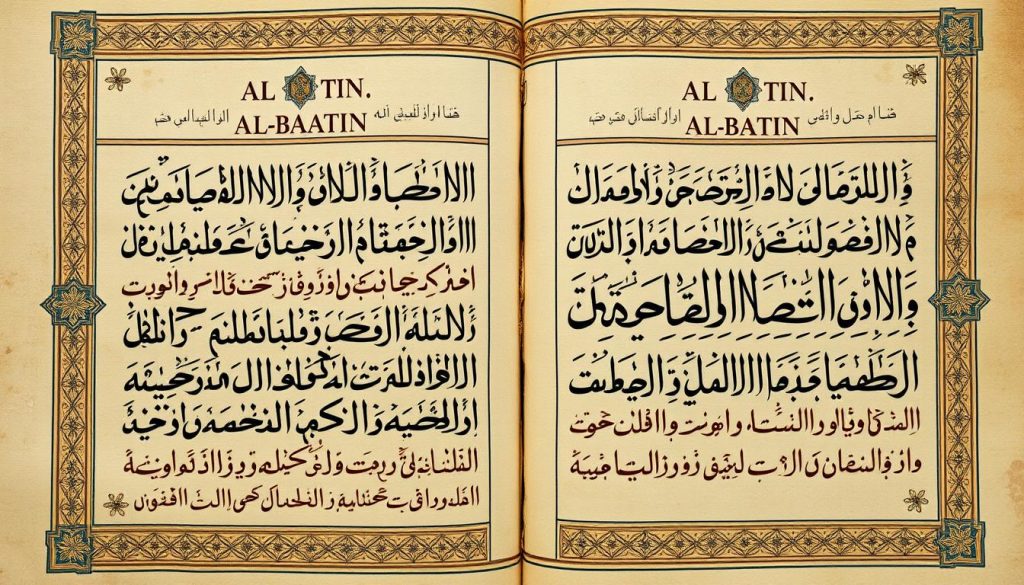
Historical Islamic manuscripts discussing Allah’s name AL-BAATIN
Conclusion: Embracing the Hidden Dimensions of Faith
Allah’s name AL-BAATIN invites believers to embrace faith’s manifest and hidden dimensions. It teaches that while Allah’s signs are evident throughout creation, His essence transcends human perception. This name reminds us that the most profound spiritual truths often lie beyond what can be seen or touched.
By reflecting on AL-BAATIN, believers develop a deeper awareness of Allah’s intimate presence in their lives. They recognize that He is closer to them than their selves, aware of their innermost thoughts and feelings. This awareness fosters sincerity, humility, and a profound connection with the Divine.
As we navigate the visible world, Allah’s name, AL-BAATIN, reminds us to look beyond appearances and connect with the hidden realities that give life its ultimate meaning. By embracing both the manifest and hidden aspects of existence, believers fully understand their Creator and purpose in this world.
This article is available in English, Arabic, French, Spanish, Turkish, Indonesian, and Urdu upon request.

Light filtering through a mosque’s windows symbolizes Allah’s hidden yet manifest presence as AL-BAATIN.
Deepen Your Understanding of Allah's Names
Download our comprehensive guide to the 99 Names of Allah and enhance your spiritual journey with detailed explanations, Quranic references, and practical applications.
Explore All 99 Names of Allah
Continue your spiritual journey by studying all of Allah’s beautiful names. Each name reveals a unique aspect of divine perfection and guides believers.
Join Our Islamic Studies Newsletter
Receive weekly reflections on Allah’s beautiful names, Quranic insights, and spiritual guidance to enhance your faith journey.
Continue Your Spiritual Journey
Download our comprehensive guide to understanding and reflecting on all 99 Names of Allah. Deepen your connection with the Creator through knowledge and contemplation.


