


AL-AHAD: Understanding Divine Oneness
AL-AHAD: Understanding Divine Oneness. In the vast tapestry of Islamic theology, the divine names of Allah hold profound significance. Among these, AL-AHAD (الأَحَد) stands as a cornerstone of monotheistic belief, embodying the concept of absolute oneness that defines Islamic faith. This name appears in one of the most recited chapters of the Quran, Surah Al-Ikhlas, where Allah declares His unique and incomparable nature. Join us as we explore this essential divine attribute’s linguistic depth, spiritual significance, and practical implications.
Linguistic Roots and Meaning of AL-AHAD
The divine name AL-AHAD in traditional Arabic calligraphy, highlighting its root letters
AL-AHAD derives from the Arabic root hamza-ha-dal (أ ح د), which carries several interconnected meanings in classical Arabic. This root fundamentally conveys being one, unique, and indivisible. Unlike many Arabic words in various forms throughout the Quran, the specific name AL-AHAD appears only once, in Surah Al-Ikhlas (112:1), underscoring its special significance.
The root hamza-ha-dal (أ ح د) appears 85 times in the Quran in various derived forms such as ahadun (anyone), ahadukum (one of you), and ihdaa (any, one). However, as a divine name, AL-AHAD occurs only in Surah Al-Ikhlas, highlighting its exclusive application to Allah alone.
Linguistically, AL-AHAD refers to something that cannot be divided into parts or components. It represents absolute unity without the possibility of division or multiplication. This distinguishes it from similar concepts of oneness, as it emphasises not just numerical singularity but essential indivisibility and incomparability.
Theological Significance in Islamic Monotheism (Tawhid)

AL-AHAD forms the core of Islamic monotheism (Tawhid)
AL-AHAD represents the purest expression of Tawhid (Islamic monotheism), which is the foundational principle of Islam. Understanding this name is essential to grasping the Islamic concept of God’s absolute unity and uniqueness. Allah as AL-AHAD is not merely numerically one, but uniquely and incomparably one in His essence, attributes, and actions.
The Three Dimensions of Tawhid
Tawhid al-Rububiyyah
AL-AHAD as the One and Only Creator and Sustainer of all existence. This dimension affirms that Allah alone is the Lord who creates, maintains, and governs all creation without partners.
Tawhid al-Uluhiyyah
AL-AHAD as the Only One worthy of worship. This dimension establishes that all worship, devotion, and spiritual connection must be directed solely to Allah without intermediaries.
Tawhid al-Asma wa al-Sifat
AL-AHAD in His unique names and attributes. This dimension recognizes that Allah’s divine qualities are incomparable and cannot be fully shared by any created being.
The concept of AL-AHAD rejects any notion of multiplicity within the divine nature. Unlike some theological traditions that propose complex divine structures, Islam emphasises the absolute oneness of Allah through this name. This theological position forms the foundation of Islamic monotheism and distinguishes it from other religious traditions.
Quranic References and Prophetic Traditions

Illuminated manuscript of Surah Al-Ikhlas highlighting AL-AHAD
AL-AHAD in the Quran
The divine name AL-AHAD appears explicitly in Surah Al-Ikhlas (Chapter 112), which is considered equivalent to one-third of the Quran in spiritual value according to authentic hadith. The chapter reads:
Qul huwal laahu ahad
“Say, ‘He is Allah, [who is] One,'” (Quran 112:1)
Allaahus-samad
“Allah, the Eternal Refuge.” (Quran 112:2)
Lam yalid wa lam yoolad
“He neither begets nor is born,” (Quran 112:3)
Wa lam yakul-lahoo kufuwan ahad
“Nor is there to Him any equivalent.” (Quran 112:4)
Prophetic Traditions on AL-AHAD
The Virtue of Surah Al-Ikhlas
Abu Darda reported Allah’s Apostle ﷺ as saying: “Is any one of you incapable of reciting a third of the Qur’an in a night?” The Companions asked: “How could one recite a third of the Qur’an (in a night)?” Upon this, he (the Holy Prophet ﷺ) said: “‘Say: He is Allah, One’ (Qur’an 112) is equivalent to a third of the Qur’an.”
Authentication: Sahih Muslim 811a & Riyad as-Salihin 1010
Palaces in Paradise
Sa’īd b. al-Musayyib reported in mursal form that the Prophet ﷺ said, “If anyone recites ten times ‘Say, He is God, One’, a palace will be built for him in paradise because of it; if anyone recites twenty times two palaces will be built for him in paradise because of it; and if anyone recites it thirty times three palaces will be built for him in paradise because of it.” ‘Umar b. al-Khattāb said, “I swear by God, messenger of God, that we shall then produce many palaces for ourselves.” he replied, “God’s abundant grace is even more comprehensive than that.”
Authentication: Mishkat al-Masabih 2185
Love for Surah Al-Ikhlas
Anas reported that one of the Ansar used to lead prayers in the Quba mosque and would always recite Surah Al-Ikhlas before another surah in each rak’ah. His companions discussed this with him, asking why he always recited this particular surah. He replied, “I love this Surah.” When the Prophet ﷺ was informed about this, he said to the man, “Your love for this Surah will make you enter Paradise.”
Authentication: Sahih al-Bukhari 774b
Comparative Analysis with Similar Divine Names
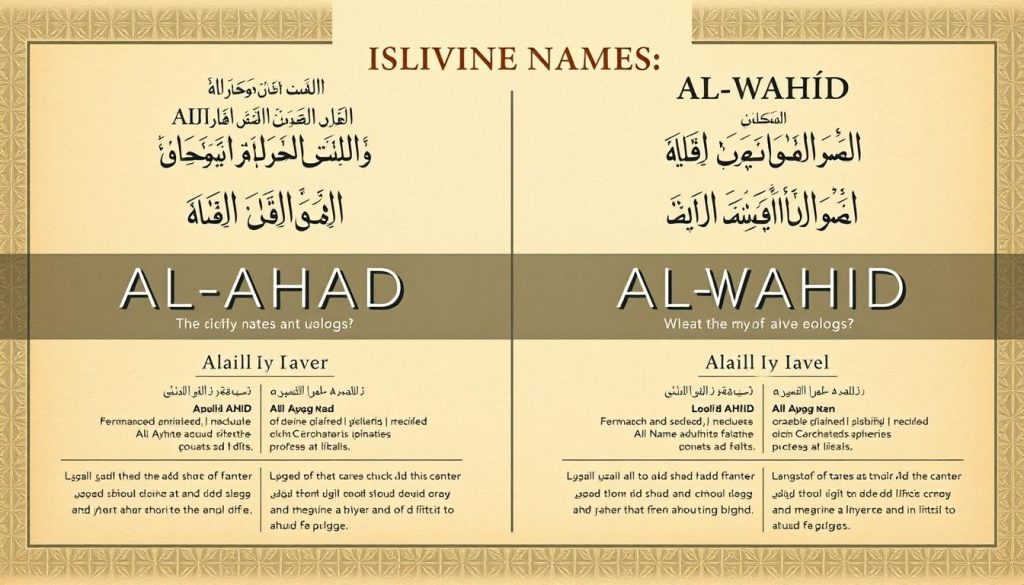
Comparative analysis of AL-AHAD and AL-WAHID divine names
While several divine names in Islam convey aspects of oneness, AL-AHAD stands distinct in its implications. Understanding these nuances enriches our comprehension of divine unity in Islamic theology.
| Divine Name | Arabic | Primary Meaning | Theological Emphasis | Quranic Occurrence |
| AL-AHAD | الأَحَد | The Absolute One | Absolute indivisibility and uniqueness in essence | Once (Surah 112:1) |
| AL-WAHID | الواحِد | The One | Numerical oneness and unity in lordship | Multiple times |
| AS-SAMAD | الصَّمَد | The Eternal Refuge | Self-sufficiency and being the ultimate recourse | Once (Surah 112:2) |
Distinguishing AL-AHAD from AL-WAHID
Classical scholars have offered various perspectives on the distinction between AL-AHAD and AL-WAHID. While both names affirm Allah’s oneness, they do so with different emphases:
AL-AHAD (الأَحَد)
- Denotes absolute, indivisible oneness
- Cannot be used for anything other than Allah in affirmative sentences
- Emphasises uniqueness in both essence and attributes
- Negates any possibility of division or multiplicity
- Appears only once in the Quran, exclusively for Allah
AL-WAHID (الواحِد)
- Indicates numerical oneness (being one, not two or more)
- Can be used for created beings in specific contexts
- Emphasises unity primarily in essence
- Affirms singularity while not necessarily negating composition
- Appears multiple times in the Quran in various contexts
As al-Zajjaj explained, “AL-WAHID refers to His being one in His essence only, whilst AL-AHAD means that He is one in both His essence and His attributes.” This subtle distinction highlights the comprehensive uniqueness conveyed by AL-AHAD.
Practical Implications for Muslim Belief and Worship

Contemplative prayer reflecting on divine oneness
Understanding AL-AHAD transforms a Muslim’s spiritual practice and worldview in profound ways. This divine name isn’t merely theological theory but shapes daily life and worship.
Implications for Faith and Practice
Purification of Faith
Believing in AL-AHAD purifies one’s monotheism from subtle forms of associating partners with Allah (shirk). It reminds believers to direct all worship, supplication, fear, hope, and reliance exclusively to Allah alone.
Spiritual Focus
Meditating on AL-AHAD helps concentrate one’s spiritual energies toward a single direction rather than being scattered among various concerns. This singularity of purpose aligns with the Quranic guidance to avoid division in faith.
Ethical Implications
Recognizing Allah as AL-AHAD establishes a unified ethical framework derived from a single divine source, rather than competing moral systems. This provides clarity and consistency in moral decision-making.
Reflect on Divine Oneness in Your Home
Display the beautiful name AL-AHAD in your living space as a constant reminder of Allah’s absolute oneness. Our handcrafted Islamic wall art combines traditional calligraphy with contemporary design to create pieces that inspire spiritual reflection.
Practical Ways to Connect with AL-AHAD

Regular recitation of Surah Al-Ikhlas connects believers with the meaning of AL-AHAD
- Regular recitation of Surah Al-Ikhlas – Incorporate this chapter into daily prayers and additional devotions, reflecting on its meaning.
- 2 Purify intentions in worship4. , not for recognition or habit.
- Supplication using this name – Include AL-AHAD in personal prayers, especially when seeking guidance or protection from confusion.
- Contemplative remembrance (dhikr) – Repeat “La ilaha illa Allah al-Ahad” (There is no deity except Allah, the One) as a form of meditation.
- 5 Studies.
The Messenger of Allah ﷺ said: “The best remembrance (dhikr) is ‘La ilaha illallah’ (There is no deity except Allah) and the best supplication is ‘Alhamdulillah’ (All praise is due to Allah).”
Authenticated by At-Tirmidhi, An-Nasa’i and Ibn Majah
Common Misconceptions About Divine Unity
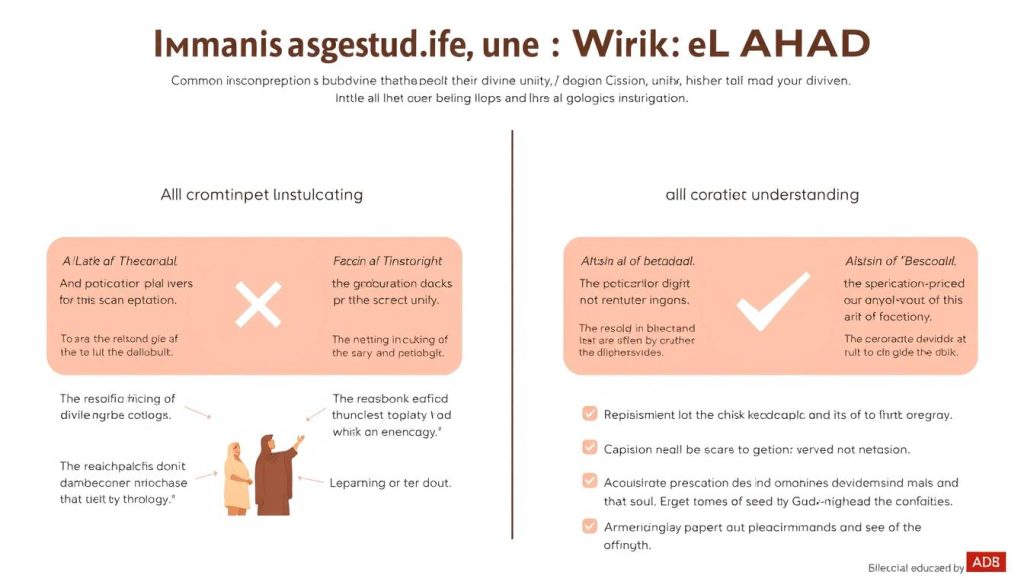
Common misconceptions about divine unity contrasted with correct understanding.
Despite AL-AHAD’s centrality to Islamic theology, several misconceptions persist about divine unity. I think it’s essential to properly grasp this fundamental concept.
Correct Understanding of AL-AHAD
- Allah’s oneness encompasses both His essence and attributes
- Divine unity means Allah is unique in every aspect of His being
- AL-AHAD affirms Allah’s absolute indivisibility
- Divine names and attributes are understood without anthropomorphism
- Tawhid requires directing all worship exclusively to Allah
Common Misconceptions
- Confusing numerical oneness with the comprehensive uniqueness of AL-AHAD
- Anthropomorphizing Allah by comparing divine unity to created unity
- Believing intermediaries are needed to approach Allah
- Separating Allah’s attributes from His essence
- Limiting divine unity to theoretical belief without practical implications
Important Note: Understanding AL-AHAD correctly is not merely an academic exercise but the foundation of authentic Islamic monotheism. Misconceptions about divine unity can lead to serious theological errors that affect one’s relationship with Allah and the validity of worship.
One significant misconception is equating Allah’s oneness with the numerical oneness we experience in creation. Unlike created beings “one” in number but composed of parts, Allah’s oneness as AL-AHAD is absolute and indivisible, with no composition or multiplicity in any aspect of His being.
Scholarly Interpretations from Classical and Contemporary Sources

Classical and contemporary scholarly works on AL-AHAD
Islamic scholars throughout history have offered profound insights into the meaning and implications of Al-Ahada. These interpretations enrich our understanding of divine unity from various theological perspectives.
Classical Interpretations
- Imam al-Ghazali (d. 1111 CE) explained that AL-AHAD signifies that Allah is one in His essence with no composition, one in His attributes with no similarity, and one in His actions with no partner.
- Ibn al-Qayyim (d. 1350 CE) distinguished between AL-AHAD and AL-WAHID by noting that AL-AHAD negates division within Allah’s essence, while AL-WAHID negates any external equal or similar.
- Imam ar-Razi (d. 1209 CE) elaborated that AL-AHAD encompasses uniqueness in all aspects of divinity, including essence, attributes, and actions, leaving no room for partnership in any form.
Contemporary Perspectives
- Muhammad Mutawalli al-Sha’rawi (d. 1998) emphasised that AL-AHAD represents absolute uniqueness that cannot be replicated or divided, unlike created things that may be unique but still share qualities with others.
- Said Nursi (d. 1960) connected AL-AHAD to the cosmic unity observed in creation, arguing that the universe’s harmony and interconnectedness point to a single, unique Creator.
- Mohammad Hussein Tabatabai (d. 1981) explored how AL-AHAD relates to the concept of divine simplicity, where Allah’s essence is not composed of parts or attributes separate from His being.
The scholarly consensus across various Islamic theological schools affirms that AL-AHAD represents the most comprehensive and absolute form of divine unity. This name establishes that Allah’s oneness is not merely numerical but encompasses uniqueness in essence, attributes, and actions without any possibility of division or similarity.
Deepen Your Understanding of Divine Names
Our comprehensive guide explores the theological depths and practical significance of Allah’s 99 beautiful names, including AL-AHAD. Download this free resource to enhance your spiritual connection through knowledge.
Reflection and Application

A space for contemplation on the meaning of AL-AHAD in daily life
Understanding AL-AHAD invites personal reflection on how this divine name can transform our spiritual journey and daily lives. Consider these questions as you contemplate the meaning of absolute oneness:
How does recognizing Allah as AL-AHAD change your approach to challenges and difficulties in life?
In what ways might your worship or prayer be directed to anything other than Allah, even subtly? How can awareness of AL-AHAD purify your intentions?
How does absolute divine unity influence your understanding of the purpose of creation and your place within it?
What practical steps can you take to make the meaning of AL-AHAD more present in your daily consciousness?
Supplication Using AL-AHAD

Supplication using the divine name AL-AHAD
Allahumma inni as’aluka ya Allah bi’annaka ‘l-Wahidu ‘l-Ahadus-samad, alladhi lam yalid wa lam yulad, wa lam yakun lahu kufuwan ahad, an taghfir li dhunubi, innaka anta ‘l-Ghafurur-Rahim.
“O Allah, I ask You. O Allah, You are the One, the Only, Self-Sufficient Master, Who was not begotten and begets not, and none is equal to Him. Forgive me my sins, surely you are forgiving, Merciful.”
Authenticated in Sunan an-Nasa’i 1301
Conclusion
AL-AHAD is one of the most profound divine names in Islamic theology, encapsulating the pure monotheism that defines the faith. This name reminds us that Allah is uniquely and absolutely one—not merely in number but in His very essence, attributes, and actions. There is nothing like Him in any respect.
Understanding AL-AHAD transforms our spiritual outlook by directing all worship, hope, fear, and reliance to Allah alone. It purifies our monotheism from subtle forms of association and clarifies our relationship with the Divine. The name appears just once in the Quran, in Surah Al-Ikhlas, yet its theological significance permeates every aspect of Islamic belief and practice.
As we contemplate AL-AHAD, we are invited to recognize Allah’s incomparable nature and align our lives with this fundamental truth. In a world of multiplicity and division, AL-AHAD calls us to unity of purpose and singularity of devotion, reminding us that all paths ultimately lead back to the One, Indivisible Creator.

The divine name AL-AHAD reminds us of Allah’s absolute oneness in all aspects


