Al-Ghaniyy (الغني) is one of the names of Allah, usually translated as the Free of Need or the Self-Sufficient. Al-Ghaniyy means that Allah depends on nothing, while everything in creation depends on Him. This guide explains the meaning of the name, the verses of the Qur’an that mention it, authentic supplications connected to it, and how reflecting on it can shape everyday life.
The Linguistic Meaning of Al-Ghaniyy (الغني)
The name Al-Ghaniyy derives from the Arabic root letters غ-ن-ي (ghayn-nun-ya), which carries several interconnected meanings in classical Arabic. This root conveys the concepts of being free from wants or needs, being self-sufficient, independent, and having no requirement for assistance from others. It also encompasses being content, satisfied, rich, wealthy, and flourishing.
Linguistically, Al-Ghaniyy represents absolute freedom from any form of need or dependency. Unlike human wealth, which is always relative and temporary, Allah’s richness is absolute and eternal. He is completely self-sufficient in His essence, attributes, and actions.
In short, Al-Ghaniyy is the One who has no need of anyone or anything, while all others depend on His provision. Prefer to study the Name in its original language? Read اسم الله الغني, Al-Ghaniyy in Arabic.
Theological Significance in Islamic Aqeedah
In Islamic theology (aqeedah), Al-Ghaniyy occupies a central position in understanding Allah’s perfection. This name affirms that Allah is independent of all creation, while all creation is utterly dependent upon Him. This concept is fundamental to Islamic monotheism (tawhid).
Key Theological Dimensions
- Allah does not need our worship, yet He deserves it completely
- Allah’s richness encompasses all forms of perfection
- All creation depends on Allah, while He depends on nothing
- Allah’s self-sufficiency is intrinsic to His divine essence
- Allah’s richness is not limited to material wealth but includes knowledge, power, mercy, and all attributes of perfection
Relationship to Other Divine Names
Al-Ghaniyy is closely related to other divine names such as:
- Al-Mughni (المغني) – The Enricher, who grants richness to His creation
- Al-Karim (الكريم) – The Generous, who gives abundantly
- As-Samad (الصمد) – The Eternal Refuge, upon whom all depend
- Al-Malik (الملك) – The Sovereign, who owns everything
- Al-Hamid (الحميد) – The Praiseworthy, often paired with Al-Ghaniyy in the Quran
Quranic References to Al-Ghaniyy
The Qur’an describes Allah as al-Ghaniyy many times, often paired with Al-Hameed (the Praiseworthy) and once with Al-Kareem (the Generous). The verses below are quoted from the Saheeh International translation on Quran.com.
Surah Al-Baqarah 2:263
“Kind speech and forgiveness are better than charity followed by injury. And Allah is Free of need and Forbearing.”
Surah Luqman 31:26
“To Allah belongs whatever is in the heavens and earth. Indeed, Allah is the Free of need, the Praiseworthy.”
Surah Fatir 35:15
“O mankind, you are those in need of Allah, while Allah is the Free of need, the Praiseworthy.”
Surah An-Naml 27:40
“…And whoever is grateful – his gratitude is only for [the benefit of] himself. And whoever is ungrateful – then indeed, my Lord is Free of need and Generous.”
Tafsir Insights on Al-Ghaniyy
Scholars of Quranic exegesis (tafsir) explain that these verses establish a fundamental truth: Allah’s complete independence contrasted with creation’s complete dependence. When the Quran states “Allah is Al-Ghaniyy,” it affirms that Allah needs nothing from His creation, not their worship, obedience, or charity. Yet in His mercy, He invites us to worship Him for our benefit and spiritual growth.
The pairing of Al-Ghaniyy with Al-Hamid (The Praiseworthy) in several verses indicates that Allah deserves all praise despite needing nothing from us. This pairing beautifully illustrates the perfection of Allah’s self-sufficiency—He is praised not because He needs praise, but because He inherently deserves it through His perfect attributes.
Prophetic Traditions About Al-Ghaniyy
The Prophet ﷺ taught supplications that ask Allah for sufficiency and freedom from want, and he explained what true richness is. The narrations below are quoted from Sunnah.com with their references and gradings.
Hadith and Supplications Connected to Al-Ghaniyy
Ali (may Allah be pleased with him) reported that a slave who had a contract to buy his freedom came to him and said he was unable to pay. Ali said: “Should I not teach you words that the Messenger of Allah ﷺ taught me? If you had a debt upon you similar to the mountain of Sir, Allah would fulfil it for you. Say:
“O Allah, suffice me with Your lawful against Your prohibited, and make me independent of all those besides You.”
(Jami` at-Tirmidhi 3563, graded hasan by Darussalam)
Abdullah ibn Mas’ud (may Allah be pleased with him) reported that the Messenger of Allah ﷺ used to supplicate:
“O Allah. I beg of Thee the right guidance, safeguard against evils, chastity and freedom from want.”
Abu Hurairah (may Allah be pleased with him) reported that the Prophet ﷺ said:
“Wealth is not in having many possessions, but rather (true) wealth is feeling sufficiency in the soul.”
These hadiths reveal that the Prophet Muhammad ﷺ taught his companions to seek true richness, not in material possessions, but in contentment and sufficiency from Allah. The supplications he taught emphasise our dependence on Allah while acknowledging His complete independence and self-sufficiency.
Practical Implications of Understanding Al-Ghaniyy
Understanding Allah’s name Al-Ghaniyy has profound implications for our spiritual journey and daily life. When we truly grasp Allah’s absolute self-sufficiency, it transforms our relationship with Him and with the world around us.
Cultivating Contentment (Qana'ah)
One of the most essential spiritual fruits of understanding Al-Ghaniyy is developing contentment (qana’ah) with what Allah has provided. When we recognise that Allah is the Self-Sufficient and that all provision comes from Him, we can free ourselves from the endless pursuit of material wealth and status.
The Prophet ﷺ said: “Whoever among you wakes up in the morning secured in his dwelling, healthy in his body, having his food for the day, then it is as if the world has been gathered for him.” (Jami` at-Tirmidhi 2346, graded hasan by Darussalam)
Practical steps to cultivate contentment include:
- Practising daily gratitude for Allah’s blessings
- Comparing yourself to those who have less, not those who have more
- Focusing on needs rather than wants
- Remembering that true richness is the richness of the soul
- Reciting the prophetic supplications seeking sufficiency from Allah
Avoiding Materialism and Greed
Understanding Al-Ghaniyy helps us resist the pull of materialism and greed that dominate modern society. When we recognise that Allah alone is rich and self-sufficient, we know the temporary nature of worldly possessions.
The Qur’an says: “Wealth and children are [but] adornment of the worldly life. But the enduring good deeds are better to your Lord for reward and better for [one’s] hope.” (Qur’an 18:46)
Practical ways to combat materialism include:
- Regular charity (sadaqah) to break attachment to wealth
- Simplifying your lifestyle and possessions
- Practising mindful consumption
- Remembering death and the temporary nature of worldly possessions
- Seeking knowledge and spiritual growth over material acquisition
Trusting in Allah's Infinite Provision
When we truly understand that Allah is Al-Ghaniyy, we develop complete trust (tawakkul) in His provision. This trust liberates us from anxiety about sustenance and allows us to focus on our spiritual journey.

The Prophet ﷺ said: “If you were to rely upon Allah with the required reliance, then He would provide for you just as a bird is provided for, it goes out in the morning empty, and returns full.” (Jami` at-Tirmidhi 2344, graded hasan by Darussalam)
Practical ways to strengthen trust in Allah’s provision:
- Reciting the morning and evening supplications seeking provision
- Taking appropriate means while trusting the outcome to Allah
- Remembering past instances when Allah provided unexpectedly
- Focusing on Allah’s attributes of generosity and richness
- Practising patience during times of scarcity
Spiritual Lessons from Al-Ghaniyy
Beyond the practical implications, Allah’s name, Al-Ghaniyy, offers profound spiritual lessons that can transform our inner lives and relationships with our Creator.
Recognising Our Complete Dependence
The Quran states: “O mankind, you are those in need of Allah, while Allah is the Free of need, the Praiseworthy” (35:15). This verse establishes the fundamental relationship between Creator and created—we are utterly dependent, while Allah is entirely independent.
This recognition should cultivate humility (khushu’) in our worship and daily life. When we genuinely understand our complete dependence on Al-Ghaniyy, we approach Him with genuine need and sincerity rather than performing religious rituals mechanically.
Recognising our need for Allah is not a weakness; it is the honest starting point of worship.
Understanding Allah's Generosity
Allah’s self-sufficiency makes His generosity all the more remarkable. Unlike human generosity, which often expects something in return, Allah gives abundantly while needing nothing from His creation.
The Qur’an pairs al-Ghaniyy with Al-Hameed (the Praiseworthy) in several verses, and with Al-Kareem (the Generous) in 27:40, showing that Allah’s richness flows outward in generosity. This should inspire us to give generously without expecting return or recognition.
Authentic Supplications for Sufficiency
Rather than invented formulas or fixed repetition counts, it is best to use the supplications the Prophet ﷺ himself taught. Two of them are quoted above:
- “O Allah, suffice me with Your lawful against Your prohibited, and make me independent of all those besides You.” (Tirmidhi 3563, hasan)
- “O Allah. I beg of Thee the right guidance, safeguard against evils, chastity and freedom from want.” (Muslim 2721a)
Contemporary Relevance of Al-Ghaniyy
In our modern world dominated by materialism and consumerism, understanding Allah as Al-Ghaniyy offers a powerful counternarrative that can transform our approach to life’s challenges.
Finding Contentment in a Consumer Society
Today’s society constantly pushes us to acquire more possessions, status, and wealth. Understanding Allah as Al-Ghaniyy helps us resist these pressures by reminding us that true richness comes from within. When we recognise that Allah alone is self-sufficient, we can break free from the endless consumption cycle and find contentment with what we have.
Practical applications include:
- Practising mindful consumption by asking “Do I need this?” before purchases
- Setting aside regular “digital fasts” to break the cycle of online shopping
- Establishing spending limits and increasing charitable giving
- Finding joy in simple pleasures and spiritual practices
- Cultivating gratitude through daily reflection on blessings
Overcoming Financial Anxiety
Many people today suffer from financial anxiety and stress about provision. Understanding Allah as Al-Ghaniyy reminds us that all provision comes from Him, and He has guaranteed sustenance for every creature. This doesn’t mean we shouldn’t work and plan responsibly, but it frees us from the paralyzing anxiety that comes from believing provision depends solely on our efforts.
The Prophet ﷺ said: “O people, fear Allah and be moderate in seeking a living, for no soul will die until it has received all its provision, even if it is slow in coming. So fear Allah and be moderate in seeking provision; take that which is permissible and leave that which is forbidden.” (Sunan Ibn Majah 2144, graded sahih by Darussalam)
Conclusion: Embracing the Wisdom of Al-Ghaniyy
Allah’s beautiful name Al-Ghaniyy offers profound insights that can transform our spiritual understanding and daily lives. By recognizing Allah’s absolute self-sufficiency and our dependence on Him, we develop humility, contentment, and trust that free us from the endless pursuit of material wealth.
The wisdom of Al-Ghaniyy teaches us that true richness lies not in possessing many things, but in needing few things while having Allah. When we internalize this divine attribute, we find freedom from the anxieties of provision and the emptiness of materialism.
As we navigate the challenges of modern life, let us carry the remembrance of Allah as Al-Ghaniyy in our hearts. Let us seek His richness through sincere supplication, cultivate contentment with His provision, and strive to emulate His generosity in our dealings with others.
Al-Ghaniyy in Arabic Calligraphy for Your Home
Displaying a name of Allah can serve as a quiet daily reminder. The name الغني (Al-Ghaniyy) suits a study or workspace, where it can prompt contentment and trust when thinking about work and provision. When choosing a design, check that the Arabic lettering remains clear at the size you plan to print.
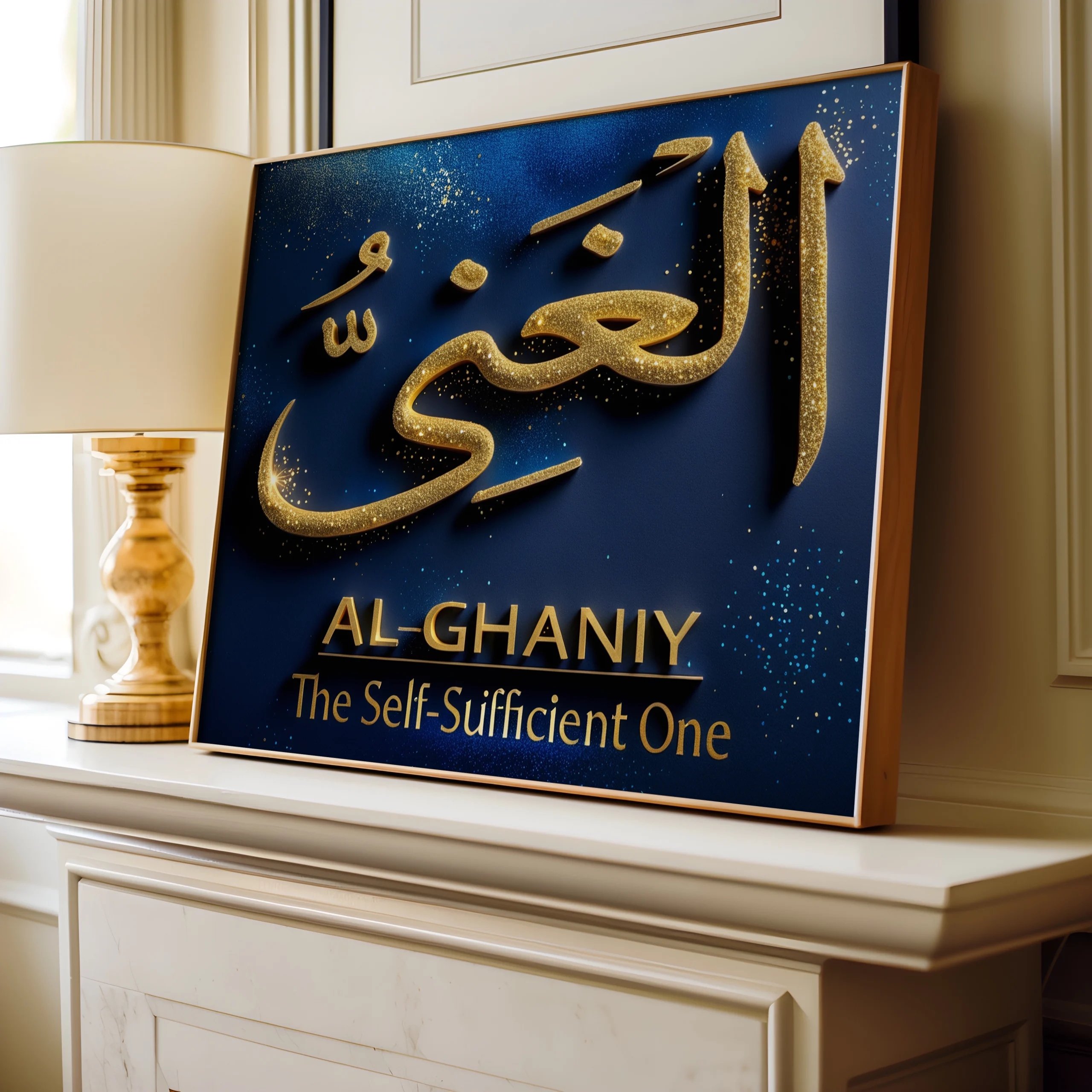
Our Al-Ghaniyy calligraphy digital download is supplied as high-resolution JPEG files for printing at home or at a local print shop. No physical item is shipped. Please see the product page for the files and print sizes included, and if you would like a different layout or colour scheme, custom designs can be requested.
Explore the full 99 Names of Allah collection for other calligraphy designs.
True richness, as the Prophet ﷺ taught, is sufficiency of the soul, and that sufficiency is sought from Al-Ghaniyy alone.