In the vast ocean of Islamic spirituality, the 99 names of Allah stand as beacons of divine attributes, each illuminating a unique aspect of the Creator’s perfection. Among these sacred names, AL-WAKEEL holds a special place of comfort and reassurance for believers. This name invites us to release our burdens, surrender our anxieties, and place our complete trust in the One who manages all affairs with perfect wisdom and care. As we explore the depths of AL-WAKEEL, we discover not just a theological concept, but a transformative approach to navigating life’s challenges with serenity and faith.
The Linguistic and Theological Meaning of AL-WAKEEL
The name AL-WAKEEL (الوكيل) derives from the Arabic root “wakala” (وكل), which carries rich connotations of entrusting, delegating, and appointing someone to manage affairs on one’s behalf. In its purest form, AL-WAKEEL refers to the One who can be fully trusted with all matters, the ultimate guardian and protector who never fails in His responsibilities.
Linguistically, AL-WAKEEL encompasses several interconnected meanings:
- The Trustee who can be relied upon completely
- The Guardian who protects and watches over His creation
- The Disposer of Affairs who manages all matters with perfect wisdom
- The Advocate who represents and defends those who trust in Him
- The Sufficient One who fulfills all needs without requiring assistance
In Islamic theology, AL-WAKEEL represents Allah’s perfect sufficiency in managing the affairs of His creation. Unlike human guardians or trustees who may be limited in power, knowledge, or commitment, Allah as AL-WAKEEL possesses unlimited capacity to care for His servants. He never tires, never forgets, and never fails in His responsibilities.
“Allāh is the Creator of all things, and He is, over all things, Disposer of affairs.”
(Qur’an 39:62, Saheeh International)
This theological understanding emphasizes that Allah’s guardianship is comprehensive and all-encompassing. When we recognize Allah as AL-WAKEEL, we acknowledge that He alone has the perfect ability to manage our affairs, protect us from harm, and guide us toward what is best for our worldly life and spiritual journey.
AL-WAKEEL in the Quran: Divine Assurances
The name AL-WAKEEL appears numerous times throughout the Quran, each instance reinforcing the message of Allah’s perfect guardianship and the importance of placing our trust in Him. These verses serve as divine assurances that when we entrust our affairs to Allah, we are placing them in the most capable hands.
Surah Al-Imran (3:173)
“Those to whom people [i.e., hypocrites] said, “Indeed, the people have gathered against you, so fear them.” But it [merely] increased them in faith, and they said, “Sufficient for us is Allāh, and [He is] the best Disposer of affairs.”
(Qur’an 3:173, Saheeh International)
This verse shows how believers respond to threats by placing their trust in AL-WAKEEL.
Surah An-Nisa (4:132)
“And to Allāh belongs whatever is in the heavens and whatever is on the earth. And sufficient is Allāh as Disposer of affairs.”
(Qur’an 4:132, Saheeh International)
This verse emphasizes Allah’s complete ownership and control over all creation.
Surah Al-Muzammil (73:9)
“[He is] the Lord of the East and the West; there is no deity except Him, so take Him as Disposer of [your] affairs.”
(Qur’an 73:9, Saheeh International)
A direct command to take Allah as our AL-WAKEEL, our guardian and trustee.
These verses highlight a key principle: when facing challenges, threats or uncertainty, the believer’s response is to turn to Allah and say Hasbunallahu wa ni’mal wakeel, “Sufficient for us is Allah, and He is the best Disposer of affairs”. Ibn ‘Abbas reported that these were the words of two Prophets at moments of great danger:
“’Allah is Sufficient for us and He Is the Best Disposer of affairs,’ was said by Abraham when he was thrown into the fire; and it was said by Muhammad when they (i.e. hypocrites) said, ‘A great army is gathering against you, therefore, fear them,’ but it only increased their faith and they said: ‘Allah is Sufficient for us, and He is the Best Disposer (of affairs, for us).’”
In the case of Ibrahim (Abraham, peace be upon him), the Qur’an records that Allah said:
“We [i.e., Allāh] said, “O fire, be coolness and safety upon Abraham.”
(Qur’an 21:69, Saheeh International)
Key Spiritual Benefits of Embracing AL-WAKEEL
Understanding and embracing Allah as AL-WAKEEL brings numerous spiritual benefits that transform our relationship with both our Creator and the challenges of life. When we truly internalize this divine attribute, we experience profound shifts in our perspective and emotional state.
1. Freedom from Anxiety and Worry
When we recognise Allah as Al-Wakeel, we understand that the One managing our affairs has perfect knowledge, wisdom and power. This frees us from the burden of anxiety about outcomes we cannot control. The Prophet (peace be upon him) gave a memorable image of this trust:
“If you were to rely upon Allah with the required reliance, then He would provide for you just as a bird is provided for, it goes out in the morning empty, and returns full.”
Notice that the bird still goes out each morning. Trust in Allah and effort go together.
Practice: Anxiety Relief Through Trust
Next time you feel overwhelmed by worry, pause and consciously entrust your concern to AL-WAKEEL. Say “Hasbunallahu wa ni’mal wakeel” with presence of mind, truly releasing the burden to Allah’s care.
2. Strengthened Resilience in Adversity
Trusting in AL-WAKEEL transforms our response to life’s challenges. Rather than being crushed by difficulties, we view them as opportunities to witness Allah’s perfect management of our affairs. This perspective builds remarkable resilience, as we understand that behind every trial is a Wise Guardian orchestrating events for our ultimate benefit.

The Companions of the Prophet (peace be upon him) showed this resilience after the Battle of Uhud, when they were warned that the enemy was gathering to attack again. According to the commentators, this is the occasion of 3:173 quoted above. Instead of giving in to fear, their faith increased, and the Qur’an describes the outcome:
“So they returned with favor from Allāh and bounty, no harm having touched them. And they pursued the pleasure of Allāh, and Allāh is the possessor of great bounty.”
(Qur’an 3:174, Saheeh International)
3. Liberation from Dependence on Creation
One of the most transformative benefits of embracing AL-WAKEEL is freedom from unhealthy dependence on other created beings. While we may seek help from others, our ultimate reliance remains on Allah alone. This liberates us from the disappointment that inevitably comes when we place excessive hope in fallible humans or unstable circumstances.
“And rely upon the Ever-Living who does not die, and exalt [Allāh] with His praise. And sufficient is He to be, with the sins of His servants, [fully] Aware -”
(Qur’an 25:58, Saheeh International)
By redirecting our ultimate trust to AL-WAKEEL, we establish a relationship with the only Being who will never disappoint, never abandon, and never fail to fulfill His promises. This creates a profound sense of security that transcends changing worldly circumstances.
4. Balance Between Effort and Trust
Trusting in Al-Wakeel does not mean abandoning effort. It means taking the necessary steps while recognising that outcomes are in Allah’s hands. A man once asked the Prophet (peace be upon him) about his camel:
“”O Messenger of Allah! Shall I tie it and rely (upon Allah), or leave it loose and rely (upon Allah)?” He said: “Tie it and rely (upon Allah).””
This balanced approach prevents both the extremes of negligence (claiming to trust while making no effort) and the illusion of self-sufficiency (believing our efforts alone determine outcomes). The believer who understands AL-WAKEEL takes appropriate action while maintaining a heart fully reliant on Allah.
5. Enhanced Spiritual Focus in Worship
When we recognize Allah as AL-WAKEEL, we understand that even our ability to worship depends on His assistance. This realization transforms our approach to spiritual practices, as we no longer rely solely on our own strength but continually seek Allah’s help in remembering, thanking, and worshiping Him properly.
Daily Supplication for Divine Assistance
The Prophet (peace be upon him) taught Mu’adh ibn Jabal a short supplication to say after every prayer:
“By Allah, I love you, Mu’adh. I give some instruction to you. Never leave to recite this supplication after every (prescribed) prayer: ‘O Allah, help me in remembering You, in giving You thanks, and worshipping You well.’”
Saying it acknowledges that we depend on Allah’s help even in our worship.
This approach creates a virtuous cycle: the more we recognize our need for Allah’s help in worship, the more sincerely we turn to Him, and the more assistance He provides. Our spiritual journey becomes characterized by humility and gratitude rather than pride in our own religious accomplishments.
Practical Ways to Integrate AL-WAKEEL into Daily Life
Understanding AL-WAKEEL intellectually is only the beginning. The true transformation comes when we actively integrate this divine name into our daily lives, allowing it to shape our thoughts, emotions, and actions. Here are practical ways to cultivate a living relationship with Allah as AL-WAKEEL:
Morning and Evening Remembrance
Begin and end each day by consciously entrusting your affairs to Allah. Among the morning and evening remembrances taught by the Prophet (peace be upon him) is this one:
“If anyone says three times: ‘In the name of Allah, when Whose name is mentioned nothing on Earth or in Heaven can cause harm, and He is the Hearer, the Knower’ he will not suffer sudden affliction till the morning, and if anyone says this in the morning, he will not suffer sudden affliction till the evening.”
By establishing this practice, you create spiritual bookends to your day, reminding yourself that all your activities occur under the watchful care of AL-WAKEEL.
Mindful Response to Challenges
When facing difficulties, train yourself to immediately turn to AL-WAKEEL rather than being consumed by worry or rushing to human solutions. Make “Hasbunallahu wa ni’mal wakeel” (Sufficient for us is Allah, and He is the best Disposer of affairs) your first response to any challenge.
This practice transforms your emotional response to difficulties, replacing anxiety with a calm certainty that the Best Guardian is managing your affairs.
Balanced Approach to Planning
While making necessary preparations for the future, keep in mind that outcomes remain in Allah’s hands. The Qur’an teaches believers to say “if Allah wills” (in sha’ Allah) when speaking of future plans:
“And never say of anything, “Indeed, I will do that tomorrow,”
(Qur’an 18:23, Saheeh International)
“Except [when adding], “If Allāh wills.” And remember your Lord when you forget [it] and say, “Perhaps my Lord will guide me to what is nearer than this to right conduct.”
(Qur’an 18:24, Saheeh International)
This balanced approach prevents both the anxiety that comes from believing everything depends on our plans and the irresponsibility that might come from misunderstanding trust in Allah.
Regular Reflection on Divine Management
Take time regularly to reflect on how Allah has managed your affairs in the past. Consider instances where outcomes you initially perceived as negative ultimately led to positive results you could not have anticipated. This practice strengthens your trust in AL-WAKEEL’s perfect wisdom and timing.
Gratitude Journal Practice
Keep a journal where you record instances of Allah’s perfect management in your life. Review these entries during times of doubt to strengthen your trust in AL-WAKEEL.
Community Support in Trust
Share your journey of trusting in AL-WAKEEL with like-minded believers. When one person’s faith wavers, others can provide reminders and encouragement. The early Muslims strengthened each other’s trust in Allah during times of trial, and we can continue this beautiful tradition.
By surrounding yourself with those who recognize Allah as AL-WAKEEL, you create an environment where trust in divine management is reinforced rather than undermined by worldly perspectives.
Addressing Common Misconceptions About Trusting in AL-WAKEEL
While the concept of trusting in AL-WAKEEL is beautiful and empowering, it is sometimes misunderstood in ways that can lead to confusion or imbalance in one’s spiritual practice. Addressing these misconceptions helps us develop a more authentic relationship with this divine name.

Balanced Understanding
- Trusting in AL-WAKEEL while taking appropriate action
- Recognizing both divine decree and human responsibility
- Finding peace in outcomes while making sincere effort
- Seeking help from others while maintaining ultimate reliance on Allah
- Balancing planning with flexibility to divine guidance
Common Misunderstandings
- Passive fatalism that neglects necessary action
- Claiming trust while making no practical effort
- Excessive anxiety despite claiming to trust
- Placing ultimate reliance on created beings
- Rigid attachment to personal plans despite contrary signs
The most common misconception is that trusting in AL-WAKEEL means taking no action at all. This misunderstanding contradicts both the Quranic guidance and the example of Prophet Muhammad ﷺ, who took all necessary measures while maintaining complete trust in Allah’s management. True reliance on AL-WAKEEL means doing your part while recognizing that the outcome remains in Allah’s hands.
“The example of those who take allies other than Allāh is like that of the spider who takes [i.e., constructs] a home. And indeed, the weakest of homes is the home of the spider, if they only knew.”
(Qur’an 29:41, Saheeh International)
Another misconception is that trusting in AL-WAKEEL guarantees our preferred outcome in every situation. In reality, Allah’s management of our affairs is based on His perfect knowledge of what is truly best for us, which may differ from our limited perspective. True trust means accepting Allah’s decree with contentment, knowing that AL-WAKEEL’s plan is superior to our own.
The Qur’an promises sufficiency to the one who relies on Allah, while leaving the timing and form of that sufficiency to Him:
“And will provide for him from where he does not expect. And whoever relies upon Allāh – then He is sufficient for him. Indeed, Allāh will accomplish His purpose. Allāh has already set for everything a [decreed] extent.”
(Qur’an 65:3, Saheeh International)
Al-Wakeel in Arabic Calligraphy and the Home
The name الوكيل (Al-Wakeel), or the phrase Hasbunallahu wa ni’mal wakeel, is a meaningful reminder for a study, workspace or entrance, where the day’s efforts begin. When choosing a design, check that the Arabic spelling is correct and that the lettering is legible at the size you plan to print.
Our Al-Wakeel artwork is an digital download supplied as high-resolution JPEG files for printing at home or at a local print shop. No physical item is shipped. If you would like a different layout or colour scheme, custom designs can be requested.
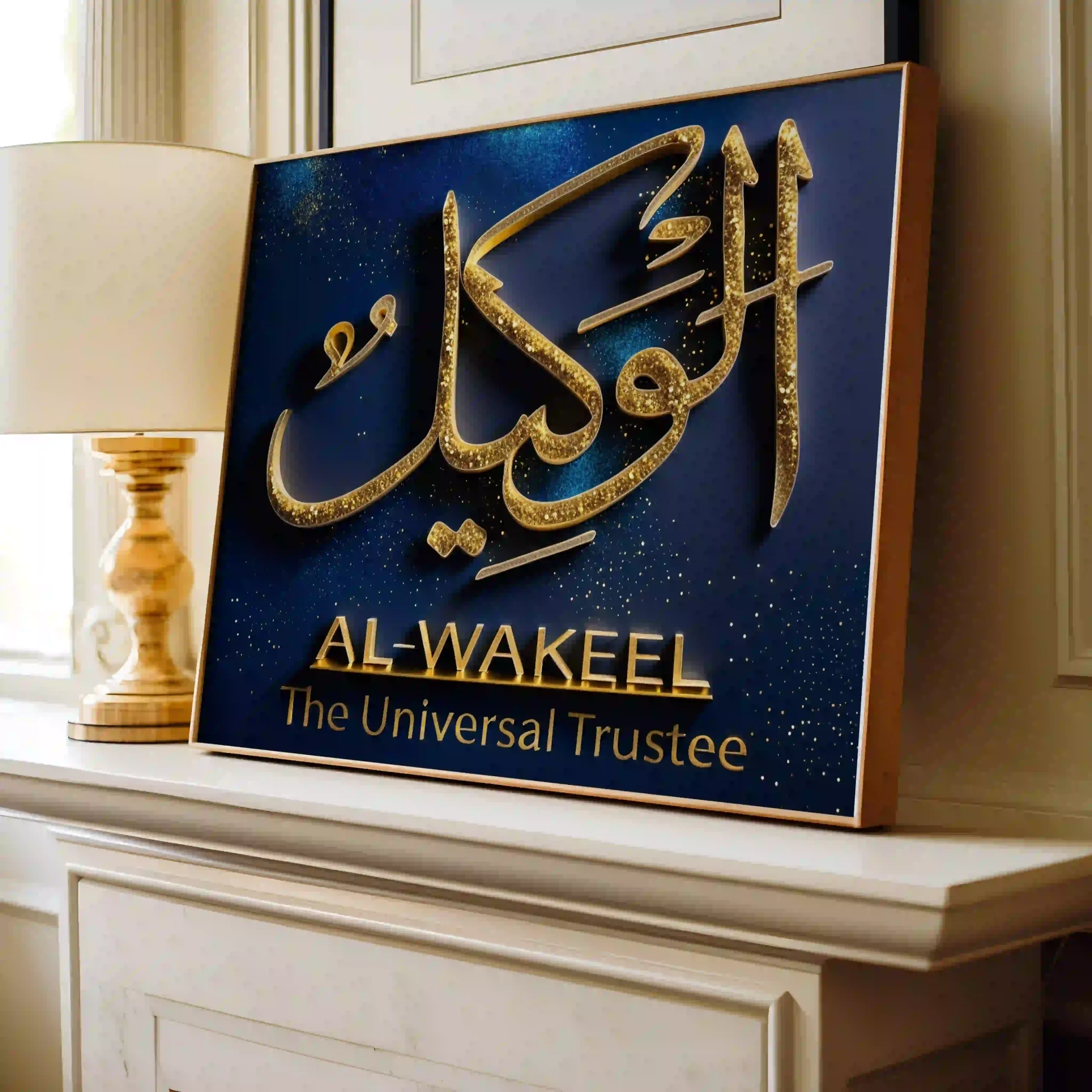
Our Al-Wakeel calligraphy digital download calligraphy design is an digital download; no physical item is shipped. Please see the product page for the files and print sizes included.
Explore the full 99 Names of Allah collection for other calligraphy designs.
Embracing AL-WAKEEL: A Journey of Faith and Serenity
Our exploration of AL-WAKEEL reveals not just a divine attribute to be intellectually understood, but a transformative relationship to be lived. When we truly recognize Allah as the Perfect Guardian, Trustee, and Disposer of Affairs, we experience a profound shift in how we navigate life’s challenges and opportunities.

Trusting in AL-WAKEEL liberates us from the prison of anxiety, the burden of excessive self-reliance, and the disappointment that comes from placing ultimate hope in created beings. Instead, we find ourselves embraced by a divine guardianship that never fails, never tires, and never abandons us even in our darkest moments.
This trust is not passive resignation but active surrender—a dynamic relationship in which we strive with all our ability while maintaining hearts completely reliant on Allah’s perfect management. It is the balance exemplified by the Prophet Muhammad ﷺ and his companions, who took all necessary measures while proclaiming, “Sufficient for us is Allah, and He is the best Disposer of affairs.”
As you continue your spiritual journey, may your understanding of AL-WAKEEL deepen from intellectual knowledge to lived experience. May you find, in moments of both ease and difficulty, the profound peace that comes from knowing you are under the care of the Perfect Guardian. And may your heart echo the beautiful supplication: “Hasbunallahu wa ni’mal wakeel”—truly, Allah is sufficient for us, and He is the best Disposer of affairs.
Frequently Asked Questions about Al-Wakeel
What does Al-Wakeel mean?
Al-Wakeel means the Trustee, the Disposer of Affairs: the One to whom matters can be entrusted completely. It comes from the Arabic root w-k-l, which refers to entrusting and relying on someone to manage one’s affairs.
Where is Al-Wakeel mentioned in the Qur’an?
Allah is described as Wakeel in many verses, including 3:173, 4:132, 39:62 and 73:9. The phrase “Hasbunallahu wa ni’mal wakeel” comes from 3:173.
Who said “Hasbunallahu wa ni’mal wakeel”?
Ibn ‘Abbas reported that Prophet Ibrahim said it when he was thrown into the fire, and Prophet Muhammad (peace be upon him) and his Companions said it when they were warned of an army gathering against them (Sahih al-Bukhari 4563).
Does trusting Allah mean I should not make an effort?
No. When a man asked whether to tie his camel or rely on Allah, the Prophet (peace be upon him) said, “Tie it and rely (upon Allah)” (Jami’ at-Tirmidhi 2517, hasan). Tawakkul means doing your part and leaving the outcome to Allah.
Does relying on Al-Wakeel guarantee the outcome I want?
Not necessarily. Allah manages our affairs with perfect knowledge of what is truly best, which may differ from what we expect. Trust includes contentment with His decree.
What file do I receive with the Al-Wakeel artwork?
You receive high-resolution JPEG files as an digital download, suitable for printing at standard sizes. No physical item is shipped.