AL-MUMEET: Understanding Allah’s Divine Name
In Islamic theology, Allah possesses ninety-nine beautiful names (Al-Asma al-Husna) that reflect His divine attributes and perfect qualities. Among these sacred names is المميت (AL-MUMEET), which refers to Allah as the One who decrees and causes death. This profound attribute reminds believers of Allah’s absolute sovereignty over life and death, serving as both a reminder of human mortality and divine power. This article examines the linguistic, theological, and spiritual aspects of this holy name, providing insights into its significance within the Islamic tradition.
Linguistic Analysis of AL-MUMEET
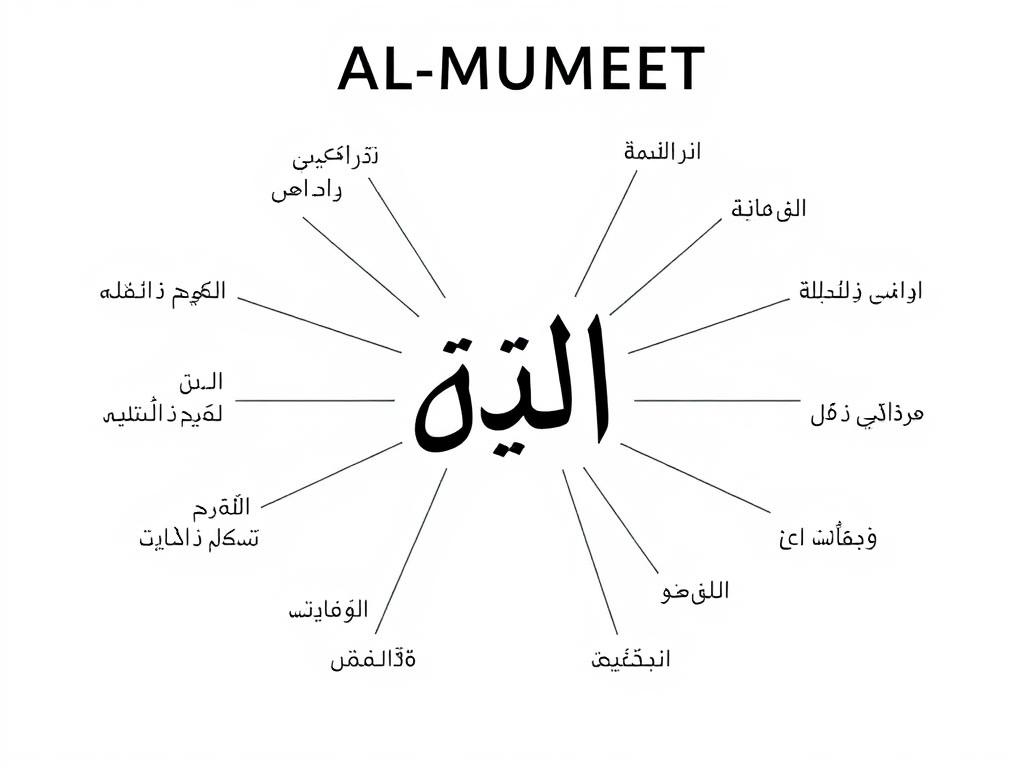
The name AL-MUMEET (المميت) is derived from the Arabic root letters م-و-ت (m-w-t), which fundamentally relates to the concept of death, cessation, or the absence of life. This root appears in various forms throughout the Arabic language, carrying nuanced meanings that help us understand the divine attribute more deeply.
Root Word Derivatives
- مَوْت (mawt): Death, the cessation of life
- مَيِّت (mayyit): One who has died
- مَمَات (mamāt): The state of death
- أَمَاتَ (amāta): To cause death
- مُمِيت (mumīt): One who causes death
Contextual Meanings
- To die or pass away physically
- To become still, quiet, or calm
- To be inanimate or lacking sensation
- To be spiritually dead (lacking spiritual awareness)
- To be barren (as in land that produces no vegetation)
As a divine attribute, AL-MUMEET signifies that Allah alone has the power and authority to decree death for His creation. It emphasises that death is not a random occurrence but a divinely ordained transition that every living being must experience. The linguistic depth of this term reveals that Allah’s role as AL-MUMEET extends beyond merely ending physical life—it encompasses all forms of cessation, transformation, and transition throughout creation.
AL-MUMEET in the Quran and Hadith
While the specific name AL-MUMEET does not appear verbatim in the Quran, the concept of Allah as the giver of death is mentioned numerous times throughout the sacred text. These references establish Allah’s absolute authority over life and death, reinforcing the theological significance of this divine attribute.
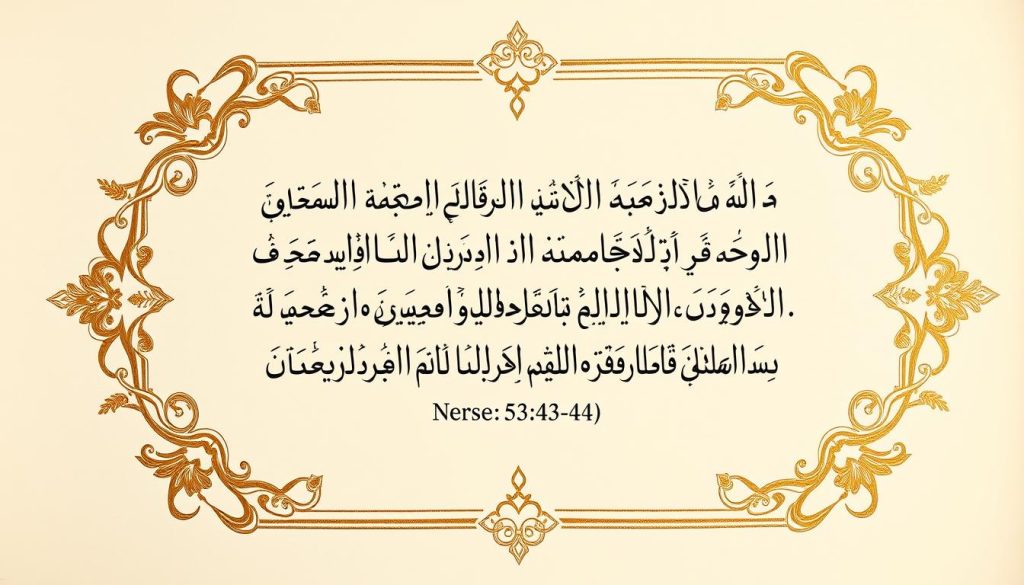
“He it is Who makes (men) laugh and makes (them) weep, and He it is Who causes death and grants life.” (Quran, 53:43-44)
“Say: ‘The Angel of Death, put in charge of you, will take your souls; then you will be brought back to your Lord.'” (Quran, 32:11)
“And it is He who gives life and causes death, and His is the alternation of night and day. Then will you not reason?” (Quran, 23:80)
Hadith References to Death and Allah's Power
Abu Huraira reported: The Messenger of Allah ﷺ said, “When Allah completed the creation, He wrote in His book with Him upon the Throne: Verily, My mercy prevails over My wrath.”
Sahih al-Bukhari 3194, Sahih Muslim 2751
Abu Dharr al-Ghifari reported that whenever the Messenger of Allah ﷺ was ready to go to bed at night, he would say, “In Your Name do we die and live,” and whenever he woke up, he would say, “All Praise is due to Allah Who has brought us back to life after having caused us to die, and to Him is our final return.”
Sahih al-Bukhari
The Prophet Muhammad ﷺ said: “Remember frequently the destroyer of pleasures (meaning death).”
Sunan Ibn Majah, Sunan al-Tirmidhi
Theological Understanding of AL-MUMEET
Classical Scholarly Interpretations
Classical Islamic scholars like Imam al-Ghazali and Ibn Kathir understood AL-MUMEET as an expression of Allah’s absolute sovereignty. In his work “The Ninety-Nine Beautiful Names of Allah,” al-Ghazali explains that AL-MUMEET signifies that Allah alone determines the appointed time for each soul, and no death occurs except by His decree.
Ibn Taymiyyah emphasized that Allah’s attribute as AL-MUMEET is paired with His attribute as Al-Muhyi (the Life-Giver), demonstrating the complete cycle of existence under divine control. This pairing shows the perfect balance in Allah’s creation and governance of the universe.
Contemporary Perspectives
Modern scholars have expanded on these classical interpretations, connecting AL-MUMEET to contemporary understandings of existence. They note that this divine name teaches Muslims to view death not as an end but as a transition to the next phase of existence.
Contemporary theologians also highlight how understanding AL-MUMEET can help believers cope with loss and grief, knowing that death occurs by divine wisdom rather than random chance. This perspective offers comfort while encouraging preparation for the inevitable return to Allah.
Relationship with Other Divine Names
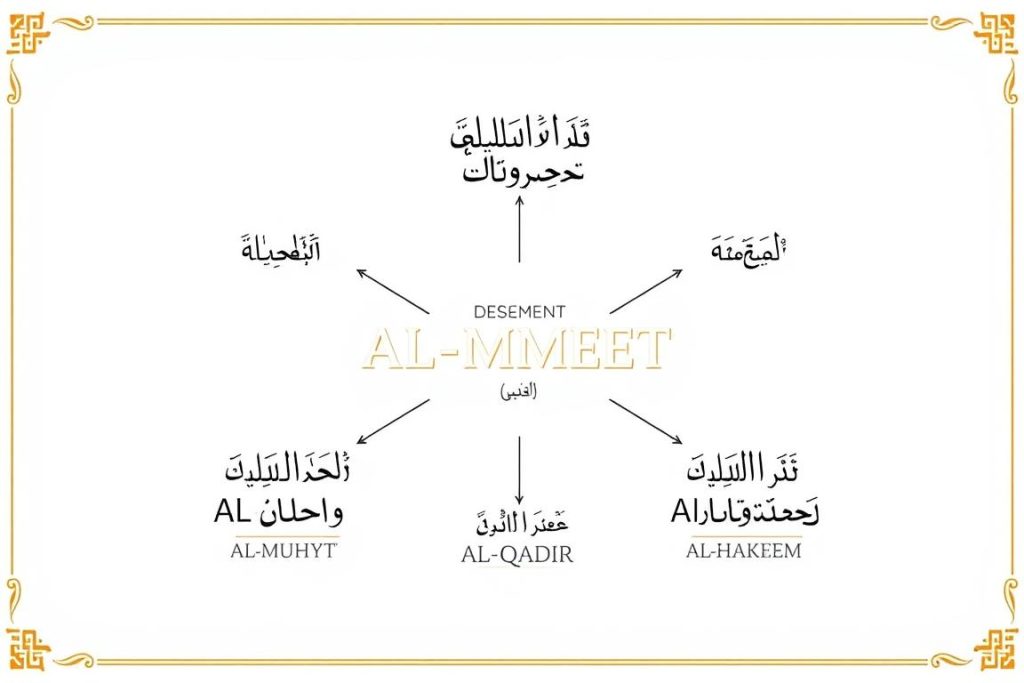
AL-MUMEET and AL-MUHYI
The most significant relationship exists between AL-MUMEET (المميت) and AL-MUHYI (الْمُحْيِي), the Life-Giver. These complementary attributes demonstrate Allah’s complete authority over the cycle of existence. While AL-MUMEET decrees the end of life, AL-MUHYI brings forth life from nothingness and will resurrect all beings on the Day of Judgment.
This pairing teaches believers about the temporary nature of worldly existence and the eternal reality of the Hereafter. It reminds Muslims that both life and death serve divine purposes within Allah’s perfect plan.
AL-MUMEET and AL-QADIR
AL-MUMEET is closely connected to AL-QADIR (القادر), the All-Powerful. Allah’s ability to cause death demonstrates His absolute power over creation. Nothing can resist His decree when the appointed time arrives, showing the limitless nature of divine power.
AL-MUMEET and AL-HAKEEM
The connection with AL-HAKEEM (الحكيم), the All-Wise, reveals that death occurs according to divine wisdom. Every death has purpose and meaning within Allah’s plan, even when humans cannot comprehend the wisdom behind it.
Spiritual Implications and Practical Lessons
Awareness of Mortality (Taqwa)
Understanding Allah as AL-MUMEET cultivates taqwa (God-consciousness) by reminding believers of their mortality. This awareness encourages Muslims to prepare for the Hereafter through righteous deeds and spiritual development. The Prophet Muhammad ﷺ advised believers to “Remember frequently the destroyer of pleasures,” referring to death as a motivation for righteous living.
Humility and Perspective
Recognizing Allah as AL-MUMEET fosters humility by highlighting human vulnerability and dependence on Allah. This perspective helps believers maintain balance in both joy and sorrow, knowing that all worldly conditions are temporary. It encourages detachment from excessive materialism and attachment to eternal values.
“Every soul shall taste death. And We test you with evil and with good as trial; and to Us you will be returned.” (Quran, 21:35)
Appreciation for Life
Paradoxically, understanding Allah as AL-MUMEET deepens appreciation for the gift of life. Knowing that our time is limited encourages believers to use it wisely in worship, service, and meaningful relationships. This awareness transforms ordinary moments into opportunities for gratitude and purposeful living.
How should Muslims reflect on AL-MUMEET in daily life?
Muslims can reflect on AL-MUMEET by:
- Remembering death regularly to maintain perspective
- Preparing for the Hereafter through consistent good deeds
- Practicing detachment from excessive worldly attachments
- Approaching each day as a valuable opportunity for worship and service
- Finding comfort in Allah’s wisdom during times of loss
Common Misconceptions About AL-MUMEET
Misconceptions to Avoid
- Viewing death as punishment: While death can be a consequence of actions, it is primarily a natural transition ordained for all creation, not necessarily a punishment.
- Attributing death to “nature” or “chance”: Islamic theology teaches that all death occurs by Allah’s decree, not by independent natural forces or random chance.
- Excessive fear of death: While healthy awareness is beneficial, paralyzing fear contradicts the balanced perspective Islam teaches about death as a return to our Creator.
- Neglecting preparation: Some mistakenly believe that acknowledging death is morbid, leading them to avoid necessary spiritual and practical preparation.
Correct Understanding
- Death as divine wisdom: Allah as AL-MUMEET decrees death according to perfect wisdom and timing for each soul.
- Death as transition: Death is not the end but a passage to eternal life and the return to our Creator.
- Balance of fear and hope: Muslims approach death with both appropriate concern and hopeful anticipation of meeting Allah.
- Preparation as worship: Preparing for death through righteous living is a form of worship and acknowledgment of Allah’s sovereignty.
Practical Application in Muslim Life
Daily Remembrance
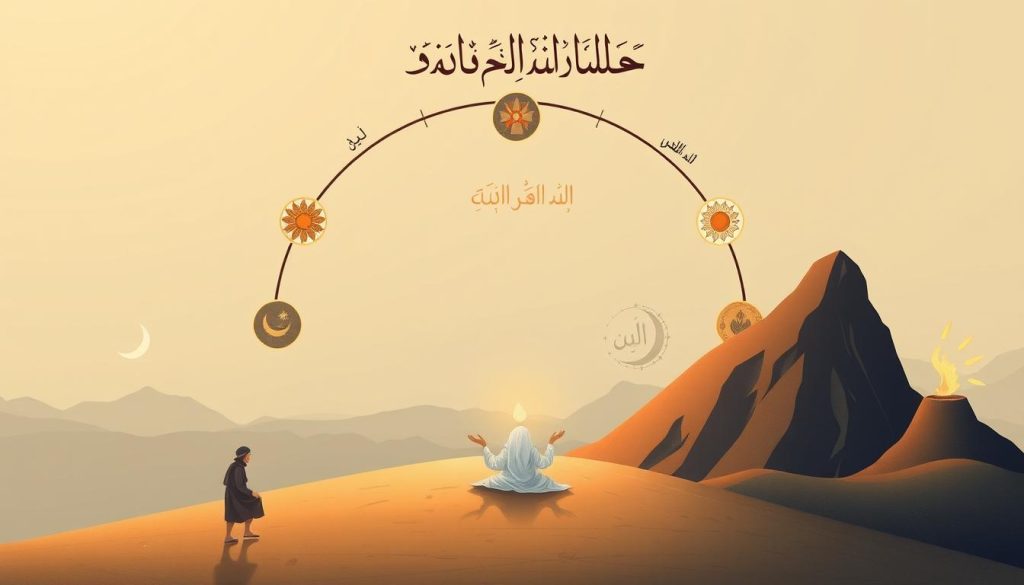
Incorporate remembrance of death into daily routines through specific supplications (dua) taught by the Prophet Muhammad ﷺ. When going to sleep, recite: “In Your Name, O Allah, I die and live.” Upon waking, say: “All praise is due to Allah who gave us life after causing us to die, and to Him is the resurrection.”
Visiting the Sick and Deceased
Islamic tradition encourages visiting the sick and attending funerals as practical reminders of mortality. These practices foster community support while reinforcing awareness of Allah as AL-MUMEET, helping believers maintain perspective on worldly matters.
Charitable Giving
Understanding Allah as AL-MUMEET motivates believers to leave behind ongoing charity (sadaqah jariyah) that continues to benefit them after death. This practice acknowledges the temporary nature of worldly possession and the eternal value of righteous deeds.
Ancient and Modern Scholarly Views
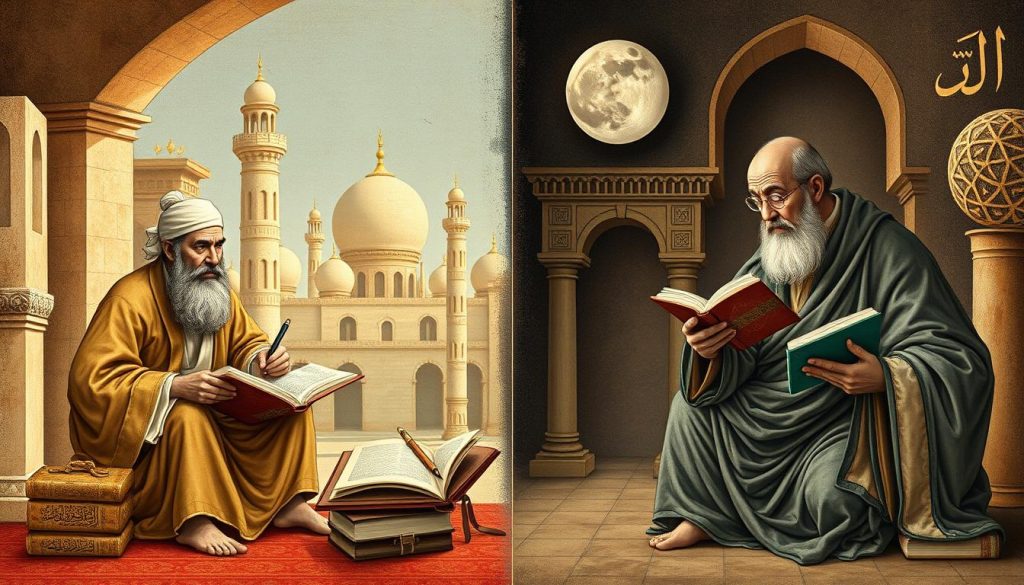
| Aspect | Classical Interpretation | Contemporary Perspective |
| Theological Emphasis | Focused on Allah’s absolute sovereignty and power over creation | Emphasizes divine wisdom and mercy in the decree of death |
| Spiritual Application | Primarily used to encourage detachment from worldly life | Balanced approach that values both worldly responsibility and spiritual preparation |
| Relationship to Science | Minimal engagement with natural explanations of death | Integrates scientific understanding while maintaining divine causality |
| Psychological Approach | Often emphasized fear as motivation for righteousness | More holistic approach addressing grief, meaning, and psychological well-being |
Embracing the Wisdom of AL-MUMEET
Understanding Allah as AL-MUMEET (المميت) offers profound insights that transform our perspective on life and death. This divine name reminds us that our existence follows a divinely ordained pattern—from nothingness to life, from life to death, and ultimately to resurrection. By embracing this knowledge, believers can cultivate greater mindfulness, humility, and purpose in their daily lives.
The recognition of Allah as AL-MUMEET encourages us to prepare for our inevitable return to Him through righteous deeds, sincere repentance, and spiritual growth. It teaches us to value each moment as an opportunity for worship and service, knowing that our time in this world is limited and precious.
Deepen Your Understanding of Allah's Divine Names
Continue your spiritual journey by reflecting on how the divine name AL-MUMEET connects with other attributes of Allah, particularly AL-MUHYI (the Life-Giver). Take time each day to contemplate the meaning of life and death in your daily worship and actions.