


Al-Muntaqim
Al-Muntaqim, In the vast treasury of Islamic knowledge, Allah’s 99 beautiful names (Al-Asma ul-Husna) stand as profound gateways to understanding the divine attributes. Among these names, AL-MUNTAQIM (المنتقم) holds special significance as it reveals an essential aspect of divine justice. This name, often translated as “The Avenger” or “The Exactor of Retribution,” invites us to contemplate the perfect balance between Allah’s mercy and justice. Understanding AL-MUNTAQIM gives us insight into how divine accountability operates in our world and the hereafter.
Linguistic Analysis of AL-MUNTAQIM
The name AL-MUNTAQIM derives from the Arabic root “nun-qaf-mim” (ن-ق-م), which carries several interconnected meanings in classical Arabic. This root conveys the concepts of disapproval, finding fault, exacting vengeance, and inflicting retribution upon those who persist in wrongdoing despite receiving clear warnings.
In its grammatical form, AL-MUNTAQIM appears as an active participle (ism fa’il), indicating that this is an ongoing, active attribute of Allah. The prefix “AL” (ال) denotes definiteness, emphasizing that Allah alone possesses this attribute in its perfect, complete form. Unlike human retribution, which may be tainted by emotion or excess, divine retribution is always perfectly measured and justified.
The linguistic depth of AL-MUNTAQIM reveals that divine retribution is not arbitrary punishment but rather the natural consequence of persistent wrongdoing after clear warnings have been given.
Deepen Your Understanding of Divine Names
Explore the linguistic roots and meanings of all 99 names of Allah with our comprehensive guide.
Quranic References to AL-MUNTAQIM
The name AL-MUNTAQIM appears explicitly in the Quran three times, each instance providing profound insight into this divine attribute. These references help us understand the contexts in which Allah’s retribution manifests and its relationship to His other attributes.
Surah Az-Zukhruf (43:41)

“And whether [or not] We take you away [in death], indeed, We will take retribution upon them.”
This verse reassures the Prophet Muhammad ﷺ that Allah’s justice will prevail against those who reject the message, regardless of whether the Prophet witnesses it in his lifetime.
Surah Ad-Dukhan (44:16)
“The Day We will strike with the greatest assault, indeed, We will take retribution.”
This verse speaks of the Day of Judgment, when divine retribution will manifest in its complete form against those who persisted in rejection and wrongdoing.
Surah As-Sajdah (32:22)
“And who is more unjust than one who is reminded of the verses of his Lord; then he turns away from them? Indeed We, from the criminals, will take retribution.”
This verse emphasizes that divine retribution comes after clear signs and warnings have been given and deliberately ignored.
Historical Examples in the Quran
The Quran provides numerous historical examples of AL-MUNTAQIM in action through the stories of past nations who rejected their prophets and persisted in wrongdoing. The story of Prophet Nuh (Noah) and the flood, Pharaoh and his army, and the people of ‘Ad and Thamud all illustrate how divine retribution manifests after repeated warnings and opportunities for repentance have been ignored.

Does AL-MUNTAQIM mean Allah is vengeful like humans?
No, unlike human vengeance which can be emotional and disproportionate, Allah’s attribute of AL-MUNTAQIM represents perfect justice. Divine retribution is always proportionate, comes only after repeated warnings, and serves the greater purpose of maintaining cosmic balance and justice.
Why is understanding AL-MUNTAQIM important for believers?
Understanding AL-MUNTAQIM helps believers maintain a balanced view of Allah’s attributes. It reminds us that while Allah is infinitely merciful (AR-RAHMAN), He also upholds perfect justice. This knowledge encourages righteous conduct and provides comfort that ultimate justice will prevail, even when it seems delayed in this world.
Theological Context of AL-MUNTAQIM
In Islamic theology, AL-MUNTAQIM represents an essential aspect of divine justice that complements Allah’s attributes of mercy and forgiveness. This name reminds us that the universe operates on principles of balance and accountability, where actions have consequences.

Balance Between Mercy and Justice
A profound aspect of Islamic theology is the perfect balance between Allah’s mercy and justice. While Allah’s mercy (represented by names like AR-RAHMAN and AR-RAHEEM) is emphasized as taking precedence, His justice ensures cosmic balance. The Prophet Muhammad ﷺ narrated that Allah has written above His Throne: “Indeed, My mercy prevails over My wrath.” This indicates that while retribution exists, it operates within the larger context of divine mercy.
Divine Warning Before Retribution
A key theological principle is that Allah never punishes without first sending clear warnings. Throughout history, messengers were sent to communities before any punishment was decreed. This demonstrates that divine retribution is not arbitrary but comes only after humans have been given ample opportunity to recognize truth and reform their ways.
Justice as a Cosmic Necessity
In Islamic theology, divine justice is not merely punitive but restorative—it maintains the cosmic balance. When persistent wrongdoing threatens this balance, divine intervention through AL-MUNTAQIM restores order. This understanding helps believers trust in ultimate justice, even when immediate circumstances may suggest otherwise.
The name AL-MUNTAQIM teaches us that divine justice is not the absence of mercy, but rather its complement—ensuring that the universe operates according to perfect wisdom and balance.
Test Your Knowledge
How well do you understand Allah’s divine attributes? Take our interactive quiz to find out and deepen your understanding.
AL-MUNTAQIM's Relationship with Other Divine Names
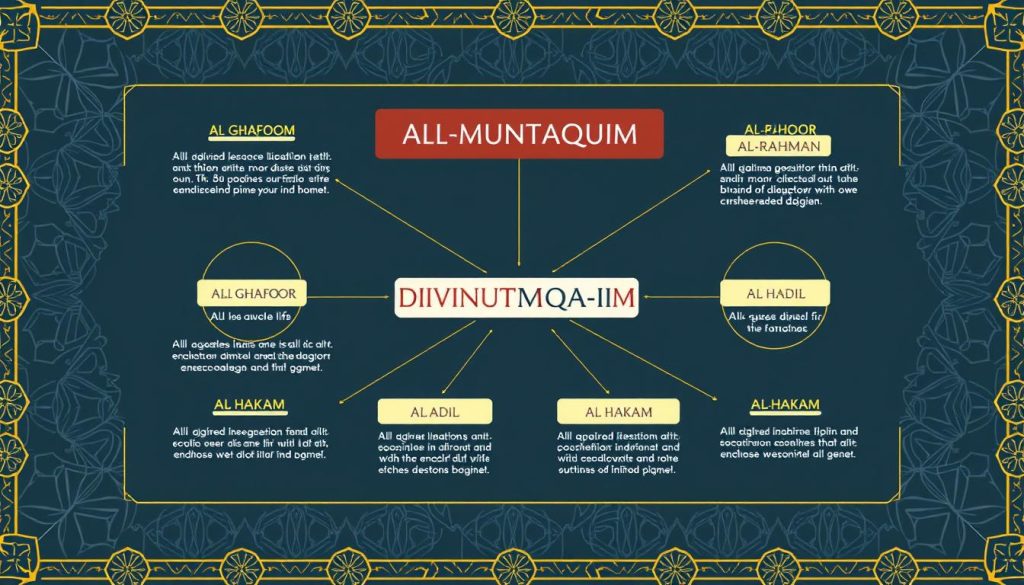
Understanding AL-MUNTAQIM becomes richer when we explore its relationship with other divine names. These connections reveal the comprehensive nature of Allah’s attributes and how they work in harmony.
| Divine Name | Meaning | Relationship with AL-MUNTAQIM |
| AL-GHAFOOR | The All-Forgiving | While AL-MUNTAQIM represents divine retribution, AL-GHAFOOR reminds us that the door to forgiveness remains open for those who sincerely repent. These names teach us that Allah gives ample opportunity for repentance before retribution. |
| AL-RAHMAN | The Most Merciful | AL-RAHMAN’s universal mercy precedes AL-MUNTAQIM’s retribution, showing that Allah’s primary relationship with creation is one of mercy. Retribution comes only after mercy has been repeatedly rejected. |
| AL-ADIL | The Just | AL-ADIL represents perfect justice in all matters, while AL-MUNTAQIM specifically relates to the implementation of justice through retribution when necessary. Together, they ensure cosmic balance. |
| AL-HAKAM | The Judge | AL-HAKAM judges with perfect wisdom, while AL-MUNTAQIM executes the judgment. These names work in tandem to establish that divine judgment is both wise and effective. |
This interconnected understanding of divine names reveals that Allah’s attributes work in harmony rather than isolation. AL-MUNTAQIM does not contradict Allah’s mercy but complements it, ensuring that justice prevails while giving ample opportunity for forgiveness and redemption.
Practical Lessons from AL-MUNTAQIM
Understanding Allah’s name AL-MUNTAQIM offers profound practical lessons for believers in their daily lives. These lessons help us develop a balanced approach to justice, accountability, and ethical living.

Reflection Exercises
To internalize the meaning of AL-MUNTAQIM in our daily lives, consider these reflection exercises:
Daily Self-Examination

Set aside time each evening to reflect on your actions. Have you been just in your dealings? Have you oppressed anyone, even unintentionally? This practice helps develop self-awareness before divine accountability.
Seeking Forgiveness

Regularly seek forgiveness for any injustice you may have committed. The Prophet Muhammad ﷺ taught us to seek forgiveness frequently, as this opens the door to mercy before facing divine retribution.
Standing for Justice

Actively stand for justice in your community. By embodying just principles in our actions, we align ourselves with divine attributes and contribute to a more balanced society.
The greatest manifestation of understanding AL-MUNTAQIM is not fear of punishment, but rather a deep commitment to justice and ethical conduct in all aspects of life.
Join Our Online Study Circle
Deepen your understanding of Allah’s names through guided discussions and practical applications in our weekly online sessions.
Conclusion: Embracing the Wisdom of AL-MUNTAQIM
Understanding Allah’s name AL-MUNTAQIM offers us profound insights into the nature of divine justice and its role in our lives. This name reminds us that while Allah is infinitely merciful, He also maintains perfect justice—ensuring that persistent wrongdoing does not go unaddressed. Rather than inspiring fear, this knowledge should motivate us toward ethical living, self-accountability, and trust in ultimate justice.

By reflecting on AL-MUNTAQIM alongside Allah’s other beautiful names, we develop a more comprehensive understanding of divine attributes—seeing how mercy, forgiveness, justice, and retribution work in harmony rather than opposition. This balanced perspective helps us navigate life’s challenges with wisdom, compassion, and unwavering commitment to justice.
May our understanding of AL-MUNTAQIM inspire us to be just in our dealings, merciful when appropriate, and always mindful that we will ultimately return to Allah for the final accounting. In this awareness lies the path to spiritual growth and a more just world.
Explore Related Divine Names
Continue your journey of understanding Allah’s beautiful names with our comprehensive guides.


