


AS-SAMAD (Allah’s Name): The Eternal Refuge
AS-SAMAD (Allah’s Name): The Eternal Refuge. In the tapestry of Allah’s 99 beautiful names, AS-SAMAD is a profound attribute that captures His absolute perfection and self-sufficiency. This divine name appears in Surah Al-Ikhlas, one of the most frequently recited chapters of the Quran, highlighting its central importance to Islamic monotheism. When we understand AS-SAMAD, we recognise Allah as the ultimate refuge to whom all creation turns in times of need, while He remains completely independent of all needs Himself.
The divine name AS-SAMAD in Arabic calligraphy
Etymology and Core Meaning of AS-SAMAD
The name AS-SAMAD (الصَّمَدُ) derives from the Arabic root letters sad-mim-dal (ص م د), which carries multiple linguistic dimensions. This root appears only once in the Quran, specifically in Surah Al-Ikhlas (112:2), yet its significance resonates throughout Islamic theology.
قُلْ هُوَ اللَّهُ أَحَدٌ ١ اللَّهُ الصَّمَدُ ٢
“Say, ‘He is Allah, [who is] One, Allah, AS-SAMAD (the Eternal Refuge).'” — (Qur’an 112:1-2)
Linguistically, AS-SAMAD encompasses several interconnected meanings:
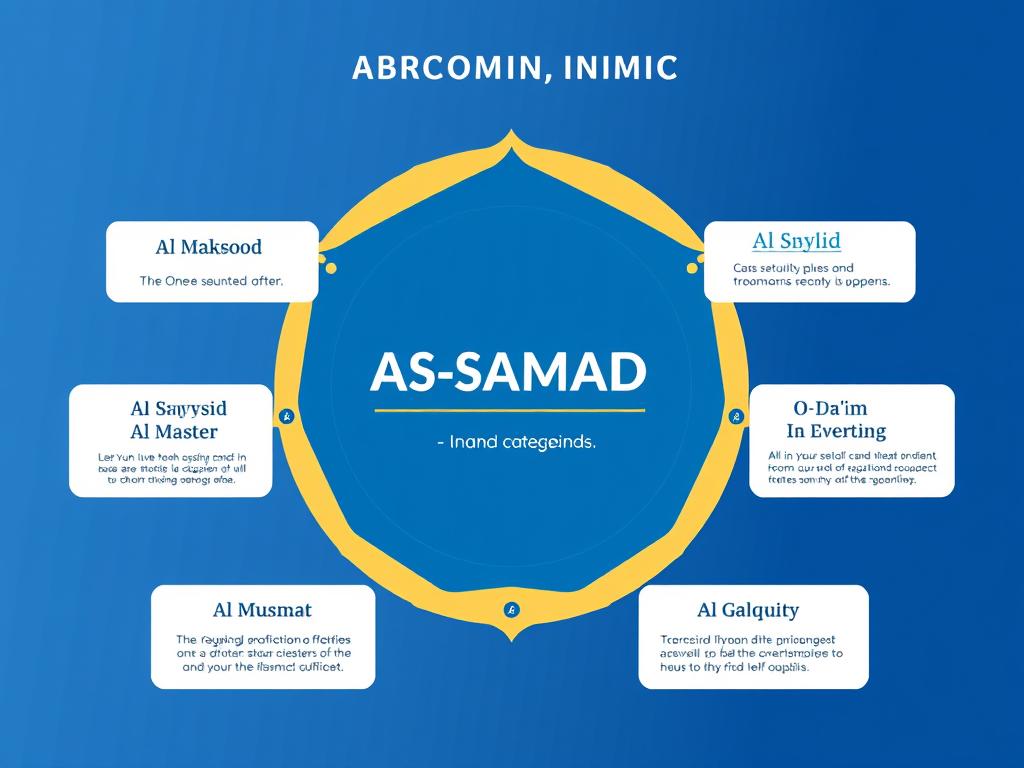
Ibn Abbas (may Allah be pleased with him), the renowned interpreter of the Quran, elaborated on AS-SAMAD as: “The Master Who is perfect in His sovereignty, the Most Noble Who is perfect in His nobility, the Most Magnificent Who is perfect in His magnificence, the Most Forbearing Who is perfect in His forbearance, the All-Knowing Who is perfect in His knowledge, and the Most Wise Who is perfect in His wisdom.”
Quranic Context and Tafsir of AS-SAMAD
Surah Al-Ikhlas holds a special place in Islamic theology. Prophet Muhammad (peace be upon him) stated that it equals one-third of the Quran in merit. This short surah encapsulates the essence of Islamic monotheism (Tawhid), with AS-SAMAD at its core.
قُلْ هُوَ اللَّهُ أَحَدٌ ١ اللَّهُ الصَّمَدُ ٢ لَمْ يَلِدْ وَلَمْ يُولَدْ ٣ وَلَمْ يَكُن لَّهُ كُفُوًا أَحَدٌۢ ٤
“Say, ‘He is Allah, [who is] One, Allah, AS-SAMAD. He neither begets nor is born, nor is there to Him any equivalent.'” — (Qur’an 112:1-4)
The placement of AS-SAMAD immediately after Al-Ahad (The One) is significant. While Al-Ahad establishes Allah’s absolute oneness, AS-SAMAD explains the nature of this oneness – He is self-sufficient and the ultimate refuge for all creation.
Tafsir Insights on AS-SAMAD
The Study Quran mentions that AS-SAMAD’s “lexical, non-theological meaning indicates something solid and impenetrable or simply ‘not hollow,'” and theologically refers to “an allusion to the primary or initial cause of all things, an eternally self-sufficient, independent being who continues to exist after His creation has ceased to exist.”
Deepen Your Understanding of Divine Names
Explore the profound meanings of Allah’s 99 names through our comprehensive guide. Enhance your spiritual connection through knowledge.
Prophetic Teachings About AS-SAMAD
The Prophet Muhammad (peace be upon him) emphasised the importance of AS-SAMAD through various hadith highlighting its significance in supplication and spiritual practice.
AS-SAMAD in Authentic Hadith
Abdullah bin Buraidah Al Aslami narrated from his father, who said: “The Prophet ﷺ heard a man supplicating, and he was saying: ‘Allahumma inni as’aluka bi annī ashhadu annaka antallāh, la ilaha illa ant, al-ahadus-samad, alladhi lam yalid wa lam yūlad, wa lam yakun lahu kufuwan ahad’ (O Allah, indeed, I ask you by my testifying that You are Allah, there is none worthy of worship except You, the One, AS-SAMAD, the one who does not beget, nor was begotten, and there is none who is like Him).”
The Prophet ﷺ said: “By the One in Whose Hand is my soul, he has asked Allah by His Greatest Name, the one which if He is called upon by it, He responds, and when He is asked by it, He gives.”
— Jami at-Tirmidhi 3475 (Sahih)

This hadith reveals that invoking Allah by His name AS-SAMAD, particularly within Surah Al-Ikhlas, carries tremendous spiritual power. The Prophet Muhammad (peace be upon him) indicated that this supplication contains Allah’s Greatest Name (Ism Allah al-A’dham), which guarantees a response when sincerely invoked.
Guidance on Seeking Help from AS-SAMAD
In another profound teaching, the Prophet Muhammad (peace be upon him) advised his young cousin Ibn Abbas:
“O boy! I will teach you some words: Be mindful of Allah, and He will protect you. Be mindful of Allah, and you will find Him before you. When you ask, ask Allah; when you seek aid, seek Allah’s aid. Know that if the entire creation were to gather together to do something to benefit you, you would never get any benefit except that Allah had written for you. And if they were to gather to do something to harm you, you would never be harmed except that Allah had written for you. The pens are lifted and the pages are dried.”
— Jami at-Tirmidhi 2516 (Hasan)
This hadith perfectly captures the essence of AS-SAMAD – the One we should turn to for all our needs. It emphasises that actual reliance should be placed solely on Allah, as He alone is self-sufficient while all creation is dependent.
Reflection Point: Consider how often you turn to creation (people, possessions, or your abilities) before turning to AS-SAMAD. How might your life change if you truly internalized that Allah alone is the Eternal Refuge?
Connecting with AS-SAMAD in Daily Life
Understanding AS-SAMAD intellectually is only the beginning. Applying this divine attribute in our daily lives and spiritual practice is the true benefit.

Practical Ways to Connect with AS-SAMAD
In Prayer and Supplication
In Daily Conduct
Thabit narrated from Anas, who said, “The Messenger of Allah (ﷺ) said: ‘Let one of you ask his Lord for his every need, even until he asks Him for the strap of his sandal when it breaks.'”
— Jami at-Tirmidhi 3604 (Hasan)
This hadith beautifully illustrates how we should approach AS-SAMAD with all our needs, no matter how insignificant they may seem. When we limit our asking, we are actually imposing our own constraints on Allah’s boundless generosity.

Reflecting AS-SAMAD in Our Character
While we cannot embody AS-SAMAD in its fullness (as only Allah is truly self-sufficient), we can reflect aspects of this attribute in our character:
I would like to remind you that when helping others, never remind them of your favour or cause them harm through your words. Allah says in the Quran: “O you who have believed, do not invalidate your charities with reminders or injury” (2:264). This would contradict the perfection of AS-SAMAD’s giving.
AS-SAMAD in Modern Spiritual Development
In our contemporary world of constant connectivity and material dependency, the concept of AS-SAMAD offers profound spiritual guidance and psychological relief.

Overcoming Modern Challenges Through AS-SAMAD
Addressing Material Dependency
Modern consumer culture creates artificial needs and dependencies. Understanding AS-SAMAD helps us distinguish between genuine needs and manufactured wants, freeing us from the cycle of consumption that never satisfies. When we recognise Allah as the only true AS-SAMAD, we can break free from the illusion that material possessions will fulfil us.
Finding Digital Balance
Our digital devices often become false refuges we turn to in moments of boredom, anxiety, or loneliness. Remembering AS-SAMAD encourages us to turn to Allah first in these moments, rather than scrolling through social media or seeking distraction. This creates space for genuine spiritual connection and mindfulness in an age of constant distraction.
Psychological Benefits of Connecting with AS-SAMAD

How can I truly rely on AS-SAMAD when I still need to work and plan for the future?
Relying on AS-SAMAD doesn’t mean abandoning worldly means, but rather recognising their true nature as channels through which Allah provides. The Prophet Muhammad (peace be upon him) taught us to “tie your camel and then trust in Allah”, – meaning we should take practical steps while maintaining our ultimate reliance on Allah. Your work, planning, and resources are all means that AS-SAMAD has provided; the outcomes remain in His hands.
If Allah is AS-SAMAD and needs nothing from us, why does He ask us to worship Him?
Allah’s command for us to worship Him is not because He needs our worship , but because we need to worship. As AS-SAMAD, Allah is completely self-sufficient and independent of our worship. Worship is prescribed for our own benefit—it aligns us with our purpose, purifies our hearts, and connects us to the source of all goodness. Our worship adds nothing to Allah’s perfection but transforms our imperfect selves.
Embracing AS-SAMAD: Key Takeaways
As we conclude our exploration of Allah’s beautiful name AS-SAMAD, let us remember that truly understanding this divine attribute transforms not just our theology, but our entire approach to life.
May our understanding of AS-SAMAD deepen our connection with Allah and transform our daily lives. As we navigate life’s journey, may we consistently turn to the Eternal Refuge in times of both ease and difficulty, recognizing that He alone is perfect in His self-sufficiency while we remain forever in need of His boundless mercy and guidance.
Continue Your Spiritual Journey
Receive weekly reflections on Allah’s beautiful names and practical ways to implement their meanings in your daily life.


One response to “AS-SAMAD (Allah’s Name): The Eternal Refuge and Self-Sufficient”
Aw, this was a really nice post. In concept I wish to put in writing like this additionally – taking time and precise effort to make a very good article… however what can I say… I procrastinate alot and certainly not seem to get something done.