



Last night, as I tucked my daughter into bed, her eyes shone excitedly. “Tell me about Prophet Yusuf again,” she asked softly. In that moment, I saw children’s profound connection with stories that help them grow spiritually. This special bedtime moment is shared by many Muslim families, passing down their faith through captivating tales.
The world of Islamic stories with morals for kids is not just for fun. It teaches essential Islamic lessons through stories. Kids learn from Prophet Ayub’s patience and Luqman’s wisdom.
For centuries, stories have been a key way to teach Islam. The Quran uses stories to share its message, and these Muslim children’s fables help young Muslims understand their faith.
We believe that when kids hear these timeless tales, they learn about Islam and grow to love it. These stories are like trusted friends, guiding them on their spiritual path, now and in the future.
In Islamic heritage, storytelling is a key way to teach faith and character to children. For ages, Muslim families have shared stories that guide them on the right path. These stories link abstract Islamic teachings to everyday life, making teaching Islamic values through storytelling very effective.
Storytelling in Islam is more than just fun—it’s a way to pass on knowledge. Prophet Muhammad (PBUH) used stories to explain complex ideas to his followers. This method made learning easier and more relatable.
Children love stories and absorb them quickly. This makes storytelling a great way to teach Islamic values. When young Muslims hear Islamic moral tales, they learn by feeling, not just memorising.
Stories have many benefits for young Muslim minds:
Studies show that moral lessons in stories are remembered better than direct teaching. When we share stories of prophets, children learn not just what happened but why it’s essential for them.
The Quran shows the power of stories in teaching. About one-third of the story is about Allah’s love for teaching Islamic values through storytelling. These stories aim to touch hearts and minds while teaching profound spiritual truths.
The Quran says, “We relate to you the best of stories” (12:3), highlighting the value of stories. The tales of prophets like Nuh and Ibrahim teach us important lessons that apply to all times.
Connecting Quranic stories to a child’s life is why Islamic moral tales are crucial in early education. When children understand and apply these lessons, they grow spiritually and find true fulfilment.
The Quran’s story structure is a guide for parents today. Following this example, we can create stories that strengthen our children’s faith and character.
The Quran’s stories of prophets teach children about faith, perseverance, and wisdom. These tales are not just history but lessons that touch young hearts. They show how prophets stayed true to Allah despite challenges.
Sharing Quran stories for children gives them a moral compass. Each prophet’s story teaches virtues like patience and honesty. The Quran tells of twenty-five prophets, each with their lessons.
Prophet Adam (AS) introduces children to humanity’s start and our bond with Allah. Adam was the first human, blessed with knowledge. Allah taught him everything, including how to plant and bake.
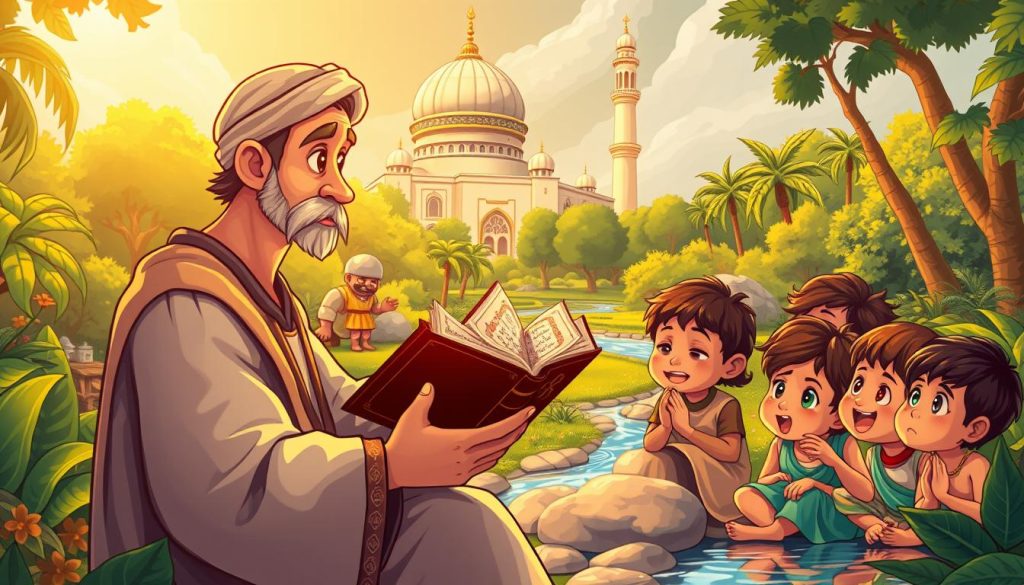
This story teaches children about being accountable for their actions. It shows the power of true repentance and Allah’s mercy. Adam’s story teaches that making mistakes is okay, but seeking forgiveness is key.
Prophet Nuh (AS) shows incredible patience and dedication. For 950 years, he preached to people, facing constant mockery. Yet, he never gave up on his mission.
When a great flood came, Allah told Nuh to build an ark. Only believers were saved, while disbelievers were lost.
This story teaches children to be strong in their beliefs, even when mocked. It shows Allah rewards those who stay true. It also highlights the importance of following Allah’s guidance, even if it’s hard.
Prophet Ibrahim (AS) is Khalilullah, the Friend of Allah. His story is filled with faith and trials. From a young age, Ibrahim questioned his people’s idol worship.
Ibrahim destroyed the idols, leaving one, and showed its uselessness. This act of truthfulness was a bold move.
Ibrahim’s willingness to sacrifice his son is a powerful lesson. Allah provided a ram as a substitute, starting Eid al-Adha.
Ibrahim’s story teaches children to trust Allah and believe in one God. It shows how to question harmful traditions and the value of faith. The major prophets of Islam, like Ibrahim, provide examples of courage and devotion.
These stories show children that prophets faced real challenges. They teach that faith, patience, and trust in Allah can overcome obstacles. By sharing these lessons from the prophet’s life, we connect our children to their spiritual heritage and give them timeless wisdom.
The stories of Prophet Muhammad (PBUH) from his childhood teach kids about integrity, wisdom, and responsibility. These tales show that being a good person starts when you’re young. They make kids understand that the Prophet they admire was once just like them, facing challenges and showing great qualities.
These stories from the Prophet’s early years give timeless moral lessons that kids can relate to today. They show how Muhammad (PBUH) developed leadership, honesty, and wisdom before becoming a prophet. Sharing these stories with young Muslims helps them connect with their faith meaningfully.
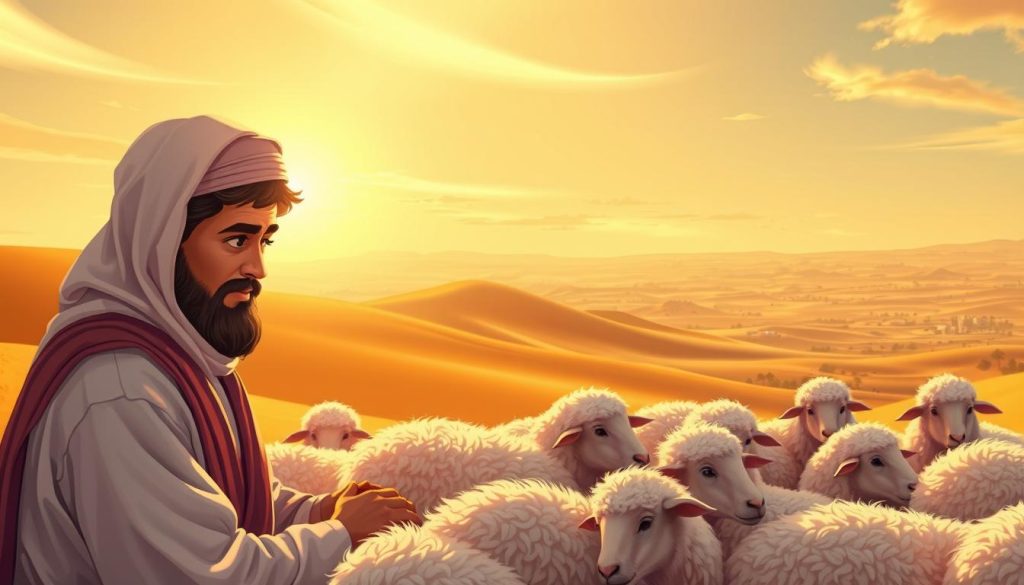
As a young boy in Makkah, Muhammad (PBUH) worked as a shepherd. He looked after sheep and goats in the rocky hills around the city. This job taught him essential skills that helped him later in life.
Through his shepherding, young Muhammad learned:
Sharing this story with children shows how simple work can build character. Muhammad’s experience watching sheep prepared him for guiding humanity. It teaches kids that every task, no matter how small, can help develop important qualities.
When Muhammad (PBUH) was about 35, the Kaaba needed rebuilding after floods damaged it. The story of how he solved a serious dispute during this time offers valuable lessons in conflict resolution.
The tribes of Makkah argued over who would place the Black Stone in its position. Tensions were high, and conflict seemed likely. They agreed to accept the judgment of the next person to enter the sanctuary, Muhammad (PBUH).
His solution was simple yet wise. He placed the Black Stone on a cloth and invited representatives from each tribe to hold the edges. This way, they shared the honour equally. Together, they raised the stone, and Muhammad (PBUH) positioned it in its place.
This story teaches children several essential values:
Muhammad’s (PBUH) honesty and reliability were unmatched before he became a prophet. These qualities earned him the title “Al-Amin” (The Trustworthy) among the people of Makkah.
Even those who later opposed his message trusted him. People trusted Muhammad (PBUH) with their valuables. His word was considered unbreakable in business transactions. His reputation for integrity was so strong that no one ever accused him of lying.
This trustworthiness manifested in several ways:
This story teaches children that building a reputation for integrity starts early. It shows that truthfulness is a foundation for leadership and respect.
We find these lessons from the Prophet’s life very valuable for young Muslims today. In a world where honesty is sometimes undervalued, the story of Al-Amin reminds children of the importance of trustworthiness.
By connecting these childhood stories to children’s experiences, we help them see how they can embody prophetic qualities. These Islamic stories with morals for kids provide practical examples of living with integrity, wisdom, and responsibility from a young age.
The lives of the Prophet’s companions are full of lessons for young Muslims today. They came from different places—former slaves, young scholars, and seekers from far away—yet they all found their place in the early Muslim community. Their stories show how faith can overcome social barriers and how being steadfast can make you a great role model.
Children love these Islamic moral tales because they see real people facing challenges like them. The companions never gave up their beliefs, even when things got tough. Their courage and conviction teach us valuable lessons that last a lifetime.
Bilal ibn Rabah’s story is a powerful lesson in perseverance. Born into slavery in Mecca, he became one of the first Muslims. His master, Umayyah ibn Khalaf, tortured him, demanding he give up his faith.
Bilal never wavered, saying “Ahad, Ahad” (One God, One God) even when it seemed like death was near. His courage is something children can admire. Abu Bakr (RA) later freed Bilal, seeing his remarkable spirit.
Prophet Muhammad (PBUH) made Bilal the first muezzin, the caller to prayer. His voice called believers to worship across Mecca and Medina, showing that Allah values faith over worldly status.
When we tell Bilal’s story, we teach children the strength of standing up for their beliefs. His journey from slavery to freedom is like the spiritual journey from darkness to light in Islam.
Aisha (RA), the young wife of Prophet Muhammad (PBUH), is an excellent example for kids. She was married young but became a top scholar in Islam. Her love for learning was unmatched, and she memorised the Prophet’s teachings perfectly.
Children find it amazing that Aisha told over 2,200 hadith. This shows how important education is in Islam. Her memory and understanding made her a teacher to many, even older men.
Aisha’s story teaches us that education is for everyone, regardless of gender. When kids hear about her knowledge, they see the value of women’s learning in Islam.
Aisha was brave in asking questions and seeking answers. This shows kids the importance of thinking critically and being guided by faith. It helps them deal with today’s world while staying true to Islamic values.
Salman Al-Farsi started his journey far from Arabia, in a Persian Zoroastrian family. He was unhappy with his family’s religion and looked for truth for years. His story teaches kids the value of seeking truth, even when it’s hard.
Salman first met Christianity and was impressed. He then travelled to learn from Christian scholars, looking for the promised prophet. When he heard about a prophet in Arabia, he set out to find him.
His journey was interrupted by slavery, but Allah used it for good. Working as a slave in Medina, Salman met Prophet Muhammad (PBUH) and found the truth. He suggested digging a trench that helped defend Medina during the Battle of the Trench.
Sharing Salman’s story teaches kids the importance of never giving up in seeking the truth. His journey shows that true dedication can lead to finding authentic faith.
| Companion | Background | Key Challenge | Primary Virtue | Lesson for Children |
| Bilal ibn Rabah (RA) | Former slave from Abyssinia | Torture for his faith | Steadfastness | Stand firm in your beliefs even when facing pressure |
| Aisha (RA) | Young wife of the Prophet | Preserving knowledge in a primarily oral culture | Intellectual curiosity | Seek knowledge actively and question respectfully |
| Salman Al-Farsi (RA) | Persian from a Zoroastrian family | Long journey across lands and religions | Perseverance in seeking truth | Follow your spiritual compass even through difficulties |
The stories of these companions show that Islam values diversity and contributions from all backgrounds. By sharing these stories with children, we help them see themselves in Islamic history. Each companion’s journey offers unique lessons for young Muslims facing modern challenges.
Sharing these Islamic moral tales with children is more than just telling history. It’s giving them spiritual companions for their faith journey. Bilal, Aisha, and Salman’s stories show that true faith and sincere seeking can lead to great spiritual heights, no matter where you start.
The history of Islam is filled with stories that teach children important lessons. These stories feature people who showed great Islamic values. They help children connect with their culture and learn values that are still important today.

Sultan Salah ad-Din (Saladin) during the Crusades teaches kids about mercy. He showed kindness even to his enemies. His actions were truly noble.
When Richard the Lionheart fell ill, Saladin made a kind choice. He sent his doctor and fresh food to help Richard. This act of kindness shows that mercy is key in Islam.
Saladin’s story teaches us that true strength is kindness, not just winning. It shows that mercy is a key quality of a true believer, as taught by the Prophet Muhammad (PBUH).
Ibn Battuta’s adventures teach kids about the importance of seeking knowledge. At 21, he started a 30-year journey. He travelled across Africa, Asia, and the Middle East, learning about different cultures while keeping his faith.
His story shows that seeking knowledge is a key Islamic value. Ibn Battuta’s curiosity and faith inspire kids to explore and learn. His journey is a great way to spark a love of learning in children.
Seeking knowledge is an obligation upon every Muslim.
Prophet Muhammad (PBUH)
Rabi’a Al-Adawiyya’s story teaches kids about deep spiritual concepts. Born in the 8th century, she became a beloved spiritual teacher. Her story is special because it shows the power of pure love for Allah.
Unlike many who worship out of fear or hope for reward, Rabi’a loved Allah for who He is. Her famous prayer shows this beautifully:
O Allah! If I worship You for fear of Hell, burn me in Hell, and if I worship You in hope of Paradise, exclude me from Paradise. But if I worship You for Your Own sake, grudge me not Your everlasting Beauty.
This story teaches kids that their relationship with Allah can be based on love. It shows that girls and women have always been important in Islamic history and spirituality. Through Rabi’a’s example, kids learn that true devotion comes from the heart.
These stories show kids that Muslims have lived by Islamic virtues throughout history. By sharing these Muslim children’s fables from Islamic history, we connect young ones to a living tradition of faith, knowledge, and compassion.
Just as a father might teach his child about acceptance through a simple story about burnt toast—”Life is full of imperfect things and imperfect people. I’ve learned to accept people’s faults and celebrate their differences”—these historical narratives teach children to embrace the beautiful diversity of Islamic heritage while holding fast to its core values.
In Islamic storytelling, animal tales are key for teaching faith and character to children. These Islamic bedtime stories with animals are special. They capture young minds and teach profound moral lessons about Allah’s creation and our duties to all living beings.
Children love animal characters, making these stories great for them. We teach them that as Muslims, we must care for the Earth and all its creatures.
A beloved Islamic moral tale is about a tiny spider helping our Prophet Muhammad (PBUH). During his migration to Madinah, they hid in the Cave of Thawr from the Quraysh.
Allah made a spider spin a web at the cave’s entrance. The Quraysh saw the web and thought no one had entered. This web was a divine shield.
“Do not grieve; Allah is with us.” (Quran 9:40)

The Quran tells us about Prophet Sulaiman (AS) and an ant. Allah gave Sulaiman (AS) the gift of understanding animal languages.
As Sulaiman (AS) marched with his army, an ant warned its colony about them. The ant said, “O ants! Enter your homes, lest Sulaiman and his army crush you while they do not perceive.” (Quran 27:18)
Sulaiman (AS) heard this and smiled. He made sure his army wouldn’t harm the ants. This story shows Islam’s respect for all life, big or small.
Children learn that Allah made a world where every creature has its place and purpose. It teaches us to be mindful of even the smallest beings.
A touching hadith tells of a camel complaining to the Prophet Muhammad (PBUH) about its treatment. The camel was crying. The Prophet (PBUH) found out it was overworked and underfed.
The Prophet (PBUH) then spoke to the camel’s owner. He reminded him to treat the camel with kindness, as the camel had complained to him about being mistreated.
This story teaches children about animal welfare and our duty to treat animals compassionately. It shows Islam’s concern for animal rights long before it became a modern issue.
These animal stories teach children their role as caretakers of the Earth. They learn that Islam encourages kindness to all of Allah’s creation.
| Animal Story | Main Character | Key Moral Lesson | Islamic Principle |
| The Spider and the Cave | Spider | Allah can use the smallest creatures for great purposes | Trust in Allah’s plan and protection |
| Prophet Sulaiman and the Ant | Ant | Respect for all living beings, regardless of size | Stewardship of Allah’s creation |
| The Crying Camel | Camel | Proper treatment of animals | Compassion and responsibility toward animals |
Sharing these islamic moral tales with children helps them develop empathy and understanding. These stories remind us of our duty to care for our planet and all its creatures.
By adding these stories to bedtime routines, parents can nurture faith and character in their children. These timeless tales show that kindness to animals is a key part of Islamic teachings, dating back to our beloved Prophet (PBUH).
Islamic bedtime stories about patience teach children about faith and perseverance. These stories are perfect for quiet moments before sleep. They help parents share tales that calm children and teach them about patience.

Prophet Ayub (AS) is an excellent example of patience in Islam. He was once wealthy and had healthy children, but he faced many trials that tested his faith.
He lost his wealth, children, and health. Yet, Ayub (AS) never complained. He turned to Allah, saying: “Indeed, adversity has touched me, and You are the Most Merciful of the merciful” (Quran 21:83).
After years of patience, Allah healed Ayub (AS). He was cured and blessed with more wealth and children.
Hajar and Ismail’s story shows patience through trust in Allah. Prophet Ibrahim (AS) left them in Makkah with little. Hajar had to find water for her baby.
She ran between hills, searching for water. Her efforts were rewarded when the Zamzam well was discovered.
This story teaches children to take action while trusting Allah. It’s part of our faith, shown during Hajj and Umrah.
Prophet Yunus (AS) teaches patience through acknowledging mistakes. He left his people and was cast into the sea. A whale swallowed him.
In the whale’s belly, Yunus (AS) prayed and remembered Allah. His prayer is a lesson for children: “There is no deity except You; exalted are You. I have been of the wrongdoers” (Quran 21:87).
Yunus (AS) showed patience and turned to Allah. After repenting, Allah saved him. He was guided back to his people.
| Story | Type of Patience | Challenge Faced | Lesson for Children | Outcome |
| Prophet Ayub (AS) | Enduring hardship without complaint | Loss of wealth, children, and health | Difficulties are temporary; maintain faith during trials | Complete restoration and increase of blessings |
| Hajar and Ismail | Active patience with effort | Abandonment in a barren desert with limited supplies | Take action while trusting in Allah’s plan | Discovery of the Zamzam well and establishment of Makkah |
| Prophet Yunus (AS) | Patience through repentance | Isolation in the whale’s belly | Turn to Allah in difficult times; acknowledge mistakes | Rescue from the whale and triumphant return to his people |
These stories teach children about patience. They learn to face challenges with faith. Patience means enduring hardship, taking action, and seeking forgiveness.
Parents should discuss these stories with their children and ask them how they would handle difficult situations. This helps children understand and apply these lessons.
Through these stories, children learn that patience is more than waiting. It’s about faith, action, and trusting Allah’s plan, even when we can’t see it.
Islamic moral tales about honesty teach children important lessons. They learn about right and wrong. Truthfulness (sidq) is a key virtue in Islam.
The Quran says, “O you who believe! Fear Allah and be with those who are truthful” (9:119).
Stories about honesty teach children that integrity is essential. These stories help them make the right choices, even when it’s hard.
Before he received revelation, Prophet Muhammad (PBUH) was known as “Al-Sadiq” (The Truthful) and “Al-Amin” (The Trustworthy). He was an honest merchant.
This teaches children always to be honest. Even if it’s hard, honesty is the best choice.
A young shepherd boy was known for always telling the truth. He never lied.
When a wolf came, he called for help. The villagers trusted him and arrived quickly.
This story shows that honesty builds trust. When we are truthful, people believe us.
Three brothers were tested for honesty. A merchant offered them wealth if they lied. The first two brothers took the offer and lost their integrity.
The third brother refused to lie. He said his faith was more valuable than money. The merchant was impressed and given wealth and a business partnership.
This story teaches that honesty is rewarded. It shows that choosing integrity can lead to greater rewards.
There was a Sheikh who was teaching his students Aqeedah (Faith). He taught them ‘La ilaha illa Allah’ and explained its meaning to them. The Sheikh loved keeping pets, so he was given a parrot by one of the students as a gift. As days went by, the Sheikh grew fond of the parrot.
One day, while teaching his students with the parrot present, the Sheikh asked, “What is the meaning of ‘La ilaha illa Allah’?” Surprisingly, none of the students answered. Suddenly, the parrot said, “It means there is no god worthy of worship except Allah.”
The Sheikh looked at his students and said, “The parrot remembered, but you all forgot. The Day of Judgement will be established upon the worst of people.” This story reminds us that knowledge without retention and application loses its value, and that honesty includes being truthful with ourselves about what we truly know and remember.
These Islamic moral tales about honesty and integrity are key for young Muslims. They teach children to make good choices. These stories guide them as they grow and face tough decisions.
In Islam, kindness and charity are key values. They show faith in action. These virtues help build a caring Muslim community. They are lessons we must teach our children.
The Quran and hadith have many stories on kindness. These tales inspire kids and teach them to live by Islamic values. Sharing these stories with young Muslims helps them grow up compassionate.
Abu Bakr, the Prophet Muhammad’s closest friend, shows us the power of giving. When asked to donate for a military trip, Abu Bakr gave all his wealth.
He said he left his family to Allah and His Messenger. This shows his complete trust in Allah’s care.
This story teaches kids that faithful giving comes from the heart. It’s about trusting Allah will provide. We can share what we have, knowing Allah rewards us for it.
Secret charity is a beautiful Islamic concept. The Quran says that giving secretly is better than openly. It’s about pleasing Allah alone.
A man in Madinah secretly gave money to needy families. No one knew who he was until he died. It was Ali ibn Abi Talib (RA).
This story teaches kids about the importance of giving sincerely. Charity is about pleasing Allah, not seeking praise. It teaches them to do good without showing off.
A hadith tells of a woman forgiven for her sins because she helped a dog. The Prophet Muhammad (PBUH) said a woman gave water to a thirsty dog from a well.
For this act of kindness, all her sins were forgiven. This shows kindness in Islam includes all living things. It teaches kids that even small acts of kindness are essential to Allah.
Sharing this story with young Muslims teaches them that kindness is not just about money. A smile, a kind word, or helping an animal can be acts of charity, making kindness easy for kids to practice every day.
The Prophet Muhammad (PBUH) said: “Every act of kindness is charity.”
In France, a Niqabi woman was confronted by a checkout girl. The girl asked her to remove her face covering. The woman replied, “We are in France, the country of freedom. And my freedom is to wear the Niqab.”
After paying, the woman gave the checkout girl 200 euros. She said, “It’s for you to buy a Hijab. We are in France, the country of freedom, and my freedom is to help my sister wear the Hijab.” This shows kids how to respond with kindness, not anger.
Through these Islamic stories with morals for kids, we teach values of generosity, sincerity, and compassion. These stories help kids develop empathy and see chances for kindness every day. By sharing these stories, we inspire kids to spread kindness in their communities.
In Islam, respecting parents is a key value. It’s more than just family rules. It’s a way to worship Allah. These stories show that showing respect to parents is essential for our relationship with Allah.
The Quran says respecting parents is like worshipping Allah: “Your Lord has decreed that you worship none but Him, and that you be kind to parents” (17:23). This shows how important it is to respect parents.
Uwais Al-Qarni’s story is a beautiful example of caring for parents. He lived during the time of the Prophet Muhammad (PBUH), but he never met him because he was always caring for his mother.
Despite never meeting the Prophet, Uwais was highly respected. The Prophet Muhammad (PBUH) told his companions to seek Uwais’s prayers. He was considered one of the best followers.
This story teaches children essential lessons:
Three men were trapped in a cave by a boulder. They prayed to Allah, mentioning their good deeds.
One man remembered always giving milk to his elderly parents before his children. He stood patiently with the milk until his parents woke up at dawn.
“O Allah, if I did this seeking Your pleasure, remove this boulder.” The boulder moved partially, but not enough for them to escape.
This story teaches children that respecting parents can help in times of trouble. When we honour our parents, Allah answers our prayers.
Juraij’s story teaches us about the importance of listening to parents. He was a devoted worshipper who ignored his mother’s calls while praying.
His mother prayed against him, saying, “O Allah, do not let him die until he sees the faces of immoral women.”
Juraij was falsely accused of fathering a child with a prostitute. A miracle proved his innocence. He then rebuilt his hermitage from clay, learning to put priorities first.
This story teaches children that in Islam:
The Prophet Muhammad (PBUH) said mothers are very important. He said, “Your mother.” The man asked, “Then who?” He said, “Your mother.” Again, the man asked, “Then who?” He replied, “Your father.”
These stories are great resources for teaching Islamic values about family. They show that respecting parents is a spiritual duty with tremendous rewards.
When sharing these stories, parents should connect them to everyday life. For example, helping with chores or speaking respectfully to parents reminds children of Uwais Al-Qarni’s devotion or the man in the cave.
These stories are powerful tools for raising faithful Muslim kids. They teach that honouring parents is a beloved deed to Allah. It brings blessings in this life and the next.
Using Islamic stories in daily parenting is a powerful way to raise children. It shapes their character and spiritual growth. Islamic storytelling is more than fun—it’s a tool for teaching values.
Make storytelling a regular part of your day. Choose times like after Maghrib prayer or before bed. This makes it special for your family.
It’s not about how long you tell stories. Even 10 minutes a day can make a big difference. Kids love routine, and it helps them learn better.
Make the storytelling area cosy. Use cushions, soft lights, or a special “story corner.” This will tell kids it’s time for something important.
Start with “Bismillah” and end with a chat. It makes the stories feel special and creates family traditions.
Link stories to what kids face every day. If they’re struggling with honesty, tell them about the Prophet’s truthfulness. If they’re fighting, share stories of brotherhood.
Keep a mental list of stories for common issues. Ask them to remember what Prophet Yusuf did when his brothers were mean. It helps them connect the story to their life.
Use everyday moments to teach. If your child shares with a friend, think of Abu Bakr’s kindness. It shows Islamic values in action.
Keep a journal of your kids’ favourite stories. It helps you find the right stories for their challenges. This way, you can teach them more effectively. Teaching Islamic values through storytelling is powerful.
There are many great resources for Islamic stories. Please look for children’s books from Kube Publishing, Islamic Foundation, and Goodword Books. They have stories from the Quran and the prophets.
Digital options are also great. Apps like “Muslim Kids TV” and “Islamic Bedtime Stories” offer interactive stories. Websites like ProductiveMuslim and Muslim Matters have articles on using stories in parenting.
Audio stories are perfect for busy families. Podcasts like “Muslim Central” and “Muslim Storytellers” make car rides and chores educational, helping kids learn while they listen.
Don’t forget about local resources. Islamic centres and mosques often have storytelling sessions or libraries. They provide content and connect families with others.
Download free stories from Islamic websites during Ramadan. These stories can be enjoyed all year, helping your family grow in faith.
“Stories are the creative conversion of life into a more powerful, clearer, meaningful experience. They are the currency of human contact.” – Robert McKee
By using Islamic stories in parenting, we build a lasting legacy of faith. These stories guide and inspire children as they grow.
Islamic stories are more than fun; they nourish young Muslims’ souls. They shape their character, teach values, and prepare them for life.
Sharing Quran stories with children connects them to a rich history. They learn from prophets, companions, and ordinary people who chose to do right. This guides them through their struggles.
The Quran teaches through stories, making complex ideas easy for kids to grasp. By sharing these tales, parents create memorable moments. They help young Muslims grow in their faith.
At Islamic Wall Arts, we believe these stories should be a big part of every Muslim home. Our art and educational materials help families make these stories real and meaningful.
If you’re teaching your kids about the Quran, IQRA Network has online courses for all ages. These courses help kids understand and love their faith even more.
May the stories you share help your children grow strong in their faith. They will connect with their Islamic heritage and be guided towards a future filled with kindness, wisdom, and devotion.
Islamic stories are key for kids’ moral and spiritual growth. They make complex Islamic ideas easy to grasp through fun stories. Studies show that moral lessons in stories are retained better than just being told.
These tales shape young Muslims’ character and faith. They also help kids connect emotionally with Islamic figures, inspiring them to follow their virtues.
The Quran values storytelling as a teaching tool. Allah says, “We relate to you the best of stories” (12:3). About one-third of the Quran is stories, showing their divine importance.
These stories are not just history but are crafted to engage and teach profound lessons.
Stories of Adam, Nuh, and Ibrahim are great for kids. Adam’s tale teaches about accountability and repentance. Nuh’s story shows patience and perseverance despite ridicule.
Ibrahim’s story teaches unwavering faith and trust in Allah. These stories feature relatable figures facing challenges, making them perfect for teaching Islamic values.
Stories of the Prophet’s childhood make him relatable to kids. Share how he learned responsibility as a shepherd. Also, tell how he resolved the Kaaba dispute and earned the title “Al-Amin” (The Trustworthy).
Connect these stories to your kids’ lives, showing them how to embody prophetic qualities.
Kids love stories of Bilal ibn Rabah, who showed unwavering faith under torture. Aisha’s intelligence and curiosity highlight the value of seeking knowledge. Salman Al-Farsi’s journey teaches perseverance.
These stories show that Muslims come from all backgrounds and have unique gifts to offer.
Yes, Islamic history is full of inspiring stories. Saladin’s mercy to his enemy teaches compassion. Ibn Battuta’s 30-year journey shows the importance of seeking knowledge while keeping faith.
Rabi’a Al-Adawiyya’s life teaches about pure love for Allah. These stories show that Islamic virtues have been lived by Muslims throughout history.
Animal stories are great for young kids. The spider protecting the Prophet in the cave shows Allah’s power through small creatures. Prophet Sulaiman’s interaction with ants teaches respect for all life.
The hadith about the crying camel teaches compassion. These stories help kids understand their role as stewards of the Earth.
Prophet Ayub’s story teaches patience during hard times. Hajar’s search for water while stranded in the desert shows active patience. Prophet Yunus’s experience in the whale teaches the seeking of forgiveness.
These stories help kids develop patience in different ways, which is helpful for daily challenges.
Share how Prophet Muhammad (PBUH) was honest in business. Tell the tale of the boy whose honesty saved his life when a wolf attacked. Also, it shares the story of three brothers who chose integrity over wealth.
These stories help kids understand honesty as a key trait for believers.
Abu Bakr’s complete generosity shows selfless giving. Stories of secret charity illustrate kindness without recognition. The hadith about the woman forgiven for giving water to a thirsty dog shows kindness to all creatures.
These narratives teach kids that kindness in Islam includes good words, smiles, and helping others.
Yes, Uwais Al-Qarni’s story shows the importance of caring for parents. The hadith about three men trapped in a cave teaches that honouring parents can bring divine help. The cautionary tale of Juraij teaches that answering a parent’s call is more important than prayer.
These stories help kids appreciate their parents and understand that honouring them is a spiritual duty.
Start a regular storytelling time, like before bed or after prayer. Create a cosy spot for stories. Use stories to tackle common issues like patience or honesty.
Keep a mental “story bank” of narratives for different values. Use these stories during teachable moments.
Good children’s books from Kube Publishing, Islamic Foundation, and Goodword Books are great. Apps like “Muslim Kids TV” and “Islamic Bedtime Stories” are also useful. Websites like ProductiveMuslim and Muslim Matters offer articles on using stories in parenting.
Islamic Wall Arts has downloadable stories and guides for enriching kids’ spiritual education through stories.
Connect timeless Islamic values to kids’ everyday lives. For example, Bilal’s steadfastness can relate to standing up against peer pressure, and the Prophet’s honesty is relevant in school.
Use these stories to help kids develop a strong Muslim identity that can handle modern challenges.
Start sharing simple Islamic stories from infancy. Even babies benefit from hearing your voice. For toddlers, use simple animal stories with clear morals.
Preschoolers can understand more complex stories about prophets with pictures. As kids grow, revisit these stories with more depth and complexity.


