


In the vast treasury of Allah’s beautiful names, MAALIK-UL-MULK (مالك الملك) stands as a profound testament to His absolute authority and ownership over all creation. This divine name, meaning “Master of the Kingdom” or “Owner of Sovereignty,” reveals the essence of Allah’s supreme power and dominion. When we contemplate this magnificent attribute, we recognize that all authority, from the grandest kingdoms to the smallest possessions, ultimately belongs to Allah alone. Through understanding this name, believers gain insight into the temporary nature of worldly power and the eternal sovereignty of the Creator.
The beautiful calligraphy of Allah’s name MAALIK-UL-MULK (مالك الملك)
Linguistic Analysis of MAALIK-UL-MULK (مالك الملك)
To fully appreciate the depth of this divine name, we must first understand its linguistic components. The name consists of two key elements: “Maalik” (مالك) and “Al-Mulk” (الملك), connected by the possessive construction.
The Root Word and Its Derivatives
MAALIK-UL-MULK derives from the Arabic root “mim-lam-kaf” (م-ل-ك), which carries connotations of possession, ownership, control, and authority. From this root emerge several essential concepts:
- Maalik (مالك) – Owner or possessor
- Malik (مَلِك) – King or sovereign
- Mulk (مُلْك) – Dominion, kingdom, sovereignty
- Malakoot (ملكوت) – Realm or kingdom (often referring to the spiritual realm)
- Tamalluk (تملّك) – To take possession of something
The Distinction Between Maalik and Malik
There is an important distinction between “Maalik” (مالك) and “Malik” (مَلِك) in Arabic:
- Maalik (مالك) – Refers to an owner who possesses something
- Malik (مَلِك) – Refers to a king who not only possesses but also has authority and command
Combined with “Al-Mulk” (the dominion), the name MAALIK-UL-MULK emphasises Allah’s complete ownership and absolute authority over all creation. He is both the Owner and the King of all sovereignty.
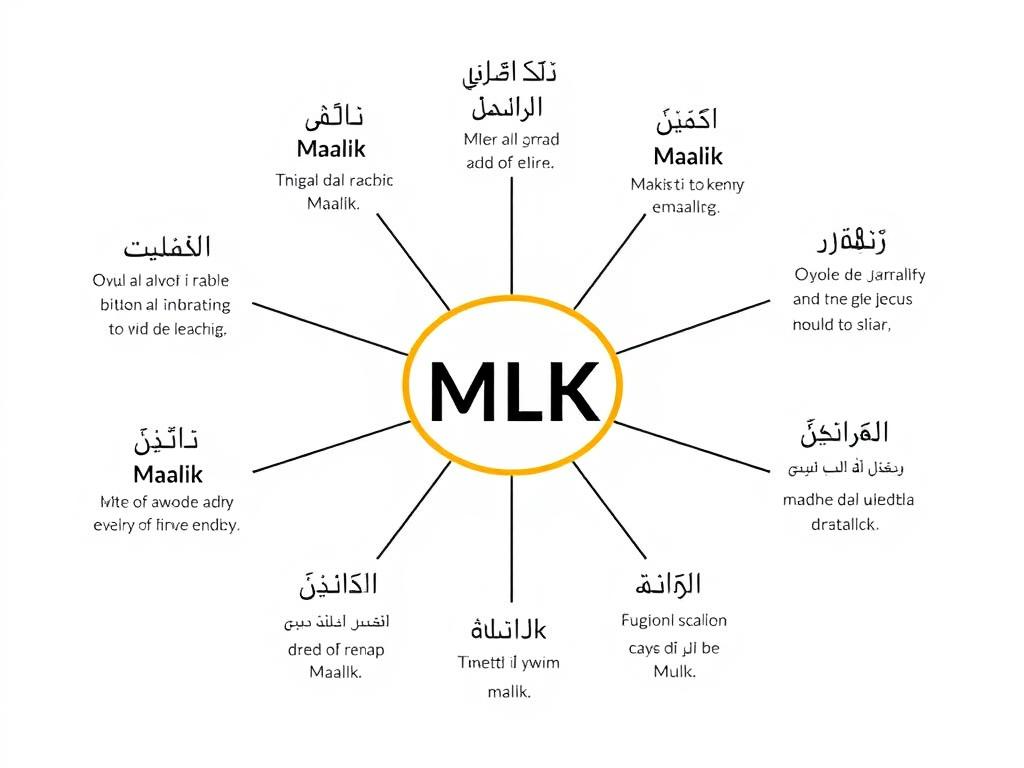
The linguistic roots and derivatives of MAALIK-UL-MULK (مالك الملك)
The meaning of MAALIK-UL-MULK encompasses three essential aspects: absolute ownership, complete authority, and unlimited power. Allah alone possesses perfect sovereignty without any limitations or constraints.
Quranic References and Hadith Sources
The Quran and authentic Hadith provide rich context for understanding Allah’s name, MAALIK-UL-MULK. These sources illuminate the profound implications of Allah’s absolute sovereignty.
Direct References in the Quran
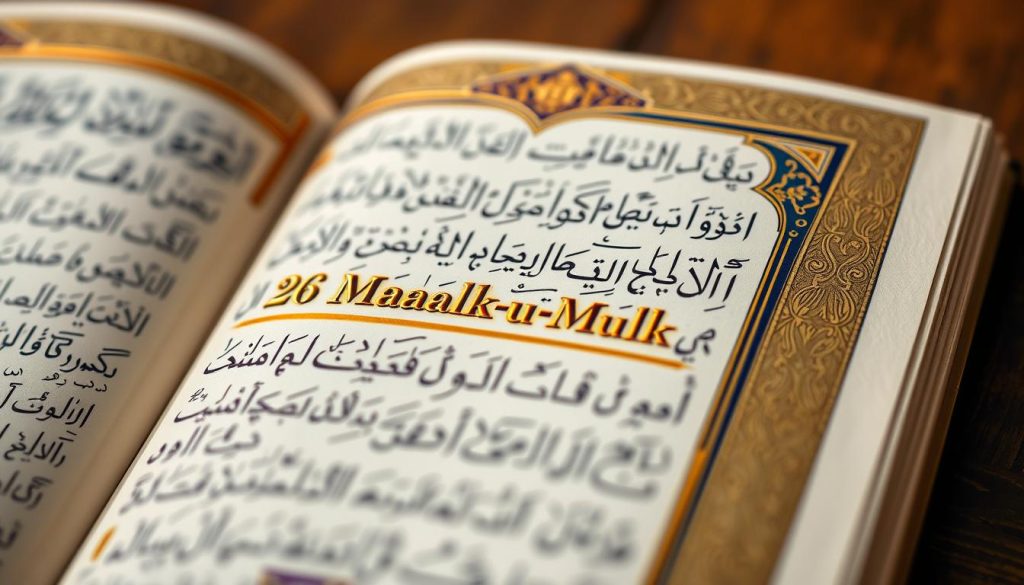
Surah Al-Imran verse 26 containing the direct mention of MAALIK-UL-MULK
قُلِ اللَّهُمَّ مَالِكَ الْمُلْكِ تُؤْتِي الْمُلْكَ مَن تَشَاءُ وَتَنزِعُ الْمُلْكَ مِمَّن تَشَاءُ وَتُعِزُّ مَن تَشَاءُ وَتُذِلُّ مَن تَشَاءُ ۖ بِيَدِكَ الْخَيْرُ ۖ إِنَّكَ عَلَىٰ كُلِّ شَيْءٍ قَدِيرٌ
“Say, ‘O Allah, Owner of Sovereignty (MAALIK-UL-MULK), You give sovereignty to whom You will and take sovereignty away from whom You will. You honour whom You will, and You humble whom You will. In your hands is all good. Indeed, you are over all things competent.'” (Quran 3:26)
This powerful verse directly addresses Allah as MAALIK-UL-MULK and elaborates on the implications of His absolute sovereignty. It emphasises that Allah alone grants and removes authority, elevates and humbles whom He wills, and holds all good in His hands.
Related Quranic Verses
وَلِلَّهِ مُلْكُ السَّمَاوَاتِ وَالْأَرْضِ ۖ وَإِلَى اللَّهِ الْمَصِيرُ
“And to Allah belongs the dominion of the heavens and the earth, and to Allah is the destination.” (Quran 24:42)
لِّمَنِ الْمُلْكُ الْيَوْمَ ۖ لِلَّهِ الْوَاحِدِ الْقَهَّارِ
“To whom belongs [all] sovereignty this Day? To Allah, the One, the Prevailing.” (Quran 40:16)
Insights from Hadith
The Prophet Muhammad ﷺ further illuminated the meaning of Allah’s sovereignty in several authentic narrations:
Abu Huraira reported that Allah’s Messenger ﷺ said: “The most wretched person in the sight of Allah on the Day of Resurrection and the worst person and target of His wrath would be the person who is called Malik al-Amlak (the King of Kings) for there is no king but Allah.”
Sahih Muslim 2143b
This hadith emphasises that claiming supreme sovereignty is a grave transgression, as absolute kingship belongs exclusively to Allah. It highlights the importance of recognizing our limited authority as humans compared to Allah’s perfect sovereignty.
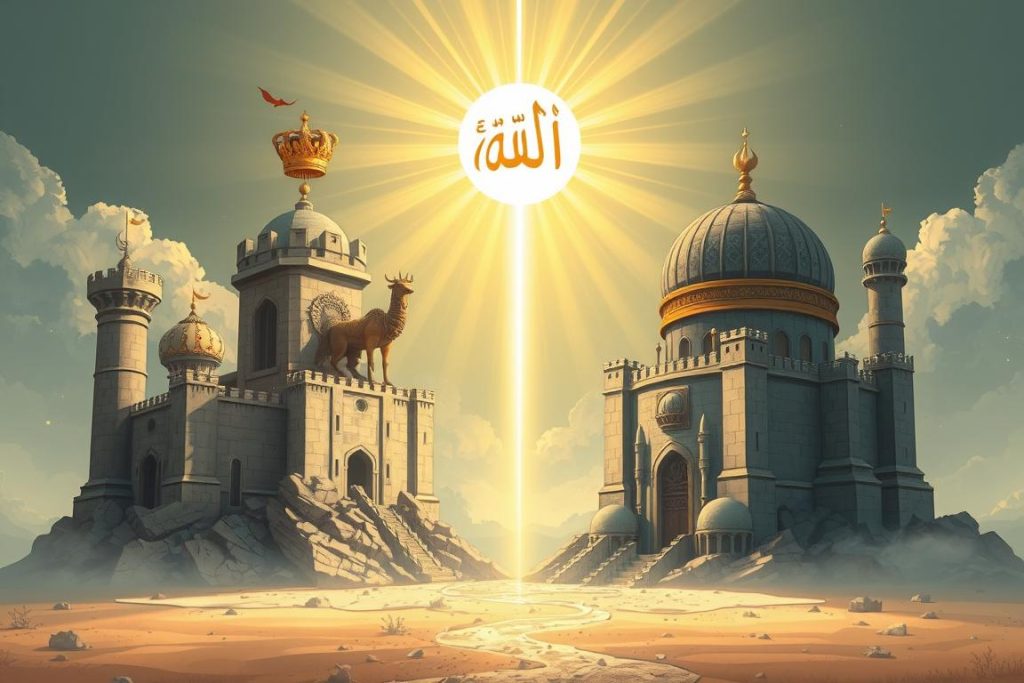
The contrast between temporary worldly kingdoms and Allah’s eternal sovereignty
Theological Implications of Allah's Absolute Sovereignty
Understanding Allah as MAALIK-UL-MULK has profound theological implications that shape the Islamic worldview and a believer’s relationship with their Creator.
Perfect Authority
As MAALIK-UL-MULK, Allah possesses perfect and complete authority over all creation. Nothing occurs without His permission, and His command is executed without resistance. Unlike human rulers who face limitations, Allah’s rule is absolute and extends over every aspect of existence.
Ultimate Ownership
This name affirms that Allah is the valid owner of everything in existence. All possessions, wealth, power, and authority that humans temporarily hold are merely entrusted to them by Allah. Understanding this truth fosters detachment from material possessions and cultivates gratitude.
Divine Justice
As the Master of Sovereignty, Allah administers perfect justice. He grants authority to whom He wills and removes it according to His wisdom. This understanding helps believers accept the rise and fall of worldly powers as part of Allah’s divine plan.
Allah’s sovereignty encompasses all creation – the heavens, the earth, and everything between
The Concept of Tawheed al-Mulk (Oneness in Sovereignty)
MAALIK-UL-MULK is directly connected to an essential aspect of Islamic monotheism known as “Tawheed al-Mulk” or “Oneness in Sovereignty.” This concept teaches that:
- Allah alone possesses true sovereignty and kingship
- All worldly authority is temporary and derived from Allah’s permission
- No creature shares in Allah’s perfect sovereignty
- All creation is subject to Allah’s authority and command
Deepen Your Understanding of Divine Sovereignty
Explore our comprehensive guide on Tawheed al-Mulk and its implications for believers. Learn how recognizing Allah’s sovereignty transforms your spiritual perspective.
Practical Lessons for Believers
Understanding Allah as MAALIK-UL-MULK has profound practical implications for believers daily. This knowledge transforms our relationship with worldly power and possessions and our approach to life’s challenges.
Trust in Divine Decree (Qadar)

Trusting in Allah’s decree brings peace and contentment
Recognising Allah as the Master of Sovereignty strengthens our trust in His divine decree (qadar). When we genuinely understand that Allah controls all affairs with perfect wisdom, we can face life’s challenges with greater resilience and peace.
- During hardship: Remember that the One who controls all sovereignty has allowed this trial for a wise purpose
- During prosperity: Acknowledge that all blessings come from Allah’s generosity, not our merit
- During uncertainty: Trust that the Master of all dominion has a perfect plan that will unfold in its time
Reflection Exercise: Think about a recent challenge you faced. How does understanding Allah as MAALIK-UL-MULK change your perspective on this situation? Could you describe three ways this knowledge can transform your response to difficulties?
Humility in Worldly Power
The name MAALIK-UL-MULK teaches us profound humility regarding any authority or possessions we may temporarily hold. Understanding that all power belongs to Allah prevents arrogance and promotes responsible stewardship.
The Example of Prophet Sulaiman (Solomon)
The Quran highlights Prophet Sulaiman (peace be upon him) as a model of humility despite his immense kingdom. When blessed with extraordinary power, his response was:
“My Lord, enable me to be grateful for Your favour which You have bestowed upon me and my parents and to do righteousness of which You approve. And admit me by Your mercy into [the ranks of] Your righteous servants.” (Quran 27:19)
The Warning of Nimrod
Conversely, the Quran mentions Nimrod as a cautionary example of one who became deluded by his temporary authority and challenged Prophet Ibrahim (Abraham). His arrogance led to his downfall, illustrating the consequences of forgetting the trustworthy source of all sovereignty.
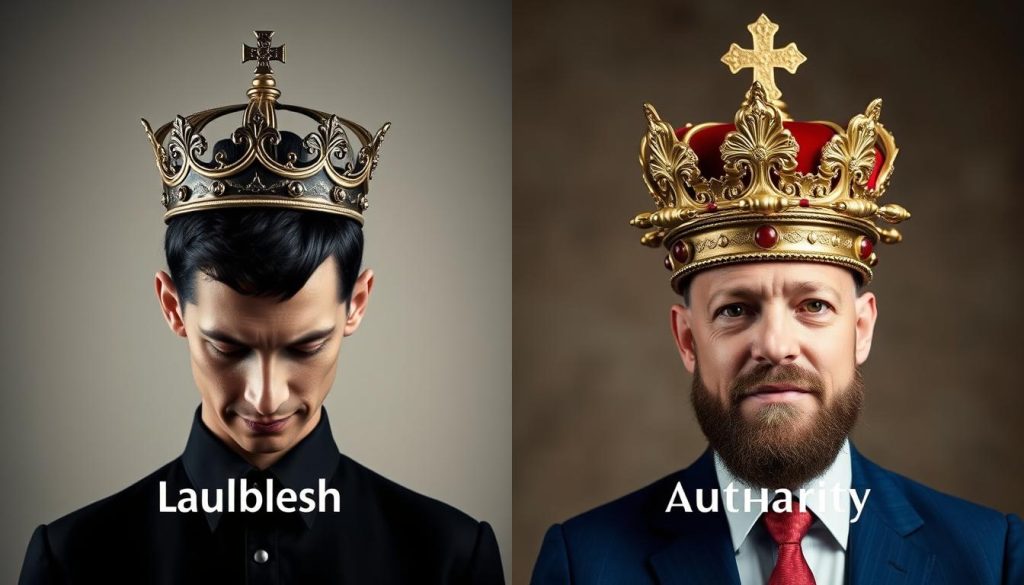
The contrast between humble leadership that acknowledges Allah’s sovereignty and arrogant authority that forgets its temporary nature
Spiritual Reflection Exercises
- Daily Ownership Awareness: When using your possessions, remind yourself: “This belongs to Allah, and He has entrusted it to me temporarily.”
- Authority Reflection: For those in leadership positions, regularly ask: “Am I exercising this authority in a way that pleases the true Master of Sovereignty?”
- Gratitude Practice: Identify three blessings demonstrating Allah’s sovereignty each evening and express gratitude for them.
- Dependency Meditation: Spend 10 minutes contemplating your complete dependency on Allah as the Owner of all dominion.
Transform Your Spiritual Practice
Download our comprehensive reflection journal with 30 days of guided meditations on Allah’s name, MAALIK-UL-MULK. Deepen your connection with this powerful divine attribute.
Supplications Using Allah's Name MAALIK-UL-MULK
Invoking Allah by His beautiful name, MAALIK-UL-MULK, connects us directly to His divine sovereignty and power. You can incorporate the following supplications into your daily worship to strengthen this connection.
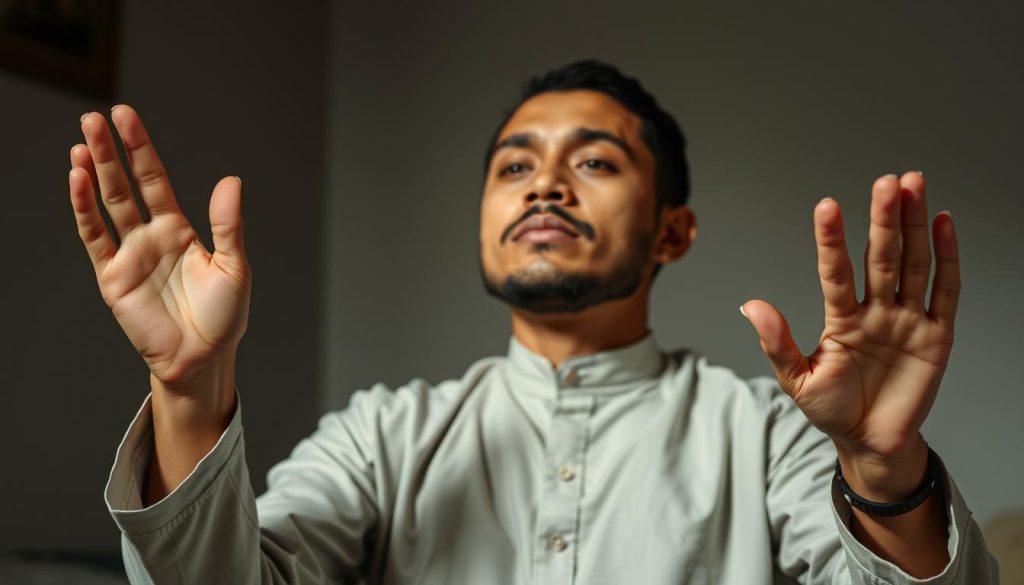
Calling upon Allah by His beautiful names deepens our connection with Him
Quranic Supplications
اللَّهُمَّ مَالِكَ الْمُلْكِ تُؤْتِي الْمُلْكَ مَن تَشَاءُ وَتَنزِعُ الْمُلْكَ مِمَّن تَشَاءُ
“O Allah, Master of Sovereignty, You give sovereignty to whom You will and You take sovereignty away from whom You will.”
Quran 3:26 (partial verse)
This powerful supplication from Surah Al-Imran acknowledges Allah’s absolute authority over all dominion. It is particularly beneficial to recite when seeking Allah’s help in matters related to authority and leadership or when facing those in positions of power.
Daily Supplications
يا مالك الملك، أسألك من فضلك وكرمك، وأعوذ بك من شر نفسي وشر كل ذي شر
“O Master of Sovereignty, I ask You from Your bounty and generosity, and I seek refuge in You from the evil of my soul and the evil of all evil things.”
يا مالك الملك، أنت ربي لا إله إلا أنت، عليك توكلت وأنت رب العرش العظيم
“O Master of Sovereignty, You are my Lord, there is no deity except You. Upon You I rely, and You are the Lord of the Magnificent Throne.”
Supplication for Guidance in Authority
اللهم يا مالك الملك، إني أستودعك ما وليتني من أمر، فأعني عليه، وسددني فيه، واجعلني ممن يقوم بحقه، ويؤدي واجبه
“O Allah, Master of Sovereignty, I entrust the authority You have granted me to You. Help me with it, guide me in it, and make me among those who fulfil its rights and perform its duties.”
This supplication is particularly beneficial for those in positions of leadership or authority, reminding them that their power is a trust from Allah that carries responsibility.

Calligraphy of supplications invoking Allah’s name, MAALIK-UL-MULK
Modern-Day Relevance of MAALIK-UL-MULK
The divine name MAALIK-UL-MULK is profoundly relevant to our contemporary world. It offers guidance on pressing issues, from political authority to wealth management and personal empowerment.
Perspective on Political Authority

Just governance acknowledges the ultimate sovereignty of Allah
In an era of complex political systems and competing claims to authority, understanding Allah as MAALIK-UL-MULK provides a crucial perspective:
- Temporary Stewardship: All political authority is temporary and entrusted by Allah
- Accountability: Leaders are ultimately accountable to Allah, the true Sovereign
- Just Governance: True leadership should reflect divine attributes of justice and mercy
- Balanced Perspective: Neither absolute submission to nor complete rejection of authority, but recognition of its proper place
Ethical Wealth Management
The concept of Allah as the Owner of all dominion transforms our approach to wealth and possessions:
Stewardship Mindset
Understanding that all wealth ultimately belongs to Allah cultivates a stewardship mindset rather than an ownership mentality. This perspective encourages responsible financial management, generosity, and ethical business practices.
Financial Humility
Recognising Allah as MAALIK-UL-MULK prevents the arrogance that often accompanies wealth. It reminds us that our financial status can change according to Allah’s wisdom and plan, encouraging gratitude during prosperity and patience during hardship.

Ethical wealth management recognises that all resources ultimately belong to Allah
Personal Empowerment Through Submission
Paradoxically, recognizing Allah’s absolute sovereignty leads to profound personal empowerment:
- Freedom from Human Approval: When we acknowledge Allah as the proper authority, we are liberated from excessive concern about human judgment
- Resilience Against Oppression: Understanding that all authority is temporary gives strength to stand firm against injustice
- Inner Peace: Trusting in the perfect plan of the Master of Sovereignty brings tranquillity amid life’s uncertainties
- Purposeful Living: Recognising our role as stewards of Allah’s dominion gives meaning and direction to our lives
“True freedom comes not from claiming sovereignty for ourselves, but from recognizing where sovereignty truly belongs—with Allah, MAALIK-UL-MULK, the Master of all dominion.”
Conclusion: Embracing the Wisdom of MAALIK-UL-MULK
As we conclude our exploration of Allah’s magnificent name MAALIK-UL-MULK (مالك الملك), we are reminded of the profound wisdom contained within this divine attribute. Understanding Allah as the Master of Sovereignty transforms our perspective on power, possessions, and our place in the universe.
This name teaches us that all authority is temporary, all ownership is entrusted, and allrecognise power ultimately returns to its source. By embracing this truth, we cultivate humility in prosperity, patience in adversity, and trust in Allah’s perfect plan. We learn to navigate the complexities of modern life with the clarity that comes from recognizing where true sovereignty lies.
May Allah, MAALIK-UL-MULK, grant us the wisdom to recognize His sovereignty in all affairs, the humility to serve as worthy stewards of what He has entrusted to us, and the faith to find peace in submission to His divine will.

The majesty of creation reflects the sovereignty of its Creator, MAALIK-UL-MULK.
Continue Your Journey Through Allah's Beautiful Names
Subscribe to our newsletter to receive weekly reflections on Allah’s 99 Beautiful Names. Deepen your understanding and strengthen your connection with your Creator.


