


In Islamic tradition, Allah is known by 99 beautiful names or attributes that reveal His divine nature and character. Each name offers a unique glimpse into the vastness of divine mercy, wisdom, and power. Among these profound attributes is Al-Mujeeb – The Responder – a name that brings immense comfort to believers and establishes a direct connection between the Creator and His creation. This name carries special significance for those seeking answers to their prayers and reminds us that we are never alone in our moments of need.
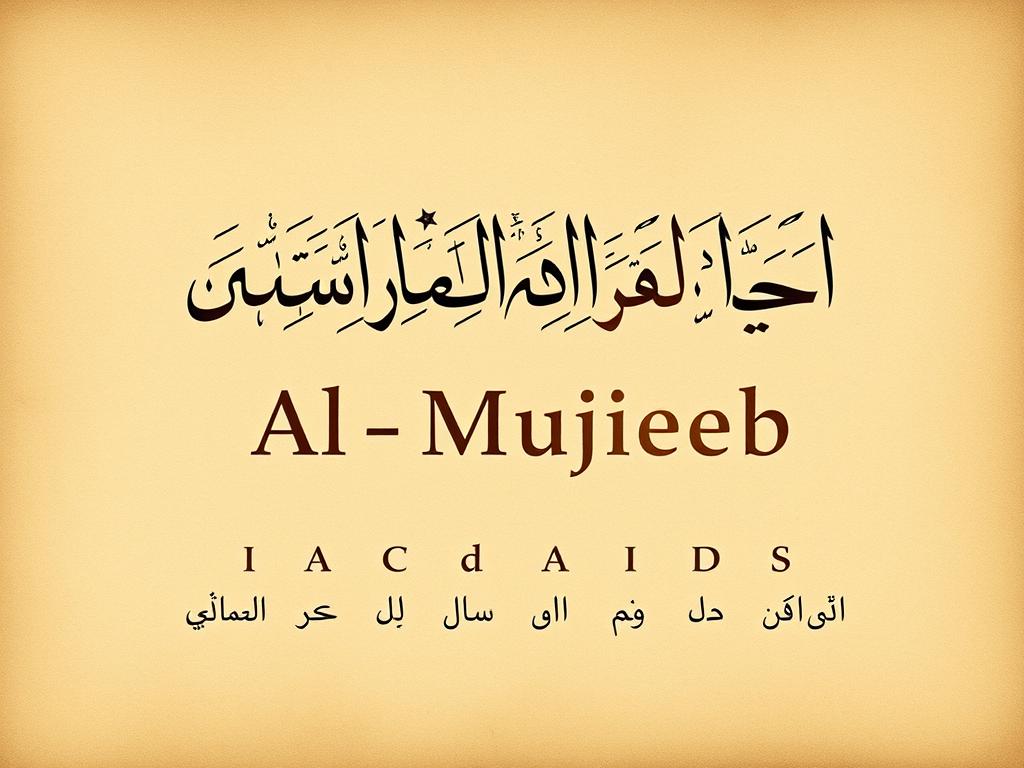
The beautiful Arabic calligraphy of Al-Mujeeb – The Responder
The Meaning of Al-Mujeeb
Al-Mujeeb derives from the Arabic root verb “ajaaba yujeebu” (أجاب يجيب), which means to respond or to answer. Linguistically, it refers to one who responds to a call or request promptly and appropriately. As one of Allah’s divine attributes, Al-Mujeeb signifies that Allah is the Responder who answers the prayers and supplications of those who call upon Him.
Linguistic Breakdown
The name Al-Mujeeb consists of the definite article “Al” (The) and “Mujeeb” (Responder). The trilateral root of this word is “j-w-b” (ج-و-ب), which conveys the meaning of answering, responding, or replying. This root appears in various forms throughout the Quran, emphasising the responsive nature of Allah to His creation’s needs and prayers.
“And when My servants ask you about Me—indeed, I am near; I respond to the call of the caller when he calls upon Me.” [Surah Al-Baqarah 2:186]
Theological Significance
In Islamic theology, Al-Mujeeb represents Allah’s attentiveness to His creation. Unlike human responses, which may be delayed, conditional, or incomplete, Allah’s response is perfect in timing, manner, and wisdom. This name assures believers that their prayers are heard and answered, even when the response may not be immediately apparent or in the form expected.
According to Islamic scholars like Al-Ghazali, Al-Mujeeb means “the One who responds to the requests of those who ask by assisting them, to the call of those who call upon Him by answering them, and responds to the plight of the poor with all they need.” This comprehensive response encompasses all forms of human need and supplication.

Quranic References to Al-Mujeeb
The Quran contains numerous references to Allah’s responsive nature, though the specific name Al-Mujeeb appears directly in Surah Hud (11:61) where Allah describes Himself as “Indeed, my Lord is near and responsive” (Qareeb Mujeeb). Other verses elaborate on this divine attribute:
These verses collectively establish that Allah’s responsiveness is a fundamental aspect of His relationship with creation, particularly with those who turn to Him in sincere supplication.
Benefits of Understanding Al-Mujeeb

Strengthening Faith Through Trust
Understanding Allah as Al-Mujeeb cultivates a profound trust in divine responsiveness. When believers recognize that their Creator is attentive to their needs and prayers, they develop a deeper reliance on Allah rather than worldly means alone. This trust becomes especially important during challenging times when human solutions seem inadequate.
The Prophet Muhammad (peace be upon him) emphasized this trust when he said: “Verily your Lord is Generous and Shy. If His servant raises his hands to Him (in supplication), He becomes shy to return them empty.” (Ahmad, Abu Dawud, Tirmidhi)
Reflect on Your Connection
Take a moment to consider how understanding Allah as The Responder might transform your approach to prayer and supplication. How might this knowledge strengthen your spiritual connection?
Psychological Comfort in Hardships
Believing in Al-Mujeeb provides immense psychological comfort during times of distress. The knowledge that one is never truly alone—that the Creator of the universe is listening and responding—can alleviate feelings of isolation, helplessness, and anxiety. This comfort is not merely theoretical but has practical implications for mental well-being.

The Quran illustrates this comfort through various stories of prophets who called upon Allah in their moments of greatest need. For example, Prophet Ayyub (Job) called upon Allah during his prolonged illness, saying: “Indeed, adversity has touched me, and you are the Most Merciful of the merciful.” Allah responded by removing his affliction and restoring his health and family (Quran 21:83-84).
Spiritual Discipline in Dua (Supplication)
Recognising Allah as Al-Mujeeb encourages believers to develop discipline and etiquette in their supplications. Understanding that Allah responds to prayers motivates believers to approach supplication with sincerity, focus, and proper manners. This includes:
Elements of Effective Supplication
Barriers to Acceptance

Community and Empathy
Understanding Al-Mujeeb encourages believers to emulate this divine attribute by being responsive to the needs of others. Just as Allah responds to His creation, believers are inspired to respond to the needs of those around them with compassion, attentiveness, and generosity.
The Prophet Muhammad (peace be upon him) said: “The most beloved people to Allah are those who are most beneficial to people.” This reflects how understanding Allah’s names should transform our character and interactions with others.
“Whoever relieves a believer of a hardship in this world, Allah will relieve him of a hardship on the Day of Resurrection.” (Sahih Muslim)
By responding to others’ needs, believers not only fulfil their social responsibilities but also draw closer to embodying the divine attribute of responsiveness in their limited human capacity.
Practical Applications: Invoking Al-Mujeeb in Daily Life

Understanding Al-Mujeeb intellectually is only the beginning. The true benefit comes from practically applying this knowledge in daily life. Here are meaningful ways to invoke and connect with Allah as The Responder:
During Times of Hardship
Difficult times provide special opportunities to experience Allah’s responsiveness. The Prophet Muhammad (peace be upon him) taught specific supplications for various hardships:
“There is no deity except You; exalted are You. Indeed, I have been of the wrongdoers.” [Dua of Prophet Yunus (Jonah)]
This supplication was made by Prophet Yunus when he was in the belly of the whale, and Allah responded by delivering him from his distress.
When facing challenges, remember the stories of prophets like Ayyub, Yunus, and Zakariya mentioned in the Quran, who called upon Allah in their moments of greatest need and received divine response.

Establishing Regular Times for Dua
Certain times have special significance for supplication, when Allah’s response is particularly near:
Establishing a habit of making dua during these special times increases the likelihood of experiencing Allah’s responsiveness tangibly.
Maintaining Proper Etiquette

To fully benefit from Allah’s attribute as Al-Mujeeb, observe these etiquettes of supplication:
Before Supplication
During Supplication
Understanding the Forms of Response
Allah’s response as Al-Mujeeb may come in various forms, not always as we expect. According to a hadith narrated by Aisha (may Allah be pleased with her), when a believer makes dua, one of three things happens:
Immediate Fulfillment
Allah grants exactly what was requested in this life.

Deferred Reward
Allah stores the reward for the Hereafter, giving something greater.

Averting Harm
Allah averts an equivalent harm or evil from the person.

Understanding these forms of response helps believers maintain patience and trust even when the answer to their prayers isn’t immediately apparent or doesn’t come in the expected form.
Apply This Knowledge Today
Begin incorporating the understanding of Al-Mujeeb into your daily spiritual practice. Set aside time for meaningful supplication and approach Allah with confidence in His response.
Stories of Divine Response in Islamic Tradition
The Quran and hadith literature contain numerous examples of Allah responding as Al-Mujeeb to those who called upon Him sincerely. These stories provide powerful illustrations of this divine attribute in action:

Prophet Ayyub (Job)
Prophet Ayyub was afflicted with severe illness for many years, losing his health, wealth, and children. Despite these immense trials, he remained patient and turned to Allah in supplication, saying: “Indeed, adversity has touched me, and you are the Most Merciful of the merciful.” Allah responded by restoring his health, returning his family, and granting him even more than what he had lost before.
“So We responded to him and removed what afflicted him of adversity. And We gave him [back] his family and the like thereof with them as mercy from Us and a reminder for the worshippers [of Allah].” [Quran 21:84]
Prophet Yunus (Jonah)
When Prophet Yunus left his people in anger and was subsequently swallowed by a whale, he found himself in complete darkness—the darkness of the night, the sea, and the whale’s belly. In this moment of utter despair, he called upon Allah saying: “There is no deity except You; exalted are You. Indeed, I have been of the wrongdoers.”

Allah responded immediately: “So We responded to him and saved him from the distress. And thus do We save the believers.” [Quran 21:88] This powerful story reminds us that even in our darkest moments, Allah hears and responds to sincere supplication.
Prophet Zakariya (Zechariah)
Prophet Zakariya was elderly, and his wife was barren. Yearning for a child to continue his prophetic legacy, he turned to Allah in private supplication: “My Lord, do not leave me alone [with no heir], while you are the Best of Inheritors.” [Quran 21:89]
Despite the apparent biological impossibility, Allah responded by blessing him with a son, Yahya (John), demonstrating that nothing is beyond Allah’s power when He responds as Al-Mujeeb.

These stories collectively illustrate that Allah’s response as Al-Mujeeb transcends natural limitations, comes at the perfect time, and often exceeds what was requested. They provide powerful examples for believers to follow in their own supplications.
Common Misconceptions About Divine Response

Despite the clear teachings about Allah as Al-Mujeeb, several misconceptions can hinder believers from fully experiencing this divine attribute:
Misconception: "My Prayers Are Not Being Answered"
Many people become discouraged when they don’t see immediate or expected responses to their prayers. However, as mentioned earlier, Allah’s response may come in different forms—immediate fulfilment, deferred reward, or averting harm. The Prophet Muhammad (peace be upon him) cautioned against hasty conclusions:
“The supplication of any worshipper will continue to be responded to, as long as he does not ask for a sin or breaking the ties of kinship, and as long as he is not hasty.” When asked what hastiness meant, he replied, “A worshipper says, ‘I have prayed and prayed, and I don’t see that it will be accepted,’ so he gives up hope of being answered and leaves supplication.” (Muslim)
Misconception: "I Am Too Sinful for Allah to Respond"
Some believers feel that their sins disqualify them from divine response. While sins can indeed be barriers to acceptance, the door to supplication is never completely closed. The story of Prophet Yunus demonstrates that acknowledging one’s wrongdoing can actually be a powerful component of an accepted prayer.

Allah’s mercy as Al-Mujeeb extends even to those who have sinned, provided they turn to Him with sincerity and repentance.
Misconception: "Allah Only Responds to Major Needs"
Some believe that Allah only responds to prayers about significant matters and that it’s inappropriate to ask for small or mundane things. However, Islamic teachings emphasise that nothing is too small to bring before Allah.
“Ask Allah for everything, even if it is only a shoelace, because if Allah does not make it easy, it will not be easy.” (Tirmidhi)
As Al-Mujeeb, Allah is attentive to all needs of His creation, regardless of how insignificant they might seem from a human perspective.
Conclusion: Embracing Al-Mujeeb in Your Spiritual Journey

Understanding Allah as Al-Mujeeb transforms our approach to prayer and life’s challenges. This divine name reassures us that we are never alone in our struggles—that the Creator of the universe is attentive to our needs and responsive to our calls. It reminds us that supplication is not merely a ritual but a profound connection with the Divine.
By embracing Al-Mujeeb, we develop greater trust in Allah’s wisdom and timing. We learn to see beyond immediate circumstances to the greater divine plan. We become more patient in awaiting responses and more grateful when they arrive—whether in the form we expected or in ways that ultimately prove better for us.
Moreover, understanding this divine attribute inspires us to embody responsiveness in our own lives—to be attentive to the needs of others and quick to offer assistance when called upon. In this way, knowledge of Al-Mujeeb not only strengthens our vertical relationship with Allah but also enhances our horizontal relationships with fellow creation.
Deepen Your Connection
Begin incorporating the understanding of Al-Mujeeb into your daily spiritual practice. Remember that Allah is near and responsive to your sincere supplications.
As we navigate life’s joys and challenges, may we always remember the comforting truth expressed in the Quranic verse: “And when My servants ask you about Me—indeed, I am near; I respond to the call of the caller when he calls upon Me.” [Surah Al-Baqarah 2:186]
In this divine promise lies the essence of Al-Mujeeb—an open invitation to call upon The Responder with certainty, sincerity, and hope.


