
Sabr (صَبْر) is the Arabic word usually translated as patience. In the Qur’an and in the teachings of the Prophet Muhammad ﷺ, it describes steadiness and self-restraint, especially when life is difficult. This article explains what the word means, where it appears in the Qur’an and authentic hadith, and how patience shows up in ordinary days. Every direct quotation links to its source.
What does Sabr mean?
In short, Sabr means patience in the sense of holding steady. The Arabic root ṣ-b-r (ص-ب-ر) carries the idea of holding back or restraining oneself. English translations of the Qur’an, including Saheeh International, usually render ṣabr as “patience” and aṣ-ṣābirīn as “the patient”.
Sabr is not the same as doing nothing. In the verses below, the Qur’an places patience beside prayer, beside righteous deeds and beside advising one another. Read together, they describe an active steadiness rather than simply putting up with things.
Sabr in the Qur’an
The verses below are quoted in the Saheeh International translation. Each reference links to the verse on Quran.com, where you can also read the Arabic text and other translations.
“O you who have believed, seek help through patience and prayer. Indeed, Allāh is with the patient.”
— Qur’an 2:153, Saheeh International
This verse names patience and prayer together as sources of help, and ends with the statement that Allah is with the patient.
“By time, Indeed, mankind is in loss, Except for those who have believed and done righteous deeds and advised each other to truth and advised each other to patience.”
— Qur’an 103:1–3, Saheeh International
Surah Al-ʿAsr is one of the shortest chapters of the Qur’an. Among the qualities of those who are not in loss, it lists advising one another to patience, which presents patience as something shared within a community, not only a private struggle.
“Say, ‘O My servants who have believed, fear your Lord. For those who do good in this world is good, and the earth of Allāh is spacious. Indeed, the patient will be given their reward without account [i.e., limit].’”
— Qur’an 39:10, Saheeh International
The verse states that the patient will be given their reward “without account”, which the translation clarifies in brackets as “without limit”.
Sabr in authentic hadith
“Narrated Anas: The Prophet (ﷺ) said, ‘The real patience is at the first stroke of a calamity.’”
— Sahih al-Bukhari 1302 (English translation as published on sunnah.com)
This narration places real patience at the first moment of hardship, when a reaction is hardest to control.
“Suhaib reported that Allah’s Messenger (ﷺ) said: Strange are the ways of a believer for there is good in every affair of his and this is not the case with anyone else except in the case of a believer for if he has an occasion to feel delight, he thanks (God), thus there is a good for him in it, and if he gets into trouble and shows resignation (and endures it patiently), there is a good for him in it.”
— Sahih Muslim 2999 (English translation as published on sunnah.com)
This hadith brings patience and gratitude together: thanks in times of ease, and patience in times of hardship. It is one reason we present Sabr alongside Shukr (gratitude) in this collection.
How patience appears in everyday life
Editorial reflection. The section below is our own reflection, written to help readers apply the meaning in daily life. It is not a religious ruling. For personal religious guidance, please consult a qualified scholar.
- The first moment. A difficult message, a disappointing result or unexpected news. Pausing before replying is a small, practical form of the steadiness described in the narration above.
- Staying consistent. Keeping up good habits, such as prayer, study or honest work, on days when motivation is low.
- Holding back words. In a disagreement, choosing not to say the thing that would hurt.
- Long waits. Searching for work, supporting a family member through illness, or recovering after a loss. Patience here often looks like continuing to do what is within reach while the outcome is still unknown.
- Patience with people. With children who are learning, with elderly parents, with colleagues who work differently from us.
In our view, patience is not the same as accepting harm. Seeking help, advice or medical care is compatible with patience. If you are unsure how this applies to your own situation, please speak to a qualified scholar or a trusted professional.
Sabr, Shukr and Tawakkul together
Sabr is one of three words in our Power Words of Faith collection. Shukr means gratitude, and Tawakkul means trusting Allah while taking the steps that are within your control. Each has its own article explaining its meaning and sources.
Keeping Sabr in view at home
Some people choose to display the word Sabr as Arabic calligraphy, as a visual reminder to pause and return to its meaning. A piece of wall art is a reminder only. It does not provide protection, blessings or guaranteed results; its value lies in prompting reflection.


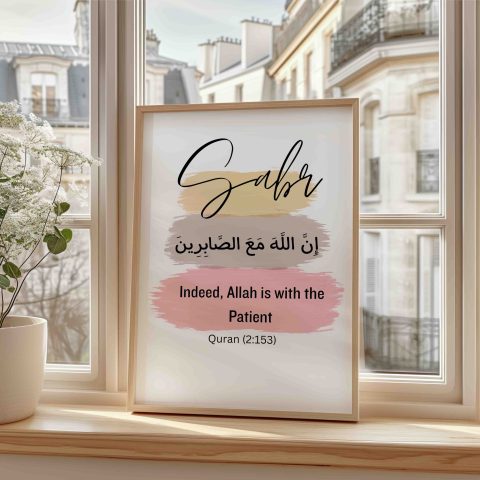
Each design is a digital download priced at £7.95. You can choose a single size or all six sizes (A5 to A0) as printable JPG files. No physical item will be shipped.
Discover the Power Words of Faith collection, which brings together Sabr, Shukr and Tawakkul designs.
Frequently asked questions
What does Sabr mean in Islam?
Sabr is usually translated as patience. It describes steadiness and self-restraint, particularly in difficulty. Its Arabic root, ṣ-b-r, carries the idea of holding back or restraining oneself.
Where is Sabr mentioned in the Qur’an?
Patience is mentioned in many verses. Three examples are Qur’an 2:153, 103:1–3 and 39:10, quoted above with links to the full text.
Does Sabr mean accepting everything without acting?
No. The Qur’an places patience beside prayer, righteous deeds and advising one another. Patience describes steadiness while continuing to act, not giving up on effort.
What is the difference between Sabr and Shukr?
Sabr is patience, especially in hardship; Shukr is gratitude, especially for blessings. The hadith in Sahih Muslim 2999, quoted above, mentions both together.
Sources
- Qur’an 2:153, 103:1–3 and 39:10, Saheeh International translation, via Quran.com.
- Sahih al-Bukhari 1302 and Sahih Muslim 2999, English translations as published on sunnah.com.