
Shukr (شُكْر) is the Arabic word usually translated as gratitude or thankfulness. In Islamic teaching it means recognising a favour and responding to it: in the heart, in words and in how the favour is used. This article explains what the word means, where gratitude appears in the Qur’an and authentic hadith, and practical ways to cultivate it. Every direct quotation links to its source.
You may also see the word written as “Shukar” or “Sukr”. In this article we use the common spelling Shukr.
What does Shukr mean?
In short, Shukr means gratitude. The Arabic root sh-k-r (ش-ك-ر) relates to thanking and acknowledging a favour. In the Qur’an, its opposite is often expressed with the root k-f-r, which in this context means denying or being ungrateful for a favour. You can see this contrast in Qur’an 14:7 and 2:152 below, where Saheeh International translates it as “deny”.
A familiar expression of gratitude is the phrase Alhamdulillah, which means “all praise is due to Allah”.
Shukr in the Qur’an
The verses below are quoted in the Saheeh International translation. Each reference links to the verse on Quran.com, where you can also read the Arabic text and other translations.
“And [remember] when your Lord proclaimed, ‘If you are grateful, I will surely increase you [in favor]; but if you deny, indeed, My punishment is severe.’”
— Qur’an 14:7, Saheeh International
This verse contains both a promise and a warning, so we quote it in full. It describes Allah’s relationship with His servants. It is not a promise that owning any object, including artwork, brings increase.
“So remember Me; I will remember you. And be grateful to Me and do not deny Me.”
— Qur’an 2:152, Saheeh International
Here gratitude is joined with remembrance of Allah.
“And if you should count the favors of Allāh, you could not enumerate them. Indeed, Allāh is Forgiving and Merciful.”
— Qur’an 16:18, Saheeh International
This verse states that Allah’s favours cannot be counted. It gives a starting point for gratitude: noticing how much has already been given.
Shukr in authentic hadith
“Narrated Abu Hurayrah: The Prophet (ﷺ) said: He who does not thank the people is not thankful to Allah.”
— Sunan Abi Dawud 4811 (English translation as published on sunnah.com, graded Sahih by Al-Albani)
This narration connects gratitude to Allah with thanking the people around us.
“Suhaib reported that Allah’s Messenger (ﷺ) said: Strange are the ways of a believer for there is good in every affair of his and this is not the case with anyone else except in the case of a believer for if he has an occasion to feel delight, he thanks (God), thus there is a good for him in it, and if he gets into trouble and shows resignation (and endures it patiently), there is a good for him in it.”
— Sahih Muslim 2999 (English translation as published on sunnah.com)
This hadith pairs gratitude in times of ease with patience in times of hardship. Our article on Sabr (patience) looks at the other half of this pairing.
Practical ways to cultivate gratitude
Editorial reflection. The section below is our own reflection, written to help readers apply the meaning in daily life. It is not a religious ruling. For personal religious guidance, please consult a qualified scholar.
- Notice before you ask. Before listing what is missing, name a few things that are already present: health, a meal, a conversation, a quiet moment.
- Say it. Saying Alhamdulillah, or simply “thank you”, turns a passing feeling into a deliberate act.
- Thank people directly. A message to a teacher, a parent or a colleague who helped you. The narration in Sunan Abi Dawud 4811 links thanking people with thanking Allah.
- Use what you have been given well. Gratitude for time, skill or wealth can show in how carefully they are used and shared.
- Write it down. Some people keep a short daily note of things they are grateful for. It is a simple habit, not a religious requirement.
- Avoid constant comparison. Comparing our lives with others’ can hide what we already have.
Shukr, Sabr and Tawakkul together
Shukr is one of three words in our Power Words of Faith collection. Sabr means patience, and Tawakkul means trusting Allah while taking the steps that are within your control. Each has its own article explaining its meaning and sources.
Keeping Shukr in view at home
Some people choose to display the word Shukr as Arabic calligraphy, as a visual reminder to notice and give thanks. A piece of wall art is a reminder only. It does not provide protection, blessings or guaranteed results; its value lies in prompting reflection.

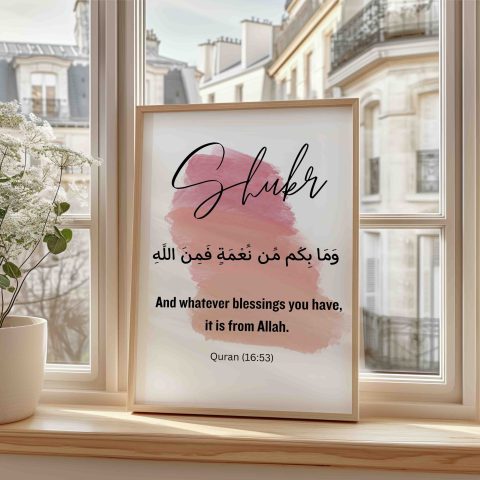


Each design is a digital download priced at £7.95. You can choose a single size or all six sizes (A5 to A0) as printable JPG files. No physical item will be shipped.
Discover the Power Words of Faith collection, which brings together Sabr, Shukr and Tawakkul designs.
Frequently asked questions
What does Shukr mean in Islam?
Shukr is usually translated as gratitude or thankfulness. It means recognising a favour and responding to it in the heart, in words and in how the favour is used.
Where is gratitude mentioned in the Qur’an?
Gratitude is mentioned in many verses. Three examples are Qur’an 14:7, 2:152 and 16:18, quoted above with links to the full text.
Is Shukr the same as Shukar or Sukr?
These are different English spellings of the same Arabic word. Shukr is the most common transliteration.
How is Shukr connected to Sabr?
The hadith in Sahih Muslim 2999, quoted above, describes gratitude in times of ease and patience in times of hardship as two sides of a believer’s response to life.
Sources
- Qur’an 14:7, 2:152 and 16:18, Saheeh International translation, via Quran.com.
- Sunan Abi Dawud 4811 and Sahih Muslim 2999, English translations as published on sunnah.com.