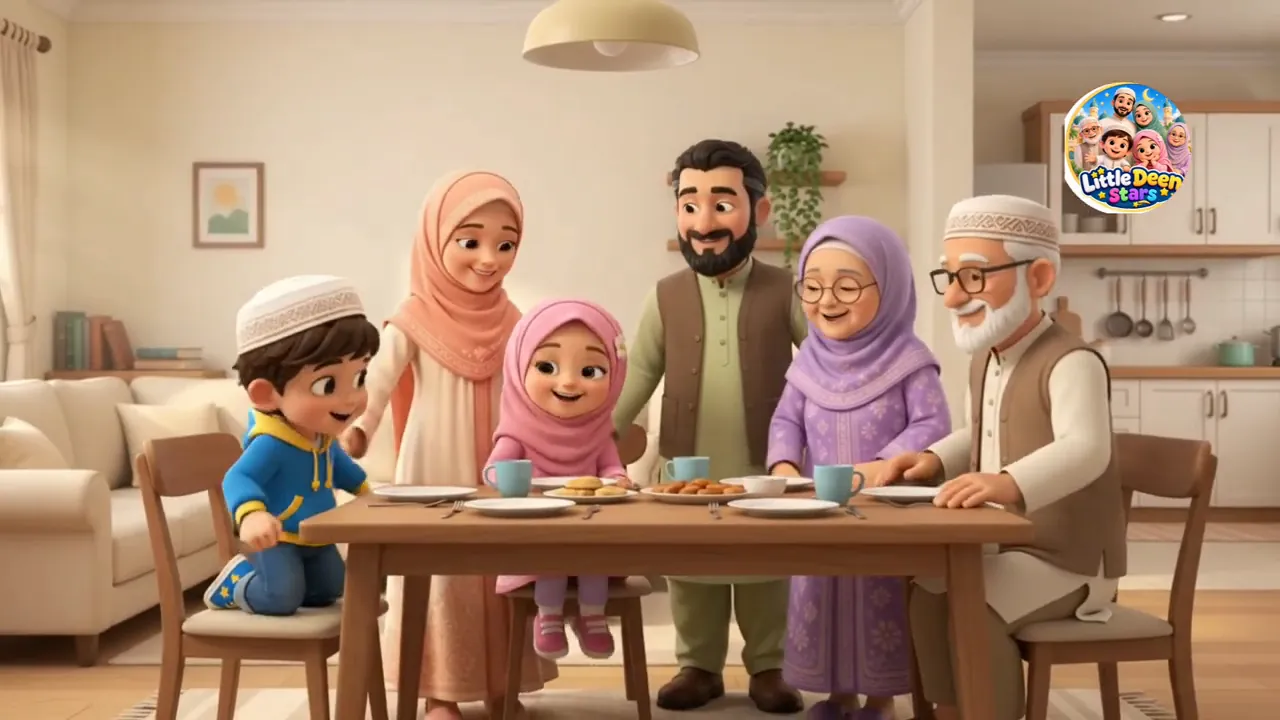
Islamic mealtime manners for young children come down to four habits you can practise together at family meals: say “Bismillah” before eating, eat with the right hand, eat from what is nearest, and say “Alhamdulillah” at the end. Introduce them one at a time, with short, warm reminders.

The hadith taught to a child at the table
ʿUmar bin Abi Salama grew up in the household of the Prophet Muhammad (peace and blessings be upon him). He remembered how, as a boy, his hand used to go all around the shared dish, and how the Prophet taught him:
“O boy! Mention the Name of Allah and eat with your right hand, and eat of the dish what is nearer to you.”
— Sahih al-Bukhari 5376 (narrated by ʿUmar bin Abi Salama, who was a boy in the Prophet’s care)
ʿUmar said that he followed those instructions from then on. The teaching was brief and given in the moment, which offers a helpful model for parents. It contains the first three of the Islamic mealtime manners below. The fourth comes from a separate hadith.
1. Begin with “Bismillah”
Before the first bite, say “Bismillah” together. (Our guide on how to teach your toddler to say Bismillah has more ideas.) If it is forgotten at the start of the meal, there is a teaching for that too:
“When one of you eats, he should mention Allah’s name; if he forgets to mention Allah’s name at the beginning, he should say: ‘In the name of Allah at the beginning and at the end of it.’”
— Sunan Abi Dawud 3767 (narrated by ʿAishah; graded sahih by al-Albani, as shown on Sunnah.com)
2. Eat with the right hand
For toddlers who are still learning to hold a spoon, this takes time. Some practical ideas:
- Lay the spoon or fork on the right-hand side of the plate.
- Hand finger foods to your child’s right hand.
- Use a playful reminder, such as “Which hand is our eating hand?”, rather than a correction.
- If your child finds using the right hand difficult, for example because of a physical difficulty, keep reminders gentle and ask a qualified scholar about your child’s situation.

3. Eat from what is nearest
This is about calm, considerate eating: not reaching across others or picking through a shared dish. For young children:
- Serve a small portion on their own plate, within easy reach.
- If food is shared, place their part of the dish directly in front of them.
- Show them how to ask: “Please may I have some rice?”
4. Finish with “Alhamdulillah”
“Allah is pleased with His servant who says: Al-Hamdu lillah while taking a morsel of food and while drinking.”
— Sahih Muslim 2734a (reported by Anas b. Malik)
When the meal is over, say “Alhamdulillah” together. (Our guide to teaching children to say Alhamdulillah has more ideas.) You can add a specific blessing: “Alhamdulillah for this soup.”

Making Islamic mealtime manners work in a busy home
- One habit at a time. Start with Bismillah, and add the next habit when the first feels settled.
- Eat together when you can. Children learn a great deal by watching the people they eat with.
- Keep reminders short and warm. A smile and a whisper tend to work better than a lecture.
- Expect mess. Spills are part of learning to eat, not bad manners.
Family activity: Teddy’s Tea Party
About 2 minutes
- Set out a toy tea party with plates for your child, you and a teddy.
- Before “eating”, everyone says “Bismillah!”
- Show teddy how to hold the cup in the right hand.
- Pass the plates so everyone eats from what is in front of them.
- Finish with “Alhamdulillah!” and a tidy-up together.
Songs can help too: in the Bismillah Song and the Alhamdulillah Song, Hashim and Ayesha practise the first and last of these Islamic mealtime manners with their family. All our songs are in the Little Deen Stars children’s library. For wider Islamic manners, see our article on Islamic etiquette.
Share an idea
What would you like Hashim and Ayesha to learn next? Parents and carers can tell us using the Little Deen Stars suggestion form.
Sources
- Sahih al-Bukhari 5376, via Sunnah.com.
- Sunan Abi Dawud 3767, via Sunnah.com (grading shown: sahih, al-Albani).
- Sahih Muslim 2734a, via Sunnah.com.
The steps and games in this guide are suggestions for families, not religious rulings.