
Gratitude is easy to feel on a special day: a wedding, a new baby, good news after a long wait. It is harder to remember on an ordinary Wednesday, between the school run, the inbox and the washing-up. This guide is about bringing Shukr, gratitude, into those ordinary routines. For what the word means, its Arabic root and the main Qur’an verses on gratitude, see our explanation of the meaning of Shukr.
In short, a daily Shukr practice means regularly noticing what you have been given, acknowledging it in words, and using it well. It can take a few seconds at a time and fit around the day you already have.
How to read this article. Qur’an verses and hadith are quoted word for word and linked to their sources. The routines and examples are our own editorial suggestions, not religious rulings or required practices.
Start by noticing everyday blessings
Daily Shukr begins with attention. Many of the things we rely on most, such as water from a tap, a working body, a quiet hour or a phone call from family, become invisible because they are always there.
A simple way to start your daily Shukr is to choose three moments in the day that already happen and use them as prompts:
- Waking up. Before reaching for the phone, notice one thing you are glad of today.
- Mealtimes. Pause briefly before and after eating.
- The end of the day. Look back and name something that went well, however small.
Mealtimes in particular are a natural point for daily Shukr. The Prophet Muhammad ﷺ said:
“Allah is pleased with His servant who says: Al-Hamdu lillah while taking a morsel of food and while drinking.”
— Sahih Muslim 2734a (reported by Anas b. Malik; Sunnah.com does not display a separate grading for this collection)
Al-hamdu lillah means “all praise is for Allah”. It is a short phrase that fits easily into a busy day.
Gratitude in words and in responsible action
Saying thank you matters, but gratitude is also shown in how we treat what we have been given. The Qur’an records the wise man Luqmān being told to be grateful, and makes clear who benefits from gratitude:
“And We had certainly given Luqmān wisdom [and said], “Be grateful to Allāh.” And whoever is grateful is grateful for [the benefit of] himself. And whoever denies [His favor] – then indeed, Allāh is Free of need and Praiseworthy.”
— Qur’an 31:12, Saheeh International
Editorial reflection. In everyday terms, daily Shukr in action can look like looking after your health rather than taking it for granted, using money and food without waste, being careful with other people’s time, and using skills to help others. These are practical examples, not a complete or authoritative definition.

Shukr Islamic Wall Art – Abstract Gratitude Design
Flowing Shukr script with the Arabic and an English rendering of part of Qur’an 16:53, set against warm yellow, orange and pink circles.
£7.95
Digital download — frame not included
Keep a short gratitude reflection
Writing things down can make daily Shukr more concrete. This does not need a special journal or a long entry. A few lines on your phone or in a notebook are enough. One simple format:
- One blessing I noticed today: something specific, not general.
- One person I am grateful for: and, if possible, why.
- One way I could use what I have been given well tomorrow.
Keep your daily Shukr note short enough that you will actually do it. Two minutes most evenings is more useful than an elaborate routine that lasts a week. Looking back through old entries during a difficult time can also be a gentle reminder of how much has been given.
Show appreciation to family and other people
Gratitude to Allah and gratitude to people are closely linked in the teachings of the Prophet ﷺ:
“Whoever is not grateful to the people, he is not grateful to Allah.”
— Jami` at-Tirmidhi 1954 (narrated by Abu Hurairah; graded Sahih by Darussalam on Sunnah.com)
Some practical ways to bring daily Shukr into how you treat others:
- Thank people specifically. “Thank you for cooking tonight, it made my evening easier” means more than a general thanks.
- Notice the invisible work. Cleaning, driving, organising and listening often go unthanked.
- Say it to children as well as adults. Thanking children teaches gratitude by example.
- Remember people outside your home. Teachers, carers, colleagues and neighbours are often glad to hear that their effort was noticed.
Build daily Shukr into ordinary routines
Gratitude does not need to wait for major events. The Prophet ﷺ taught his companion Mu’adh b. Jabal a short supplication to say after prayer:
“O Allah, help me in remembering You, in giving You thanks, and worshipping You well.”
— Sunan Abi Dawud 1522 (reported by Mu’adh b. Jabal; graded Sahih by Al-Albani on Sunnah.com)
Other ordinary moments can also become prompts for Shukr: arriving home safely, finishing a piece of work, a clear day after a week of rain, or simply having enough. The aim is not to add pressure or another task to the day, but to notice what is already there.
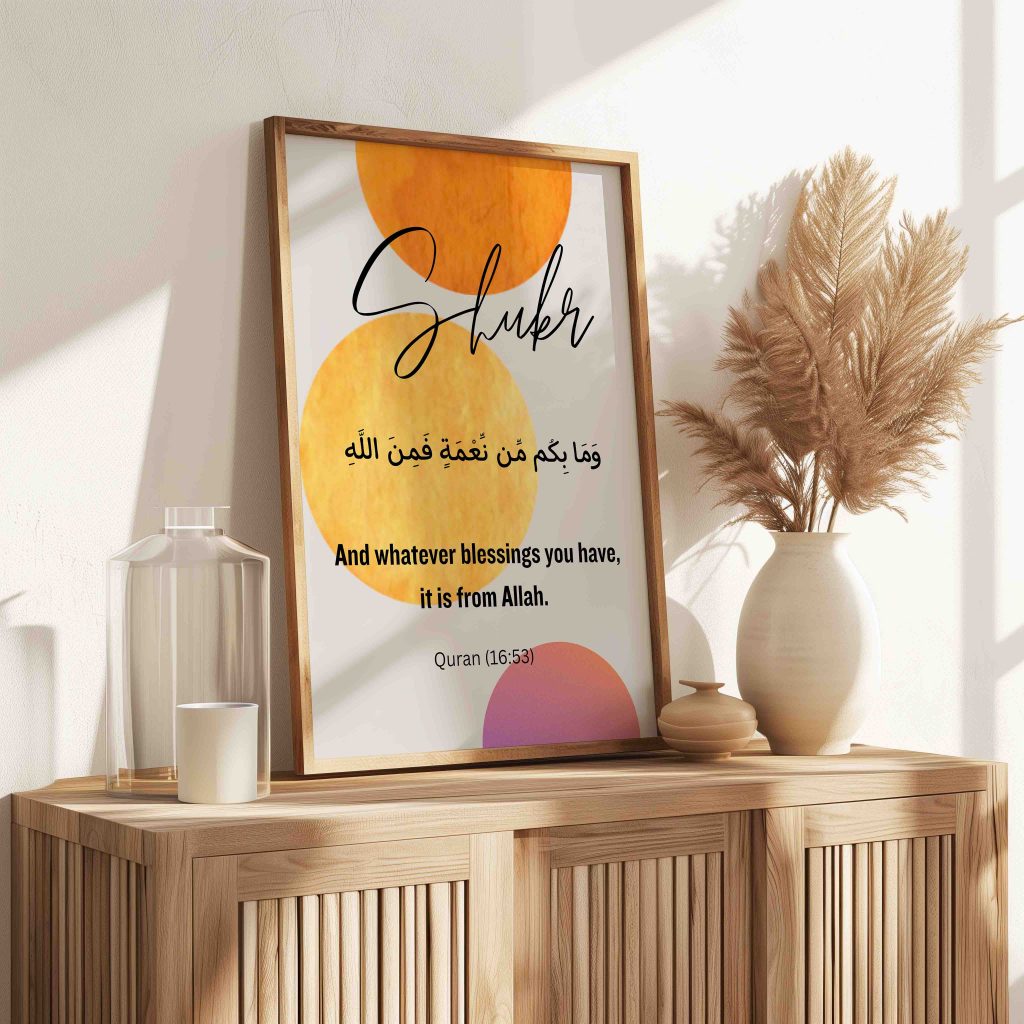
A reminder on the wall can play a small part in this. Seeing the word each day may prompt a moment of reflection, but it is only a reminder: it does not create gratitude, blessings or any particular result on its own.
Frequently asked questions
What is a simple daily Shukr routine?
A simple routine might be three short pauses: noticing one blessing on waking, saying al-hamdu lillah at meals, and writing down one thing you are grateful for before sleep. The aim is consistency rather than length.
How long should a daily Shukr reflection take?
Two or three minutes is enough for most people. A short note that you keep up over weeks is more useful than a long entry that you abandon after a few days.
Can I make du’a of thanks in my own words?
Personal du’a can be made in your own words. You can also use the supplication from Sunan Abi Dawud 1522 quoted above, which asks Allah for help in remembering Him and giving Him thanks. For specific questions about acts of worship, please consult a qualified scholar.
How can families practise daily Shukr together?
Families sometimes share one thing they are grateful for at the evening meal, or thank each other specifically for help during the day. Children tend to learn gratitude by hearing it said and seeing it shown.
How Shukr connects with Sabr and Tawakkul
Gratitude and patience are often discussed together, because both shape how we respond to what life brings. Trust in Allah helps us act with calm after we have done our part. If you would like to continue in the same practical way, read how to practise Sabr in everyday life and our guide to Tawakkul and taking action.

If you would like a visual reminder for your daily Shukr at home, you can see this Shukr artwork or explore the Power Words of Faith collection.
Sources
- Qur’an 31:12, Saheeh International translation, via Quran.com.
- Sahih Muslim 2734a, via Sunnah.com.
- Jami` at-Tirmidhi 1954 (Sahih, Darussalam), via Sunnah.com.
- Sunan Abi Dawud 1522 (Sahih, Al-Albani), via Sunnah.com.
- For the meaning of Shukr and further Qur’an verses, see Shukr meaning: gratitude in Islam.