
Most of us know that Sabr means patience. The harder question is what patience looks like on an ordinary Tuesday: when a reply does not come, when a conversation turns sharp, or when a difficult season at work or at home simply goes on. This guide looks at how to practise Sabr from that practical angle. For the fuller definition, the Arabic root and the key Qur’an verses, see our explanation of what Sabr means.
In short, practising Sabr means holding steady in what you say and do while something is difficult or unresolved, and continuing to do what is right in the meantime. It is an active steadiness, not silence or giving up.
How to read this article. Qur’an verses and hadith are quoted word for word and linked to their sources. Everything else, including the everyday examples and suggested habits, is our own editorial reflection and practical suggestion, not a religious ruling. For personal questions of Islamic law, please speak to a qualified scholar.
How to practise Sabr during delays and uncertainty
One of the most common places to practise Sabr is while waiting. Many everyday tests of patience are not dramatic. A job application goes quiet. A medical result takes weeks. A family plan keeps being postponed. The difficulty is often less the event itself than the not knowing.
The Qur’an speaks openly about being tested and about the response of those who are patient:
“And We will surely test you with something of fear and hunger and a loss of wealth and lives and fruits, but give good tidings to the patient,”
— Qur’an 2:155, Saheeh International
“Who, when disaster strikes them, say, “Indeed we belong to Allāh, and indeed to Him we will return.””
— Qur’an 2:156, Saheeh International
In practical terms, to practise Sabr during a delay might mean:
- Doing the part that is still in your hands, such as following up once, politely, rather than refreshing your inbox every few minutes.
- Separating what you know from what you fear. Writing both down can make the uncertainty feel smaller and clearer.
- Carrying on with prayer, work and family responsibilities rather than putting life on hold until the answer arrives.
- Choosing not to vent the frustration on people who are not responsible for it.
Responding calmly during a disagreement
Disagreements are one of the hardest moments to practise Sabr, often within seconds. The Prophet Muhammad ﷺ described strength in a way that many people find surprising:
“The strong is not the one who overcomes the people by his strength, but the strong is the one who controls himself while in anger.”
— Sahih al-Bukhari 6114 (narrated by Abu Huraira; Sunnah.com does not display a separate grading for this collection)
The Qur’an also links patience with answering harm in a better way:
“And not equal are the good deed and the bad. Repel [evil] by that [deed] which is better; and thereupon, the one whom between you and him is enmity [will become] as though he was a devoted friend.”
— Qur’an 41:34, Saheeh International
“But none is granted it except those who are patient, and none is granted it except one having a great portion [of good].”
— Qur’an 41:35, Saheeh International
Some practical ways to practise Sabr in a tense conversation:
- Slow the reply down. If a message makes you angry, draft your answer and send it later, after you have re-read it calmly.
- Lower the volume before raising the point. It is possible to disagree firmly without shouting, mocking or bringing up old grievances.
- Step away if you need to. Saying “I would like to come back to this when we are both calmer” is a patient response, not a defeat.
- Keep to the issue. Patience includes resisting the urge to win the argument by any means.

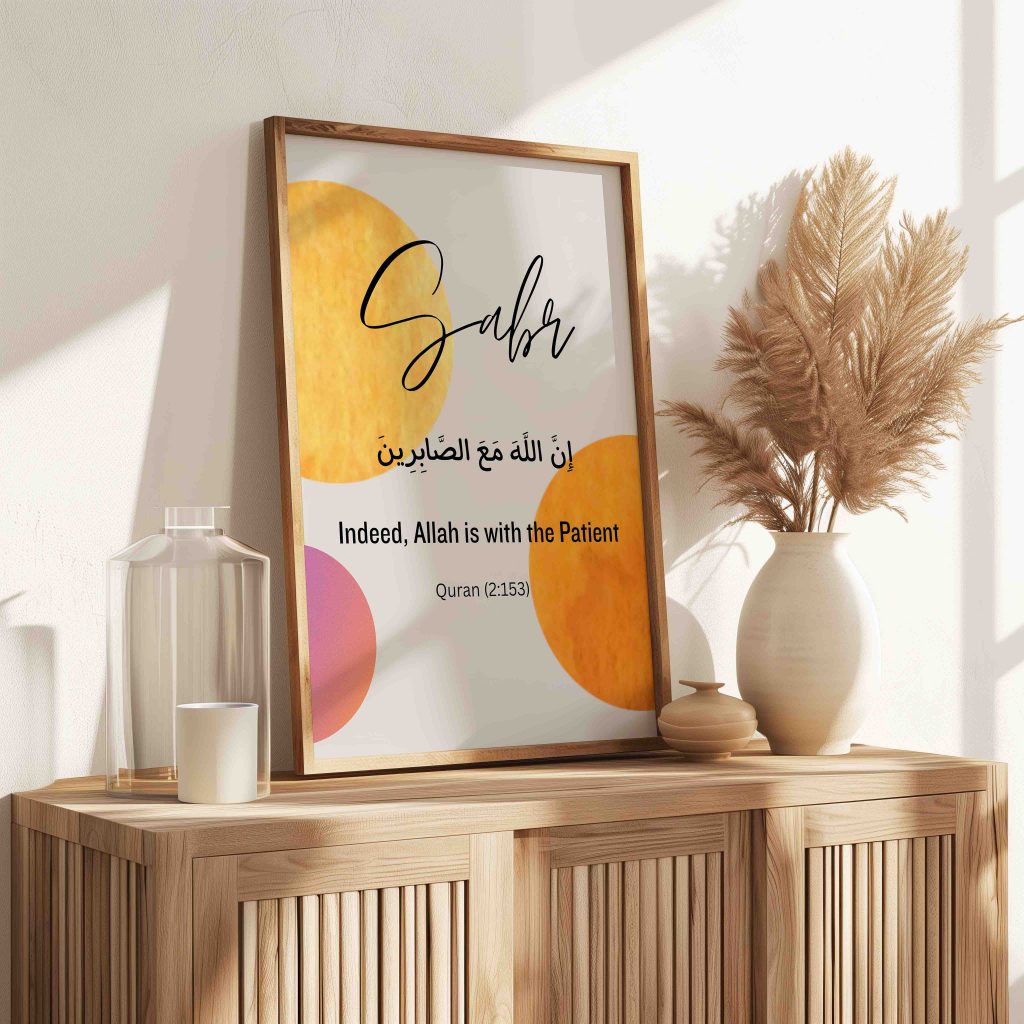
Sabr Arabic Calligraphy Wall Art UK
Flowing Sabr script with the Arabic and an English rendering of part of Qur’an 2:153, set against warm yellow, orange and pink circles.
£7.95
Digital download — frame not included
Continuing through personal or professional difficulty
Some difficulties are not a single moment but a long stretch: caring for an unwell relative, rebuilding after a loss, or a demanding period at work. Here, to practise Sabr often means perseverance: continuing to do what is right and useful even when progress is slow.
“For indeed, with hardship [will be] ease [i.e., relief].”
— Qur’an 94:5, Saheeh International
“Indeed, with hardship [will be] ease.”
— Qur’an 94:6, Saheeh International
Practical steps that may help you practise Sabr during a long difficulty:
- Break the load into days. Ask “What do I need to do today?” rather than trying to carry the whole season at once.
- Keep small routines. Regular prayer times, meals and sleep give structure when other things feel uncertain.
- Accept help. Patience does not require you to struggle alone. Asking family, friends, colleagues or professionals for support is part of responsible action.
- Notice progress. Recording what has been done, however small, can make it easier to continue.
Patience is not the same as accepting injustice
A common misunderstanding is that Sabr means staying silent when you or someone else is being wronged. The Qur’an, in the same passage that praises patience and forgiveness, also acknowledges responding to wrongdoing in a just manner:
“And whoever retaliates after having been wronged – those have not upon them any cause [for blame].”
— Qur’an 42:41, Saheeh International
“And whoever is patient and forgives – indeed, that is of the matters [worthy] of resolve.”
— Qur’an 42:43, Saheeh International
Editorial reflection. Read together, these verses suggest that patience and seeking what is fair are not opposites. In everyday terms, patience can shape how you respond: calmly, honestly and without cruelty, rather than removing the need to respond at all. If you or someone else is unsafe, being harmed or being treated unfairly, seeking help from appropriate people, services or authorities is a responsible step. For specific religious questions about your situation, please consult a qualified scholar.
Small habits that help you practise Sabr
The following are practical suggestions rather than religious requirements. They are simply ways to practise Sabr by creating a moment between a feeling and a reaction, so that you can pause and respond thoughtfully.
- Take one slow breath before answering. A short pause is often enough to change the tone of a reply.
- Name the difficulty honestly. Saying to yourself “this is a delay” or “this is a hard conversation” can make it easier to respond rather than react.
- Return to the words of Qur’an 2:156. The Qur’an describes the patient as saying, “Indeed we belong to Allāh, and indeed to Him we will return.” Many people find that remembering these words helps them regain perspective.
- Make a short du’a in your own words. Asking Allah for steadiness does not need a set formula.
- Choose one next action. Patience becomes easier when you know the one thing you can do next.
- Keep a visible reminder. A word on the wall that you pass every day can prompt a moment of reflection. It is a reminder only; it does not create patience on its own.
Frequently asked questions
How can I practise Sabr when I feel angry?
Start with the smallest step available: pause before speaking, lower your voice, or leave the conversation for a while. The hadith quoted above describes self-control in anger as real strength. Returning to the discussion later, calmly, is often more effective than winning it in the moment.
Is it wrong to feel impatient?
Feeling frustrated during a delay or a difficulty is a normal human experience. In our editorial view, the practical question is what you do with the feeling: whether you let it drive harsh words and hasty decisions, or pause, practise Sabr and choose a better response. For personal religious questions, please speak to a qualified scholar.
How can children learn to practise Sabr?
Children often learn patience by watching how adults wait, disagree and handle setbacks. Naming the moment (“we are waiting, and that is hard”), keeping promises about when something will happen, and praising calm behaviour can help children practise Sabr in small, everyday ways.
Does Sabr mean I should stay silent about a problem?
No. As the section on injustice explains, patience shapes how you respond rather than removing the need to respond. Raising a concern honestly and calmly, or seeking help from appropriate people, can itself be part of how you practise Sabr.
How Sabr connects with Shukr and Tawakkul
As you practise Sabr, you may find that patience rarely stands alone. Gratitude helps us notice what is still good while we wait, and trust in Allah helps us keep going after we have done our part. If you would like to explore those ideas in the same practical way, read how to make Shukr part of your daily routine and how Tawakkul relates to taking action.

If you are looking for a daily reminder to practise Sabr at home, you can view this Sabr design or browse the full Power Words of Faith collection, which brings Sabr, Shukr and Tawakkul together.
Sources
- Qur’an 2:155, Saheeh International, via Quran.com.
- Qur’an 2:156, Saheeh International, via Quran.com.
- Qur’an 41:34, Saheeh International, via Quran.com.
- Qur’an 41:35, Saheeh International, via Quran.com.
- Qur’an 42:41, Saheeh International, via Quran.com.
- Qur’an 42:43, Saheeh International, via Quran.com.
- Qur’an 94:5, Saheeh International, via Quran.com.
- Qur’an 94:6, Saheeh International, via Quran.com.
- Sahih al-Bukhari 6114, via Sunnah.com.
- For the definition of Sabr and further verses and hadith, see Sabr meaning: patience in Islam.