
Tawakkul is often translated as trust in, or reliance on, Allah. A question people regularly ask is: does Tawakkul mean doing nothing and simply waiting for things to work out? This guide looks at that question in practical terms: how Tawakkul fits alongside planning, effort, advice and taking action responsibly. For the fuller definition and the main Qur’an verses, see our explanation of what Tawakkul means.
In short, Tawakkul does not mean avoiding preparation or effort. The sources quoted below describe people who took sensible steps, sought counsel and made decisions, and who relied on Allah in doing so.
How to read this article. Qur’an verses are quoted word for word from the Saheeh International translation and linked to Quran.com. The examples and suggestions are our own editorial reflection, not religious rulings. For personal questions of Islamic law, please speak to a qualified scholar.
Does Tawakkul mean doing nothing?
The Qur’an gives a clear example of trust and precaution together. The Prophet Ya’qub (Jacob) gave practical advice to his sons before a journey, while also stating his reliance on Allah:
“And he said, “O my sons, do not enter from one gate but enter from different gates; and I cannot avail you against [the decree of] Allāh at all. The decision is only for Allāh; upon Him I have relied, and upon Him let those who would rely [indeed] rely.””
— Qur’an 12:67, Saheeh International
In the same verse, a practical precaution and a statement of reliance appear side by side. Our Tawakkul meaning article also discusses the well-known hadith in which the Prophet ﷺ told a man to tie his camel and rely upon Allah; you can read it there with its source and grading.
Making a decision after careful thought
The Qur’an links reliance on Allah with the moment of decision, after consultation:
“… and consult them in the matter. And when you have decided, then rely upon Allāh. Indeed, Allāh loves those who rely [upon Him].”
— Qur’an 3:159, Saheeh International
Everyday decisions rarely come with certainty. A practical approach might include:
- Gathering the facts you can reasonably find. Costs, dates, options and likely consequences.
- Being honest about your intention. Is the choice right, fair and within your responsibilities?
- Making du’a. Asking Allah for guidance and for what is good, in your own words.
- Deciding, then taking action. Endless second-guessing can become its own kind of anxiety. Once a sensible decision is made, trust helps you move forward.
Seeking appropriate advice
Consultation is described in the Qur’an as a characteristic of the believers:
“And those who have responded to their Lord and established prayer and whose affair is [determined by] consultation among themselves, and from what We have provided them, they spend,”
— Qur’an 42:38, Saheeh International
In practice, seeking advice can mean asking a family member who knows you well, a colleague with relevant experience, a doctor, solicitor or financial adviser for specialist matters, or a qualified scholar for religious questions. Asking for advice before taking action is part of acting responsibly; it does not show a lack of trust.

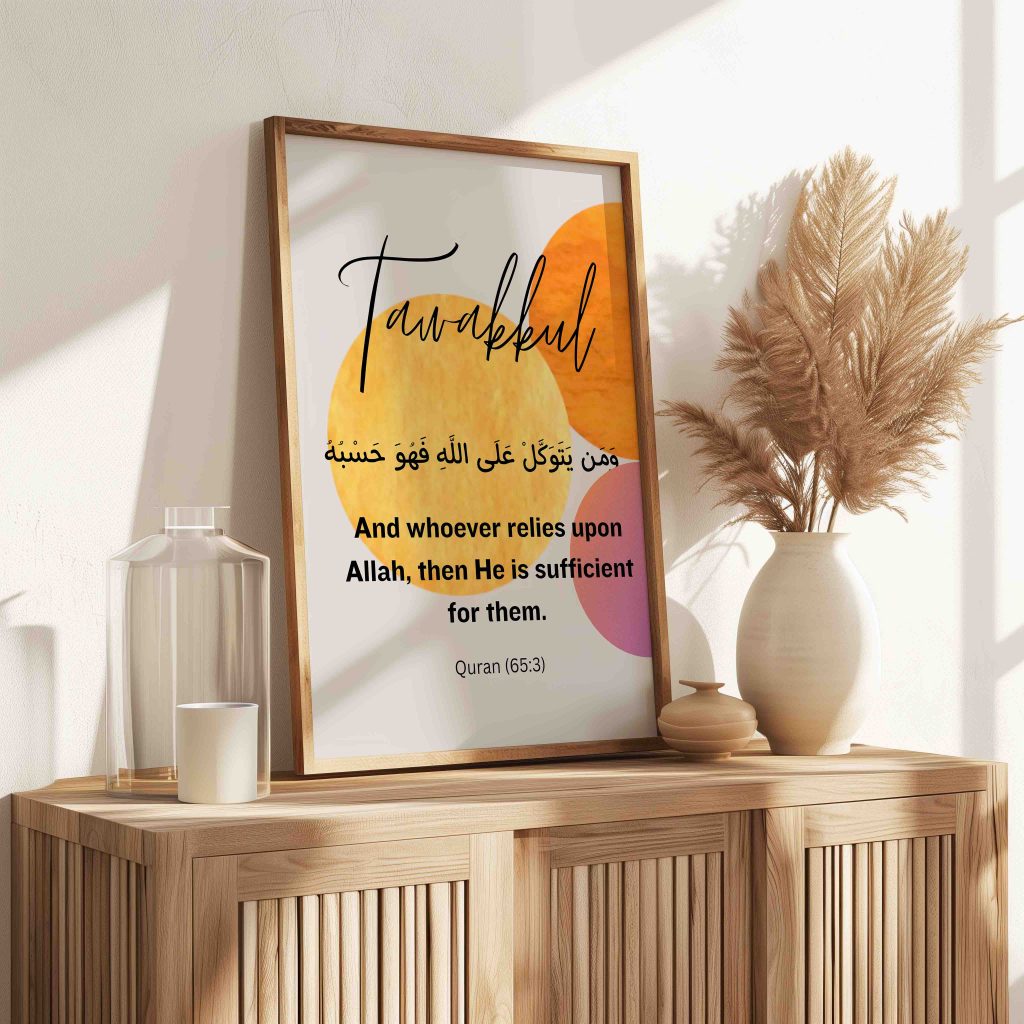
Tawakkul Islamic Wall Art – Inner Peace Through Faith Artwork
Flowing Tawakkul script with the Arabic and an English rendering of part of Qur’an 65:3, set against warm yellow, orange and pink circles.
£7.95
Digital download — frame not included
Preparing properly, then accepting what you cannot control
Every situation has two parts: what is within your control, and what is not. Tawakkul helps with the second part without excusing us from taking action on the first.
Editorial reflection. A student revises thoroughly and then sits the exam without panicking over the result. A job seeker prepares a careful application, then does not treat silence as a personal failure. A parent takes sensible safety measures, then does not let fear control every decision. In each case the effort is real, and so is the letting go.
A simple exercise can help: divide a page into two columns. In the first, list what you can do. In the second, list what you cannot control. Start taking action on the first column; bring the second to Allah in du’a.
Taking action at work, at home and in difficulty
Some everyday examples of trust alongside taking action:
- At work: preparing well for a meeting or deadline, being honest about problems, and then not being consumed by outcomes you cannot influence.
- With family: planning finances carefully, having difficult conversations when they are needed, and accepting that other people make their own choices.
- With health: seeking medical advice and following treatment, while relying on Allah for the outcome.
- In personal difficulty: asking for help, taking the next practical step and not waiting to feel certain before acting.
Trust, passivity and carelessness: what is the difference?
It can help to set the three side by side. This comparison is our own editorial summary:
- Passivity waits for things to change without doing what is reasonably possible.
- Carelessness takes risks without preparation and calls it trust.
- Tawakkul, as the verses above describe it, combines thought, consultation and taking action with reliance on Allah for the result.
The Qur’an also reassures those who rely on Allah:
“And whoever relies upon Allāh – then He is sufficient for him.”
— Qur’an 65:3 (part of the verse), Saheeh International
A reminder on the wall, such as the Tawakkul artwork shown above, can prompt a moment of reflection before a decision or a busy day. It is a visual reminder only and does not bring about trust, protection or any particular result on its own.
Frequently asked questions
Is taking action a sign of weak trust in Allah?
No. The verses quoted above describe precaution, consultation and decision-making alongside reliance on Allah. Taking action within your responsibilities and trusting Allah for the outcome belong together.
How do I know when I have done enough?
In our editorial view, a useful test is whether you have taken the reasonable steps available to you: gathering information, seeking advice where appropriate, and acting on your decision. Beyond that, worry rarely changes the outcome, and Tawakkul helps you let go of what you cannot control.
What if things do not work out after taking action?
Effort does not guarantee a particular result, and the Qur’an reminds us that the decision belongs to Allah (Qur’an 12:67 above). A disappointing outcome can be a moment for patience, reflection and, where needed, taking action again in a different way. Our guide to practising Sabr looks at this in more detail.
Should I ask for advice before taking action?
For important decisions, yes, where appropriate advice is available. Qur’an 42:38 describes consultation as a quality of the believers. The right adviser depends on the matter: family, an experienced colleague, a professional, or a qualified scholar for religious questions.
How Tawakkul connects with Sabr and Shukr
Trust, patience and gratitude often work together: trust helps us act, patience helps us continue, and gratitude helps us notice what we have been given along the way. For more practical ideas, read our guide to practising Sabr day to day and ways to make Shukr part of your routine.

If a daily reminder would help, you can view this Tawakkul design or browse the Power Words of Faith collection.
Sources
- Qur’an 12:67, Saheeh International, via Quran.com.
- Qur’an 3:159, Saheeh International, via Quran.com.
- Qur’an 42:38, Saheeh International, via Quran.com.
- Qur’an 65:3, Saheeh International, via Quran.com.
- For the meaning of Tawakkul and the hadith about tying the camel, see Tawakkul meaning.