Digital downloads and physical products are clearly identified. Product, delivery and payment details are shown before order confirmation.

Reviewed reflections appear only after source and reviewer approval.
The 99 Names of Allah

Al-Muhsee Meaning: The Reckoner, a Name of Allah

Al-Muhsee means the Reckoner who counts all things. Explore its Arabic root, key Qur’anic verses, an authentic hadith on deeds and practical reflection.

In the rich tapestry of Islamic spirituality, the 99 Names of Allah (Asma ul Husna) serve as gateways to understanding the divine attributes. Among these sacred names, AL-MUHSEE stands as a profound testament to Allah’s all-encompassing knowledge and perfect accounting. This name invites us to reflect on how every thought, deed, and moment of our existence is known to the Creator with perfect precision.

When we explore AL-MUHSEE, we discover not just a theological concept, but a living attribute that can transform our relationship with Allah and deepen our spiritual awareness. This divine name offers comfort, guidance, and a pathway to greater consciousness in our daily lives.

The Profound Meaning of AL-MUHSEE

AL-MUHSEE (الْمُحْصِي) linguistically means “The Reckoner,” “The Counter,” or “The One who takes account of all things.” This name derives from the Arabic root letters ha-sad-ya (ح ص ي), which carry connotations of counting, numbering, recording, and comprehending completely.

When we refer to Allah as AL-MUHSEE, we acknowledge that He:

  • Numbers and counts all things with perfect precision
  • Records every deed, thought, and intention
  • Comprehends everything in its totality
  • Possesses complete knowledge of all creation
  • Takes account of every detail, no matter how minute

Theologically, AL-MUHSEE represents Allah’s perfect awareness and recording of all things. Nothing escapes His knowledge – not a leaf falling from a tree, not a thought crossing our minds, not a deed performed in secret. This name reminds us that Allah’s knowledge is not just vast but meticulously detailed and precise.

“That he [i.e., Muḥammad (ﷺ)] may know that they have conveyed the messages of their Lord; and He has encompassed whatever is with them and has enumerated all things in number.”

(Qur’an 72:28, Saheeh International)

This divine attribute teaches us that Allah’s knowledge is active, not passive. He doesn’t merely observe; He accounts for, records, and comprehends every aspect of existence with perfect wisdom and purpose.

Al-Muhsee and Related Names

Al-Muhsee is closely related to other names that describe Allah’s knowledge and accounting. Al-Aleem (the All-Knowing) describes the completeness of His knowledge. Al-Haseeb (the Reckoner, the Sufficient) describes Him as the One who takes account of deeds and who is sufficient for His servants. Ash-Shaheed (the Witness) describes His presence to every event. Al-Muhsee adds the specific meaning of counting and enumerating: Allah knows not only that something happened, but exactly how many, how much and how often.

AL-MUHSEE in the Quran and Hadith

The exact word al-Muhsi is not used as a name of Allah in the Qur’an. It appears in the well-known list of ninety-nine names recorded by at-Tirmidhi (Jami’ at-Tirmidhi 3507), a narration at-Tirmidhi described as gharib and which is graded weak as a list. For this reason, some scholars who compiled the names directly from the Qur’an and Sunnah did not include it. Its meaning, however, is clearly affirmed in the Qur’an through the verb ahsa (to count, enumerate), in verses such as these:

“But all things We have enumerated in writing.”

(Qur’an 78:29, Saheeh International)

“And the record [of deeds] will be placed [open], and you will see the criminals fearful of that within it, and they will say, “Oh, woe to us! What is this book that leaves nothing small or great except that it has enumerated it?” And they will find what they did present [before them]. And your Lord does injustice to no one.”

(Qur’an 18:49, Saheeh International)

“On the Day when Allāh will resurrect them all and inform them of what they did. Allāh had enumerated it, while they forgot it; and Allāh is, over all things, Witness.”

(Qur’an 58:6, Saheeh International)

“And He gave you from all you asked of Him. And if you should count the favor [i.e., blessings] of Allāh, you could not enumerate them. Indeed, mankind is [generally] most unjust and ungrateful.”

(Qur’an 14:34, Saheeh International)

“He has enumerated them and counted them a [full] counting.”

(Qur’an 19:94, Saheeh International)

These verses emphasize that Allah’s accounting is comprehensive, leaving nothing unrecorded. This perfect enumeration extends to both our deeds and Allah’s countless blessings upon us, which are too numerous for us to fully count or comprehend.

Every Small Deed Counts

Because Allah counts everything, no good deed is too small to matter, and no wrong is too small to ignore. The Qur’an says:

“So whoever does an atom’s weight of good will see it,”

(Qur’an 99:7, Saheeh International)

“And whoever does an atom’s weight of evil will see it.”

(Qur’an 99:8, Saheeh International)

Allah’s accounting is also generous. The Prophet (peace be upon him) described how deeds are recorded:

“Allah ordered that the good and the bad deeds be written. If somebody intends to do a good deed and does not do it, Allah will write for him a full good deed. If he intends and actually does it, Allah will write for him from ten to seven hundred times or many more times. If somebody intended to do a bad deed and does not do it, Allah will write a full good deed for him. If he intended and actually did it, Allah will write one bad deed.”

(Sahih al-Bukhari 6491)

This balance of precision and mercy is central to understanding Al-Muhsee. The count is exact, but it is kept by the Most Merciful, who multiplies good and records a wrong only as it is.

The Clear Record

The Qur’an also teaches that everything people leave behind, including the effects of their actions after they are gone, is recorded:

“Indeed, it is We who bring the dead to life and record what they have put forth and what they left behind, and all things We have enumerated in a clear register.”

(Qur’an 36:12, Saheeh International)

This encourages believers to think about the lasting impact of their deeds: knowledge taught, charity that continues to benefit, and good habits passed on to others.

Lessons from Reflecting on Al-Muhsee

Person in peaceful meditation reciting Allah's names

Reflecting on the meaning of Al-Muhsee can bring real benefits to your faith and daily life:

Deepening Divine Awareness

When we regularly reflect upon AL-MUHSEE, we develop a heightened consciousness of Allah’s presence in our lives. This awareness that every thought and deed is known to Allah helps us cultivate taqwa (God-consciousness) and mindfulness in our actions.

Person reflecting by window with prayer beads, contemplating AL-MUHSEE

Strengthening Trust in Allah's Plan

Understanding that Allah accounts for everything in perfect measure helps us trust in His divine wisdom. When we face challenges or uncertainties, remembering AL-MUHSEE reminds us that nothing in our lives is random or overlooked. Every experience is precisely measured and accounted for in Allah’s perfect knowledge.

Freedom from Anxiety About Provision

Reflecting on Al-Muhsee helps ease worries about sustenance and livelihood. When we truly internalize that Allah accounts for everything and provides with perfect measure, we can release the anxiety that comes from fearing scarcity or loss. This name reminds us that our provision is precisely calculated by the One who knows our needs perfectly.

Person with peaceful expression symbolizing freedom from anxiety

Cultivating Gratitude and Humility

Reflecting on AL-MUHSEE encourages profound gratitude as we recognize that Allah’s blessings upon us are too numerous to count. The Quran states, “If you were to count Allah’s favors, you would not be able to enumerate them” (14:34). This awareness fosters humility and appreciation for the countless mercies we receive each day.

Person in gratitude prayer with sunlight symbolizing divine blessings

Practical Ways to Reflect on Al-Muhsee

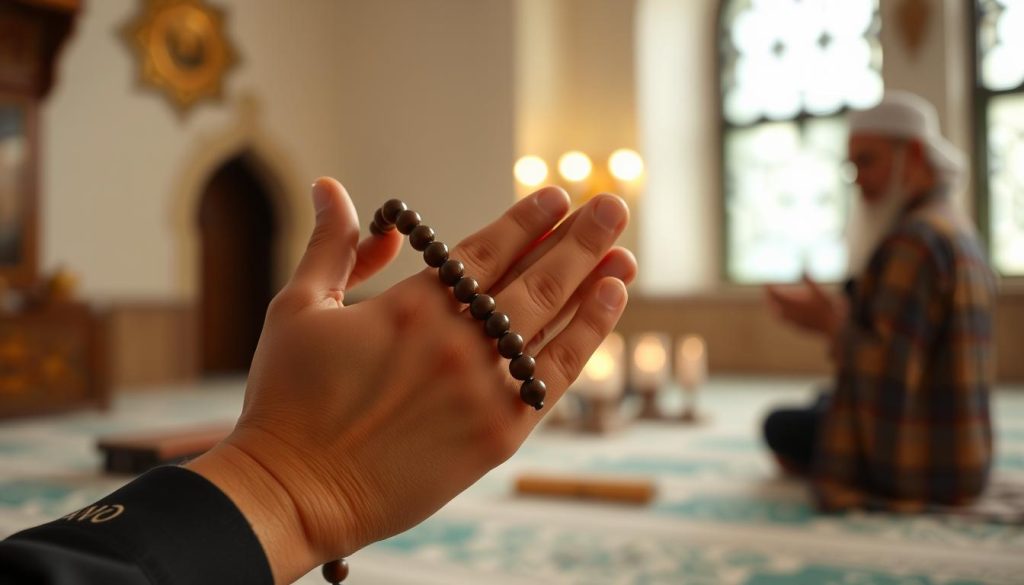
Person with prayer beads reciting Allah's names in structured practice

Incorporating AL-MUHSEE into your spiritual practice can be done in several meaningful ways:

Daily Dhikr Practice

One of the most effective ways to connect with this divine name is through regular dhikr (remembrance):

  • Pause during your daily remembrance to recall that Allah has counted every deed, word and blessing.
  • Keep the authentic adhkar after prayer, and reflect on how many times each day Allah’s favours reach you.
  • Call upon Allah by His names with sincerity. No authentic hadith sets a specific number of repetitions or a promised result for reciting “Ya Muhsee”.
  • End each day with a short self-review: what would I be glad to find in my record, and what should I repent from?

Incorporating into Dua (Supplication)

When making personal supplications, you may call upon Allah as the One who knows and counts all things, in your own words. For example:

“O Allah, You have counted all things and nothing is hidden from You. Guide me to what is best for my life in this world and the next, for You know what I need better than I do.”

This is a personal supplication, not a narrated dua; its value lies in sincerity and in the meanings it affirms.

This type of invocation acknowledges Allah’s perfect accounting and surrenders to His superior knowledge of what is best for us.

Reflection and Contemplation

Set aside time for quiet reflection on the meaning of AL-MUHSEE in your life:

  • Contemplate how Allah accounts for your deeds, thoughts, and intentions
  • Reflect on how this knowledge should influence your choices and actions
  • Consider the comfort in knowing that no good deed, however small, is lost in Allah’s account
  • Meditate on how Allah’s perfect accounting extends to His provision for all creation

Muhasabah: Holding Ourselves to Account

Reflecting on Al-Muhsee naturally leads to muhasabah, the practice of taking account of oneself before the final accounting. The Qur’an calls believers to this kind of forward-looking self-review:

“O you who have believed, fear Allāh. And let every soul look to what it has put forth for tomorrow – and fear Allāh. Indeed, Allāh is Aware of what you do.”

(Qur’an 59:18, Saheeh International)

A simple evening routine can put this into practice. Spend a few minutes asking: Did I pray on time? Did I speak kindly? Did I fulfil my responsibilities at home and at work? Is there anyone I wronged who deserves an apology? Then thank Allah for the good, seek His forgiveness for the shortcomings, and make one small, specific intention for tomorrow. Over time, this habit turns awareness of Allah’s perfect record into steady personal growth, without anxiety or despair.

Person in contemplative reflection with Quran and prayer beads

Embracing the Wisdom of AL-MUHSEE in Daily Life

As we conclude our exploration of AL-MUHSEE, we are reminded that this divine name offers profound insights for our spiritual journey. When we truly internalize that Allah accounts for everything with perfect precision – our deeds, our thoughts, our needs, and our struggles – we develop a deeper trust in His wisdom and care.

The recognition that we are constantly in the presence of AL-MUHSEE transforms how we approach life’s challenges and blessings alike. It encourages mindfulness in our actions, gratitude for our blessings, patience in our trials, and confidence in Allah’s perfect plan for us.

By incorporating the recitation and contemplation of AL-MUHSEE into our spiritual practice, we open ourselves to a more conscious relationship with our Creator. We begin to see the world through the lens of divine wisdom, recognizing that nothing happens by chance and everything serves a purpose in Allah’s perfect accounting.

May our understanding of AL-MUHSEE bring peace to our hearts, clarity to our minds, and guidance to our actions as we strive to live in alignment with divine wisdom.

Al-Muhsee in Arabic Calligraphy and the Home

The name المحصي (Al-Muhsee) can serve as a reminder in a study or prayer corner to count blessings and to keep one’s own account honestly. When choosing a design, check that the Arabic spelling is correct and that the lettering is legible at the size you plan to print.

Our Al-Muhsee artwork is an digital download supplied as high-resolution JPEG files for printing at home or at a local print shop. No physical item is shipped. If you would like a different layout or colour scheme, custom designs can be requested.

Al-Muhsee calligraphy digital download Arabic calligraphy wall art, المحصي, Al-Muhsee — The Reckoner

Our Al-Muhsee calligraphy digital download calligraphy design is an digital download; no physical item is shipped. Please see the product page for the files and print sizes included.

Explore the full 99 Names of Allah collection for other calligraphy designs.

Frequently Asked Questions about Al-Muhsee

What does Al-Muhsee mean?

Al-Muhsee means the Reckoner or the One who counts and enumerates all things. It comes from the Arabic root h-s-y, which refers to counting and comprehending completely.

Is Al-Muhsee mentioned in the Qur’an?

The exact name is not used in the Qur’an, but its meaning is. Verses such as 72:28, 78:29, 19:94 and 58:6 describe Allah as having counted and enumerated all things.

Is Al-Muhsee one of the 99 names?

It appears in the list of names recorded by at-Tirmidhi (3507), a narration graded weak as a list. Some scholars who compiled the names directly from the Qur’an and Sunnah did not include it, but the meaning it describes is firmly established.

Is there a set number of times to recite “Ya Muhsee”?

No authentic hadith sets a specific number of repetitions or a promised benefit for reciting “Ya Muhsee”. Sincere remembrance of Allah, the authentic adhkar and reflection on the meaning are the best approach.

How does Allah record good and bad deeds?

The Prophet (peace be upon him) taught that a good intention is recorded as a good deed, a good deed done is multiplied from ten to seven hundred times or more, and a bad deed done is recorded only as one (Sahih al-Bukhari 6491).

What file do I receive with the Al-Muhsee artwork?

You receive high-resolution JPEG files as an digital download, suitable for printing at standard sizes. No physical item is shipped.


99 Names of Allah Arabic calligraphy print in a light oak frame, with the name Allah at the centre surrounded by the 99 Names in traditional script

Leave a Reply