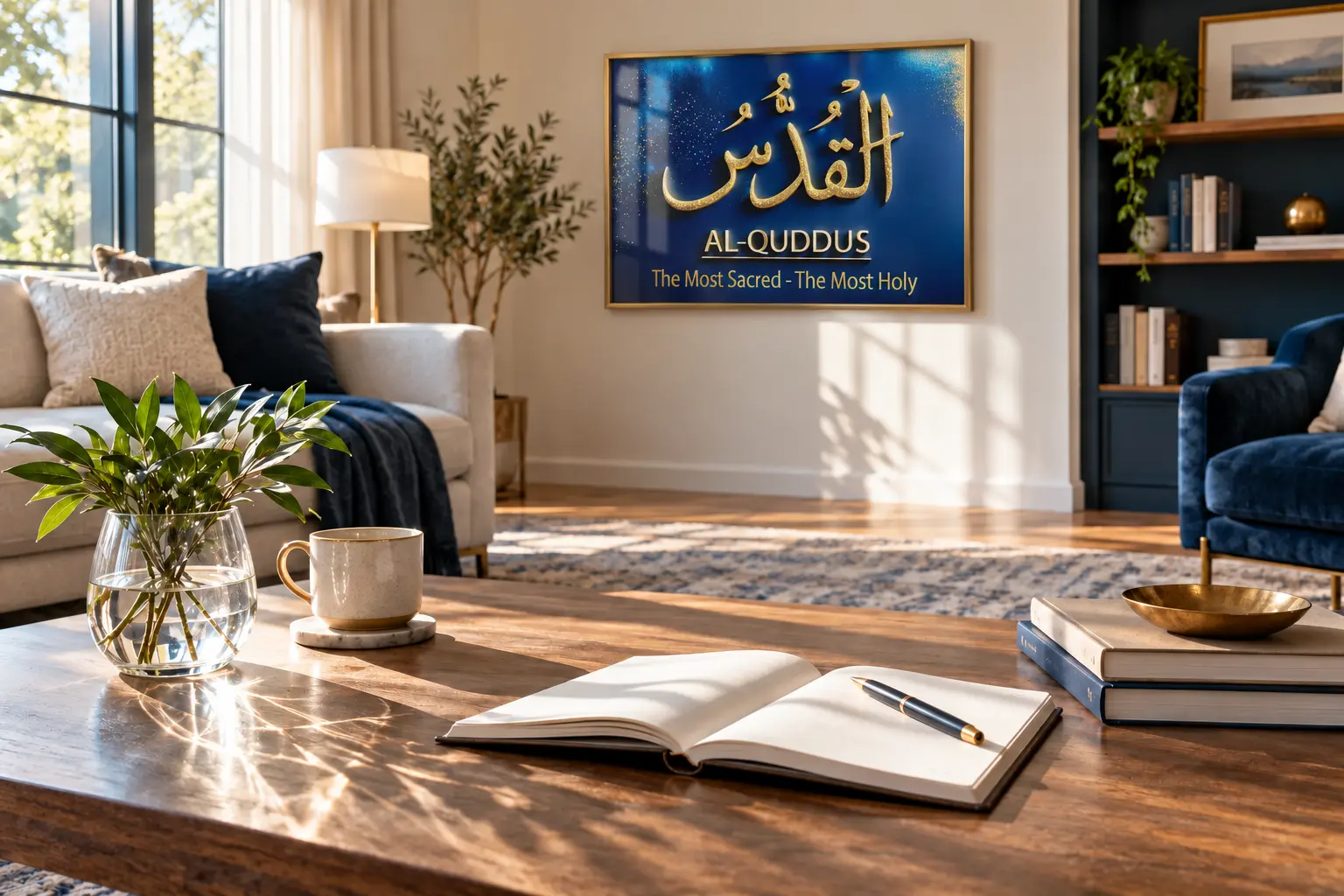
Al-Quddus (الْقُدُّوس) is one of the beautiful names of Allah. It is commonly translated as “The Most Holy” or “The Most Pure” and expresses Allah’s complete freedom from every fault, weakness and imperfection. Learning this name is not merely about memorising a translation. It should deepen our understanding of the One we worship and encourage us to approach Him with humility, sincerity and hope.
Many people search for the benefits of saying Ya Quddus or for a wazeefa with a fixed number such as 100, 1,000 or 1,200 repetitions. This article separates what is authentically reported from practices that may be personal but should not be presented as guaranteed prophetic formulas.
What does Al-Quddus mean?
The Arabic name Al-Quddus comes from the root qāf–dāl–sīn (ق د س), associated with holiness and purity. When applied to Allah, it affirms that He is perfectly holy, exalted above every deficiency and unlike His creation.
Al-Quddus appears by name in two places in the Qur’an. In Surah al-Hashr 59:23, Allah is described as the King, the Most Holy, the Source of Peace, the Giver of Security and the Supreme Authority. In Surah al-Jumu‘ah 62:1, everything in the heavens and earth glorifies Allah—the King, the Most Holy, the Almighty, the All-Wise.
These verses place Al-Quddus within a wider understanding of Allah’s majesty. His holiness is absolute. Human beings seek purification, make mistakes and return through repentance; Allah is eternally free from every imperfection.
Readers wishing to continue through the sequence in Surah al-Hashr can also study Al-Malik, the King, As-Salam, the Source of Peace and Al-Mu’min, the Giver of Security.
What does “Ya Quddus” mean?
The word Al means “the.” Al-Quddus therefore means “The Most Holy.” Ya is used when calling upon someone, so Ya Quddus means, in this context, “O Most Holy.”
The Qur’an teaches that Allah possesses the most beautiful names and instructs believers to call upon Him by them in Surah al-A‘raf 7:180. A Muslim may therefore say Ya Quddus in personal du‘a and ask Allah to purify the heart, forgive sins, improve character and help them leave harmful habits. This is a personal supplication—not a promise that merely repeating two words a certain number of times automatically produces a particular result.
Authentic remembrance involving Al-Quddus


Two reliably reported practices give us clear guidance.
’A’ishah reported that the Prophet Muhammad ﷺ would say during bowing and prostration:
سُبُّوحٌ قُدُّوسٌ رَبُّ الْمَلَائِكَةِ وَالرُّوحِ
Subbūḥun Quddūsun, Rabbul-malā’ikati war-rūḥ.
“All-Glorious, All-Holy, Lord of the angels and the Spirit.”
This is recorded in Sahih Muslim 487a.
After Witr prayer, the Prophet ﷺ is reported to have said:
سُبْحَانَ الْمَلِكِ الْقُدُّوسِ
Subḥānal-Malikil-Quddūs.
“Glory be to the Sovereign, the Most Holy.”
He said it three times, raising his voice on the third. This narration is reported through ’Abdur-Rahman ibn Abza from his father in Sunan an-Nasa’i 1732, where it is graded sahih.
These practices have a stated setting and wording. Following them allows remembrance of Al-Quddus to rest on clear evidence rather than an unattributed promise circulated online.
Is there a wazeefa of 100, 1,000 or 1,200 repetitions?
You may encounter instructions claiming that saying Ya Quddus a fixed number of times will certainly purify the heart, cure illness, remove anxiety or guarantee protection. We have not found a reliably authenticated Qur’anic verse or prophetic narration prescribing those particular counts and outcomes for Ya Quddus.
That does not mean a person is forbidden from remembering Allah repeatedly or making abundant du‘a. It means we must distinguish between voluntary personal remembrance and a religious formula attributed to Islam. A personal routine should not be described as Sunnah, obligatory or guaranteed unless reliable evidence establishes it.
Numbers themselves are not the purpose of worship. A person might complete a thousand repetitions while distracted, yet neglect repentance, prayer, honesty or the rights of other people. Another person may spend several attentive minutes recognising their faults, asking Allah for help and sincerely intending to change. We cannot measure whose worship Allah accepts, but the second approach better expresses the presence of heart that this reminder is meant to encourage.
A sincere way to call upon Allah as Al-Quddus

Choose a quiet place if it helps you concentrate, although privacy is not a prescribed condition. Remove distractions, remember the meaning of Al-Quddus and speak to Allah truthfully. Do not try to imagine Allah physically before you. Instead, remember the teaching of ihsan: to worship Allah as though you see Him, while knowing that although you do not see Him, He sees you. This teaching is recorded in Sahih al-Bukhari 50.
You might say:
Ya Quddus, You are perfectly holy and free from every imperfection. Purify my heart from arrogance, envy, resentment and hypocrisy. Forgive my sins, improve my character and help me love what is pleasing to You. Give me sincerity in worship and strength to correct the wrongs within myself. Amin.
This is suggested personal wording, not a quotation from the Qur’an or Sunnah and not a fixed formula. Use your own language if that allows greater honesty. Allah says that He is near and responds to the call of the caller in Surah al-Baqarah 2:186.
What are the benefits of understanding Al-Quddus?
We should not promise a special worldly outcome unsupported by revelation. Nevertheless, reflecting on Al-Quddus can benefit a believer by directing attention towards sound principles already taught in Islam.
It strengthens awareness of Allah’s perfection and protects us from imagining Him with human weaknesses. It encourages honest self-examination without pretending that human beings can attain divine holiness. It can lead to sincere repentance, cleaner speech, fairer conduct and a stronger effort to remove envy, pride and dishonesty from the heart.
Reflection must lead beyond words. If someone asks Allah to purify their heart but continues knowingly harming others, the request has not yet shaped their conduct. Begin with one practical change: apologise for a wrong, stop malicious speech, return something owed, forgive where appropriate or abandon a private habit that damages faith.
Keeping the meaning visible at home
Islamic calligraphy can act as a visual reminder, but displaying Allah’s name is neither an obligation nor a substitute for worship. The value lies in what the reminder directs us towards: remembrance, learning and better conduct.
Our Al-Quddus wall art presents القدوس in gold Arabic calligraphy, with its English meaning beneath. The downloadable artwork is supplied as JPEG files in A1, A2, A3, A4 and A5 sizes, with blue and purple options. No physical item is shipped.
You can also browse the wider 99 Names of Allah digital art collection and connect each design with its meaning rather than choosing decoration without understanding.
Final reflection
Al-Quddus teaches us that Allah alone is perfectly holy and free from every defect. Saying Ya Quddus can form part of a sincere personal du‘a, while the authentic Sunnah gives us established words for bowing, prostration and after Witr.
The essential lesson is not to chase impressive repetition counts or guaranteed claims. Learn the name, call upon Allah sincerely, follow the practices that are reliably reported and allow remembrance to produce visible improvement in your character. A heart turned honestly towards Allah is not measured merely by how many words the tongue completes.
Knowledge becomes fruitful when remembrance inspires repentance, gratitude, humility and compassionate action.