Every morning, we wake up to see provision all around us. The air we breathe, the water we drink, and the food we eat are all gifts. We often forget these blessings and rush through our days without thinking about where they come from.
When we worry about money or face financial troubles, we turn to Allah’s names for comfort. Ar-Razzaaq reminds us that our sustenance comes from One source. This name in the Quran teaches us about provision and trust.
Learning about ar-razzaaq changes how we see our daily needs. When Allah says He is The Provider, He promises to take care of all living things. This is a remarkable promise.
The Provider in Islam is more than just money or food. It’s about every part of our lives – our knowledge, our love for family. By exploring Allah’s names, like Ar-Razzaaq, we find peace. We know our needs are taken care of by the Most Merciful.
Key Takeaways
- Ar-Razzaaq (الرزّاق) means the Provider: the One who provides for every creature, continually and abundantly.
- The name appears in the Qur’an in Surah Adh-Dhariyat (51:58).
- Provision (rizq) includes material needs and also faith, knowledge, health and peace of heart.
- Trust in Allah goes together with honest effort, not instead of it.
- Keeping family ties, gratitude, taqwa and seeking forgiveness are linked to provision in the Qur’an and authentic hadith.
Understanding Allah's Name Ar-Razzaaq: The Divine Provider
Ar-Razzaaq is a special name among Allah’s 99 beautiful names. It shows the deep bond between the Creator and His creation. It’s about the endless flow of sustenance from Allah to all living beings. This name helps us see Allah’s mercy and care for His creation.
Etymology and Linguistic Roots of Ar-Razzaaq
The name Ar-Razzaaq comes from the Arabic root raa-zaa-qaa. This root means:
- Receiving something beneficial
- Getting a portion or share
- Being provided with life’s necessities
This root is found in Arabic literature and Islamic names. It talks about provision and sustenance. It’s not just about food and drink but also about life’s essentials like air and knowledge.
The Intensive Form and Its Significance
Ar-Razzaaq is special because of its grammar. It follows the fa’aal pattern, showing continuous and abundant provision. This means Allah provides constantly, without stopping.
This form tells us Allah’s provision never ends. It’s there from the start of life to the end, and even after.
Quranic References to the Provider
The Qur’an returns to the theme of provision again and again. In Surah Adh-Dhariyat, Allah says:
“And in the heaven is your provision and whatever you are promised.”
(Qur’an 51:22, Saheeh International)
This verse tells us that our provision is decreed and secure with Allah.
In the same surah (51:56–58), Allah explains that He created jinn and humans to worship Him, that He needs no provision from them, and then describes Himself by this name:
“Indeed, it is Allāh who is the [continual] Provider, the firm possessor of strength.”
(Qur’an 51:58, Saheeh International)
What Is Rizq? Exploring Islamic Provision
When we think of sustenance from ar-razzaaq, we often think of money or food. But in Islamic tradition, rizq means so much more. It’s every blessing Allah gives us, from the air we breathe to the peace in our hearts.
Beyond Material Wealth: The Complete Definition
Rizq is about all the good things in our lives. Scholars say even a kind word from a friend or a moment of clarity in prayer is a gift from Allah. The spiritual benefits of ar-razzaaq go far beyond what we can see or count.

Types of Rizq: Physical, Spiritual, and Intellectual
Allah’s provision comes in three main types:
- Physical rizq: Food, water, shelter, health, and material things
- Spiritual rizq: Faith, love of Allah, inner peace, and divine guidance
- Intellectual rizq: Knowledge, wisdom, understanding, and good character
The Qur’an shows prophets asking Allah for both kinds of provision: Ibrahim prayed for his family to be provided with fruits (2:126), and he also prayed for guidance and prayer to remain in his descendants (14:40). Every breath we take is a reminder of Allah’s constant care.
The Guaranteed Nature of Divine Provision
The Qur’an says:
“And there is no creature on earth but that upon Allāh is its provision, and He knows its place of dwelling and place of storage. All is in a clear register.”
(Qur’an 11:6, Saheeh International)
This promise can calm the anxious heart: no creature is forgotten.
AR-RAZZAAQ Meaning and the Benefit of AR-RAZZAAQ
Learning about ar-razzaaq changes how we see life’s gifts. It shows Allah is the only one who gives us everything we need. The name Ar-Razzaq means “the All-Provider”. It covers money, guidance, and feeling good.
The Prophet ﷺ taught that, while a baby is still in the womb, an angel is sent to write four things for it: its deeds, its livelihood, its time of death, and whether it will be blessed or wretched (Sahih al-Bukhari 3208). Our provision is known to Allah before we are born, which is a source of peace rather than passivity.
Believers who embrace ar-razzaaq for abundance see big changes. They gain:
- Trust in Allah’s plan
- Contentment no matter what
- Seeing provision in many ways
- Peace instead of worry about money
Allah gives what we need in many ways, sometimes through work and sometimes unexpectedly. Maryam (Mary) was found with provision in her prayer chamber and said: “It is from Allāh. Indeed, Allāh provides for whom He wills without account” (3:37).
The Test of Rizq: Why Provision Varies Among People
Life’s biggest mystery is why some have more than they need while others struggle. Allah’s name Ar-Razzaaq helps us understand this. The way rizq is given is not random. It’s a test for us all.
Divine Wisdom in Distribution
Allah gives provision according to His wisdom, not our idea of fairness. The Qur’an says:
“Indeed, your Lord extends provision for whom He wills and restricts [it]. Indeed He is ever, concerning His servants, Aware and Seeing.”
(Qur’an 17:30, Saheeh International)
Both having more and having less are tests.
- The wealthy face trials of gratitude and generosity
- Those with modest means develop patience and contentment
- Everyone learns dependence on Allah rather than material possessions

Wealth as Trial, Poverty as Elevation
Being wealthy can be a test. Many struggle with pride, greed, or forgetting Allah. Their riches may make them forget the spiritual lessons of Ar-Razzaaq.
Having less can also be a test, of patience and trust. Many people with modest means show remarkable contentment and closeness to Allah, while some with much feel empty. Wealth or poverty alone says nothing about a person’s worth before Allah.
Understanding Global Inequality Through Faith
Faith also asks us to respond to need around us. Islam commands zakah, charity and fair dealing precisely so that wealth circulates and those in need are cared for. Where people suffer from poverty, believers are called to act, not only to reflect.
How Actions Influence Your Provision
Many of us wonder why our rizq changes, even though Allah promised to provide for all. The truth is, while Allah’s promise is true, our actions greatly affect our provision. Knowing the ar-razzaaq meaning and its benefits shows we have more control over our provision than we think.
Our choices matter. The Qur’an and authentic hadith link certain actions with increased provision and blessing (barakah):

- Keeping family ties. The Prophet ﷺ said: “Whoever loves that he be granted more wealth and that his lease of life be prolonged then he should keep good relations with his Kith and kin” (Sahih al-Bukhari 5986).
- Taqwa (God-consciousness). Allah promises to provide for the one who fears Him “from where he does not expect” (65:2–3).
- Gratitude. “If you are grateful, I will surely increase you [in favor]” (14:7).
- Seeking forgiveness. The Prophet Nuh told his people that asking forgiveness would bring rain, wealth and children (71:10–12).
The Qur’an describes the reward of taqwa in words that have comforted believers for centuries:
“And will provide for him from where he does not expect. And whoever relies upon Allāh – then He is sufficient for him. Indeed, Allāh will accomplish His purpose. Allāh has already set for everything a [decreed] extent.”
(Qur’an 65:3, Saheeh International)
Trust in Ar-Razzaaq: Building Reliance on Allah
Trust in Allah as the provider in Islam is a mix of faith and action. Allah promises to provide for all, but we must still work hard. This promise encourages us to have tawakkul – total trust in Allah while we act in our daily lives.
The Example of Birds and Divine Trust
The Prophet ﷺ used the birds to teach trust:
“If you were to rely upon Allah with the required reliance, then He would provide for you just as a bird is provided for, it goes out in the morning empty, and returns full”
Notice that the bird does not stay in its nest waiting. It goes out every morning. Trust in Allah and effort belong together.

Balancing Work with Tawakkul
The spiritual benefits of Ar-Razzaaq come when we combine effort with trust. The Qur’an tells believers, after the Friday prayer, to “disperse within the land and seek from the bounty of Allāh, and remember Allāh often” (62:10). Work and worship go hand in hand.
We work with full effort, while knowing in our hearts that only Allah provides.
Overcoming Anxiety About Provision
Remembering Allah as the Provider helps ease worry about money or jobs. When we are anxious about our needs, turning to Him in dua brings calm. The trusting believer works hard without being consumed by worry.
Practical Ways to Seek Allah’s Provision
Islamic teaching offers practical guidance for seeking provision with the right heart. These practices strengthen our connection with Allah and bring barakah into what we already have.
When Fatimah, the Prophet’s daughter, asked him for a servant to help with exhausting household work, he taught her and Ali something he called better for them than a servant. At bedtime they should say (Sahih al-Bukhari 3705):
- Subhan Allah (Glory be to Allah) – 33 times
- Alhamdulillah (All praise is for Allah) – 33 times
- Allahu Akbar (Allah is the Greatest) – 34 times
This teaches that strength and ease come from Allah, and that remembrance can carry us through what we cannot change.
Other practices include praying with focus (khushu’), reading the Qur’an regularly, and seeking forgiveness often. The Prophet ﷺ himself sought Allah’s forgiveness more than seventy times a day (Sahih al-Bukhari 6307).
| Practice | What the sources say | Reference |
|---|---|---|
| Charity (sadaqah) | Allah multiplies what is spent in His way | Qur’an 2:261 |
| Family ties | Linked to more provision and a longer life | Sahih al-Bukhari 5986 |
| Seeking forgiveness | Linked to rain, wealth and children | Qur’an 71:10–12 |
| Taqwa | Provision from where one does not expect | Qur’an 65:2–3 |
| Gratitude | Increase in favour | Qur’an 14:7 |
These practices are acts of worship first. They work alongside honest effort and complete trust in Allah’s wisdom, not as formulas for guaranteed results.
The Spiritual Dimensions of Ar-Razzaaq
The spiritual side of Ar-Razzaaq goes beyond money and food. Scholars who wrote on the names of Allah, such as al-Qushayri, explain that Allah also provides for the heart: faith, knowledge, certainty and remembrance.
Internal Rizq: Divine Openings and Insights
Understanding Ar-Razzaaq shows us the value of inner provision. This includes fath, an opening of understanding that Allah gives to whom He wills, so that a verse or a lesson suddenly becomes clear and alive.

The Food of the Heart: Love and Remembrance
Our hearts need food just like our bodies do. This spiritual food comes from Allah’s love and remembrance. People with little wealth can feel rich in spirit, while the wealthy may feel empty.
Heavenly Sustenance in Islamic Tradition
When the Prophet ﷺ fasted continuously and his companions wanted to copy him, he told them he was not like them, because his Lord gave him food and drink (Sahih al-Bukhari 1964). Scholars explain this as a special provision of strength from Allah, a reminder that provision is not only physical.
Halal, Haram, and Doubtful Provisions
In Islam, not all provision is equal. Scholars divide rizq into three main groups. These groups shape how we connect with divine sustenance.
Halal provisions are those from honest work, legal trade, and fair business. On the other hand, haram sources include interest, theft, and deceit. Then, there’s mashbooh provision, where it’s hard to tell if it’s okay or not.
The Qur’an states: “Allāh has permitted trade and has forbidden interest” (2:275). Allah provides, and He wants us to earn in ways that are clean.
The Prophet ﷺ compared doubtful matters to grazing animals near a private pasture: whoever stays close to the boundary may soon cross it (Sahih al-Bukhari 52). Seeking clearly lawful provision protects our faith.
The Prophet ﷺ also warned about a man whose food, drink and clothing were unlawful, asking how his dua could be answered (Sahih Muslim 1015). Lawful earnings bring barakah to both material and spiritual life.
The lesson from Islam is that true wealth isn’t just about how much we have. It’s about the purity of our sources.
Living by Allah's Name Ar-Razzaaq
Living in harmony with sustenance from ar-razzaaq changes our daily life into worship. Understanding ar-razzaaq meaning and its benefits brings us peace. It teaches us to live with trust, gratitude, and generosity.
Contentment with Divine Decree
True peace comes from accepting what Allah has decreed for us. What is written for us will reach us, and what is not will not, so we do our best, make dua, and leave the outcome with Allah without resentment.
Using Provisions Righteously
Every blessing we get comes with a responsibility. The ar-razzaaq meaning and its benefits are not just in receiving. It’s also in how we use what we have.
- Avoiding forbidden sources of income
- Spending wisely on family needs
- Sharing with those less fortunate
- Using resources for beneficial purposes
Becoming a Channel of Allah's Provision
When we live like sustenance from ar-razzaaq, we spread divine mercy. This means caring for our families, feeding the hungry, and even animals. We see ourselves as channels, not sources, of provision. This brings deep peace and inspires true generosity.
The Connection Between Ar-Razzaaq and Al-Wahhaab
Ar-Razzaaq and Al-Wahhaab are closely related. Ar-Razzaaq emphasises Allah’s continual provision of everything creatures need to live. Al-Wahhaab emphasises His free gifts, given generously beyond any need or effort. Both names remind us that everything we have comes from Allah.
Divine Gifts Without Expectation
Al-Wahhaab shows Allah’s kindness without expecting anything back. Some people get respect without asking for it. Others find doors open without even knocking.
Imagine waking up to new chances or discovering talents you never knew you had. These are wahbah – gifts from Allah that don’t need anything in return.
These names teach us that provision is not only about food. While we work hard, Allah may also bless us with things we never planned for: an opportunity, a friendship, a new ability.
How Success and Love Are Forms of Rizq
Provision from Allah includes things money cannot buy: success in our work, respect, friendship and love.
Some people work hard for years but still face rejection. Others find love easily wherever they go. This shows that provision is more than just money.
Strengthening Family Ties for Increased Provision
The Prophet Muhammad (peace be upon him) showed us a deep link between keeping family bonds strong and getting help from Ar-Razzaaq. This teaching tells us that the meaning and benefits of ar-razzaaq go beyond just personal prayer. It also includes how we treat our family members.
A man once told the Prophet ﷺ that he kept good relations with his relatives, but they cut him off and treated him badly. The Prophet ﷺ said that if it was as he described, there would always remain with him a supporter from Allah as long as he continued in this way (Sahih Muslim 2558). Kindness to family, even when it is not returned, is never wasted.
- Extended lifespan as a blessing from Allah
- Increased provisions in ways beyond regular income
- Divine support during challenging family situations
- Barakah (blessings) in existing wealth and resources
Mending family ties is an act of worship in its own right, and the hadith above links it to blessing in provision and life. Rizq is more than a simple equation of work and reward.
Islamic Wall Art: Bringing Ar-Razzaaq's Blessings Home
Make your home a place of faith with Islamic wall art. At Islamic Wall Arts UK, we create designs that remind you of Allah’s kindness. Our art blends modern looks with Islamic tradition, making your space more meaningful.
Creating Sacred Spaces with Divine Names
Your home reflects your values and faith. Seeing the name Ar-Razzaaq every day is a gentle reminder to trust Allah and be grateful for what He provides.
Living rooms become places for reflection with calligraphy. This decor enriches your home and spirit.
Digital Downloads for Meaningful Islamic Decor
Our digital downloads are easy to use. Choose from various calligraphy styles, including Ar-Razzaaq and other reminders:
- Sabr (Patience) – for perseverance through trials
- Shukr (Gratitude) – expressing thankfulness for provisions
- Tawakkul (Trust in Allah) – reinforcing reliance on The Provider
- Bismillah – beginning each day with divine remembrance
Print these high-resolution JPEG files at home or through a local print shop, in the size that suits your wall. No physical item is shipped.
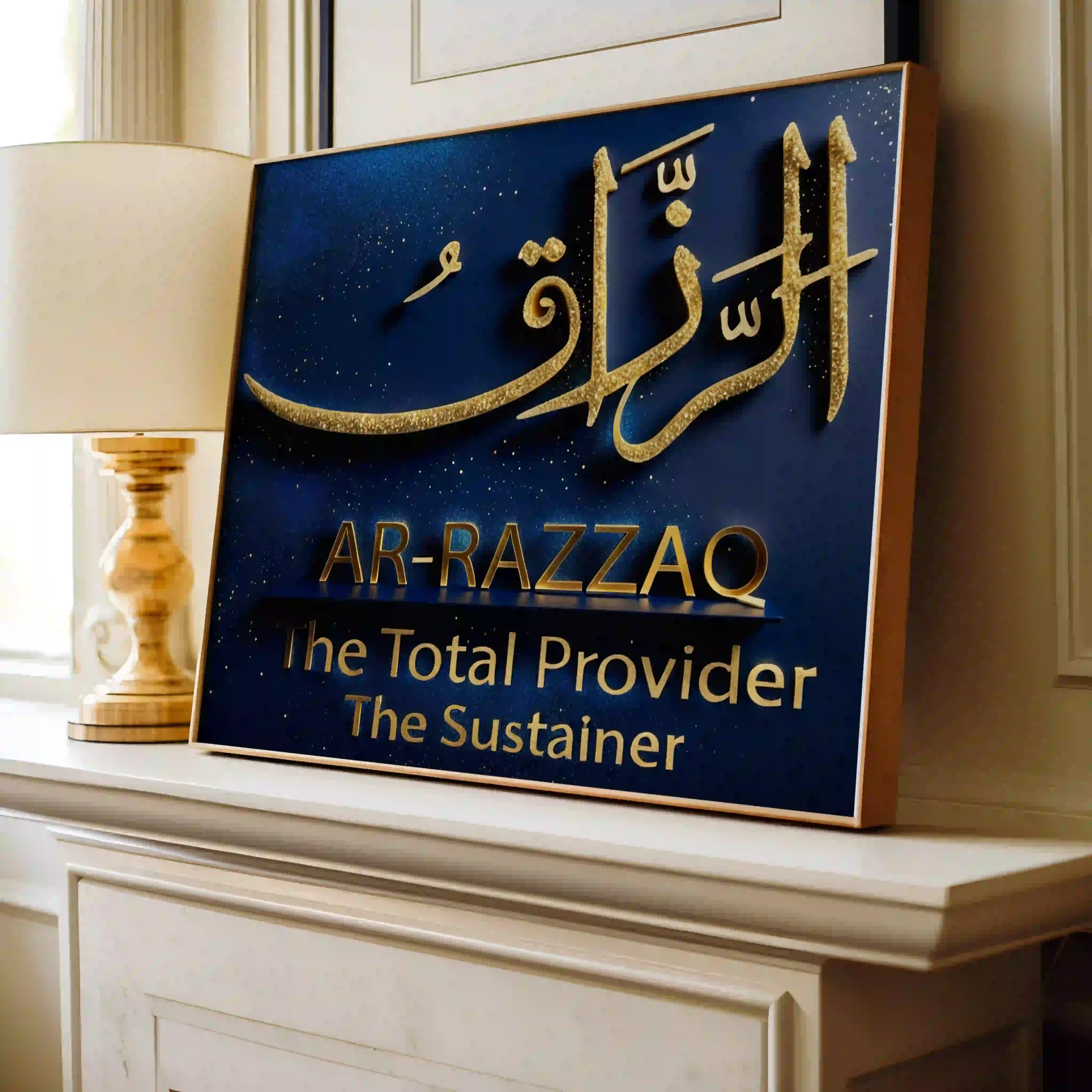
Our Ar-Razzaaq calligraphy design is an digital download; no physical item is shipped. Please see the product page for the files and print sizes included.
Explore the full 99 Names of Allah collection for other calligraphy designs.
Perfect Gifts for Islamic Occasions
Islamic wall art is a great gift for special times. Here are some ideas:
| Occasion | Recommended Artwork | Spiritual Significance |
|---|---|---|
| Ramadan | Ar-Razzaaq with Quranic verses | Gratitude for divine sustenance during fasting |
| Eid celebrations | 99 Names of Allah collection | Comprehensive reminder of divine attributes |
| Wedding gifts | Paired calligraphy sets | Blessing new homes with divine protection |
| Housewarming | Barakah (Blessings) designs | Inviting prosperity through divine names |
Check out islamicwallarts.co.uk for beautiful collections. Each download brings divine truth into your home, making it more peaceful and meaningful.
Conclusion
Learning about Ar-Razzaaq changes how we see our daily needs. When we understand that Allah is our Provider, our worries about tomorrow lose their grip. We still work, but we stop treating jobs, businesses or other people as the real source of our provision.
Ar-razzaaq in Quran shows provision is more than just money and food. Allah gives knowledge, patience, and peace to those who need it. This understanding helps us see blessings in every part of life. We learn to value the air we breathe, the love in our families, and the guidance that leads us to paradise.
Living with trust in ar-razzaaq means taking action while trusting Allah’s plan. We work hard, keep family bonds strong, give charity, and avoid what blocks our blessings. At the same time, we accept what comes with contentment, knowing Allah gives each person what they need for their test in this world.
As we end our journey through ar-razzaaq in Quran, remember Allah provides for birds in the sky and His servants on earth. Let this divine name fill your home with blessings, your heart with peace, and your life with purpose. Trust in Ar-Razzaaq, work righteously, and become a channel through which Allah’s provision flows to others.
FAQ
What does Ar-Razzaaq mean?
Ar-Razzaaq means “the Provider”: the One who provides for every creature, continually and abundantly. It comes from the root r-z-q, meaning provision or sustenance.
Where is Ar-Razzaaq mentioned in the Qur’an?
In Surah Adh-Dhariyat: “Indeed, it is Allāh who is the [continual] Provider, the firm possessor of strength” (51:58). Related verses include 51:22 and 11:6.
What does rizq include?
Rizq includes food, money, shelter and health, and also faith, knowledge, good character, family, peace of heart and every other blessing.
Is there a special number of times to recite Ya Razzaaq?
No authentic text sets a special number of repetitions for this name. You can call on Allah by it sincerely in your own dua whenever you ask Him for provision.
What actions are linked to increased provision?
The Qur’an and authentic hadith link provision with keeping family ties (Sahih al-Bukhari 5986), taqwa (65:2–3), gratitude (14:7), seeking forgiveness (71:10–12) and charity (2:261). These are acts of worship first, alongside honest work.
Does trusting Allah mean I do not need to work?
No. The Prophet ﷺ compared trust to a bird that goes out every morning to find food (Jami’ at-Tirmidhi 2344), and the Qur’an tells believers to seek Allah’s bounty after prayer (62:10).
Can I display Ar-Razzaaq calligraphy at home?
Yes. Islamic Wall Arts offers Ar-Razzaaq calligraphy as an digital download in JPEG format, which you can print at home or through a local print shop. No physical item is shipped.