Where does the history of Islamic wall art begin? Long before framed prints, Muslims decorated walls with carved inscriptions, painted plaster and glazed tiles. The history of Islamic wall art follows three main threads, calligraphy, geometry and plant-based arabesque, from the first mosques to the homes of today.
For a practical guide to choosing pieces now, see our Islamic wall art guide.
Why Letters, Geometry and Plants?
Islamic religious art generally avoids images of people and animals in sacred spaces. Instead, artists developed three visual languages:
- Calligraphy: the words of the Qur’an and remembrance of Allah; see Islamic calligraphy.
- Geometry: repeating stars and polygons built from circles and lines.
- Arabesque: flowing, endlessly repeating vines and leaves.
Early Monuments
Some of the earliest surviving examples of Islamic wall decoration are in the Dome of the Rock in Jerusalem, completed around 691 CE, where mosaics and a long band of Qur’anic inscription wrap around the interior. Mosque walls, mihrabs and domes across the Islamic world followed this pattern of inscription and ornament.
Tiles and Mosaic
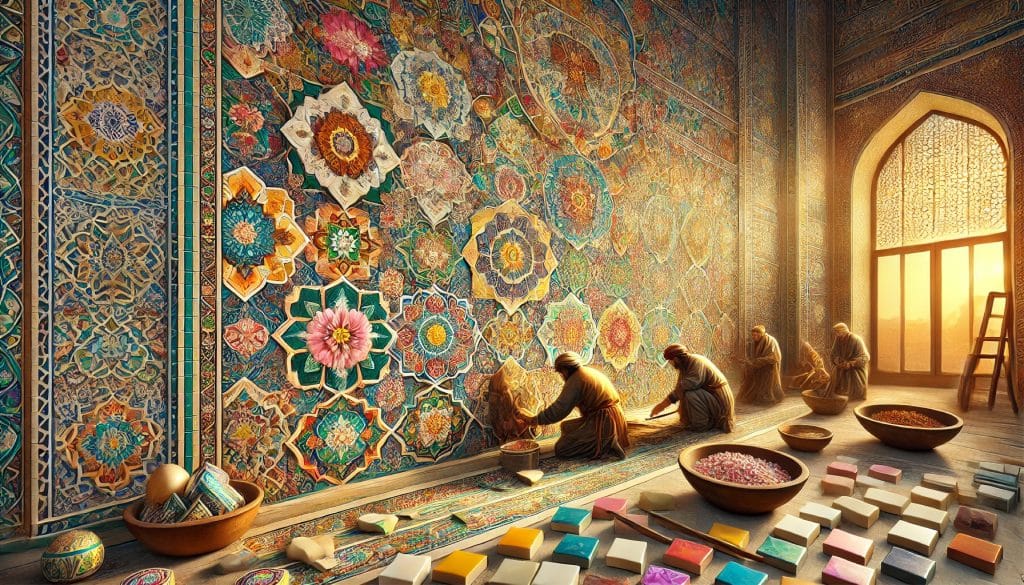
Tiles are a major chapter in the history of Islamic wall art. Glazed tilework became one of the great forms of Islamic wall art. Examples include the zellige mosaics of Morocco and Al-Andalus, the blue and turquoise tiles of Safavid Isfahan, and the Iznik tiles used in Ottoman mosques.
Calligraphic Panels for the Home
The history of Islamic wall art moved into the home with calligraphic panels. In the Ottoman world, calligraphers produced framed panels, known in Turkish as levha, carrying names of Allah, verses and prayers, to hang in mosques and homes. These are close ancestors of the calligraphy prints many families display today.
Islamic Wall Art Today
Today the history of Islamic wall art continues in new forms: contemporary calligraphy, minimal typography, watercolour backgrounds and printable digital designs. The principles stay the same: accurate words, balanced composition and respect for sacred text.

Seeing the History of Islamic Wall Art in the UK
You do not have to travel far to see historic pieces up close. In London, the British Museum’s galleries of the Islamic world and the Jameel Gallery at the V&A display tiles, inscriptions, metalwork and manuscripts from across the Islamic world.
When you visit, look at how the three traditions work together: the calligraphy carries the meaning, the geometry gives order, and the plant forms add movement. Notice too how inscriptions often run in bands around a doorway or across the top of a wall, framing the space. These same principles still guide how calligraphy is placed in a home today: give the words a clear setting and enough space to be read.

Why It Still Matters
- A reminder: a verse or name of Allah on the wall prompts remembrance through the day.
- Identity: it connects families to a long artistic heritage.
- Beauty: Islamic art is admired well beyond the Muslim world for its balance and craftsmanship.
Frequently Asked Questions
What are the main styles in the history of Islamic wall art?
Calligraphy, geometric patterns and arabesque, often combined, in materials from stone and stucco to tiles, paper and prints.
Where can I see historic Islamic wall art?
Famous examples include the Dome of the Rock, the Alhambra in Granada, the mosques of Isfahan and Istanbul, and museum collections such as those in London’s British Museum and Victoria and Albert Museum.
How can I bring this tradition into my own home?
Choose one well-made piece of calligraphy, pair it with a single geometric element such as a patterned cushion, rug or tile, and keep the rest of the room simple. Our guide to Islamic home decor has more ideas.
Continue the Tradition
Explore Iqra Digital Download Calligraphy, an digital download supplied as a high-resolution JPEG file for printing at home or at a local print shop; no physical item is shipped. Custom designs can be requested. Read the verse behind it on quran.com.