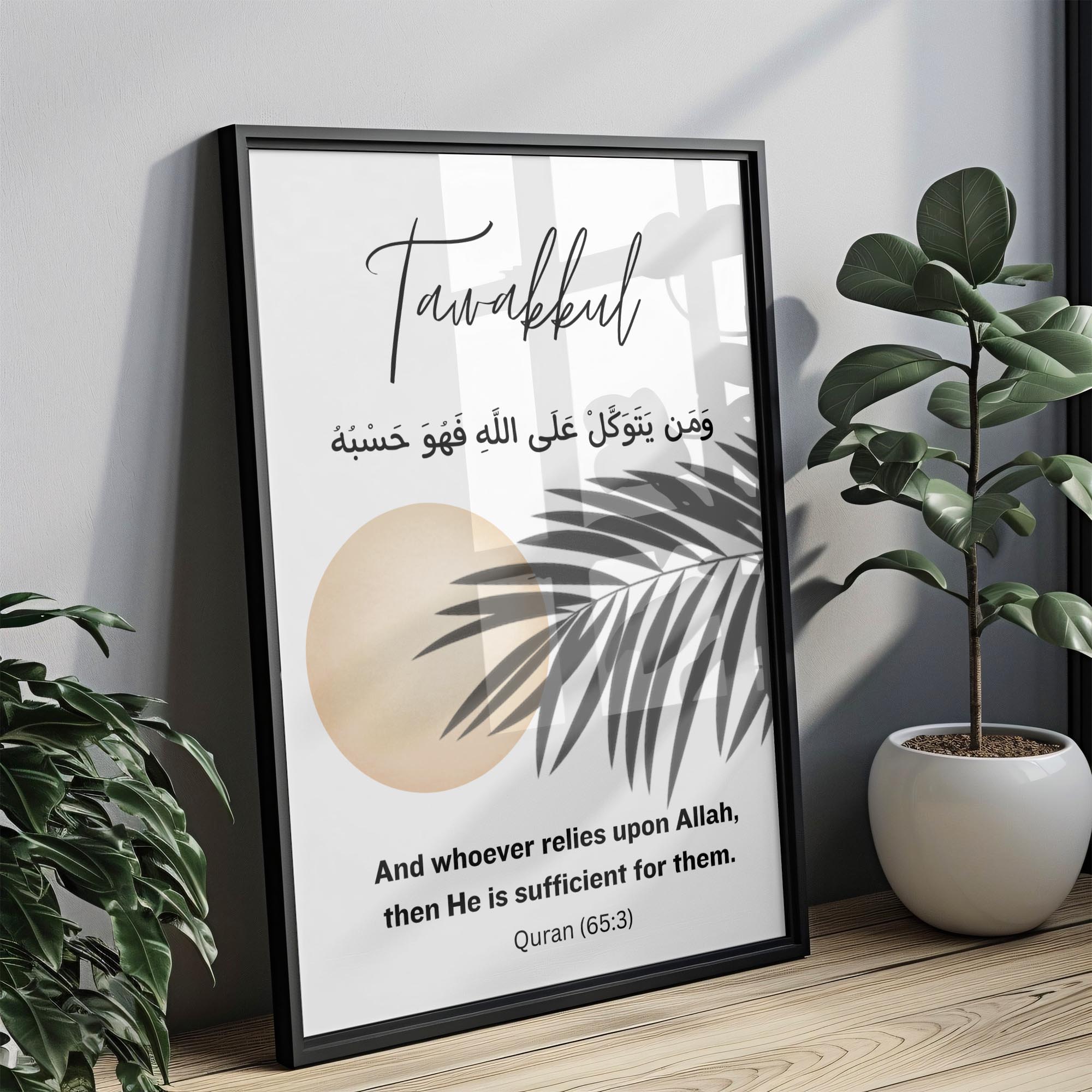
Mixing styles creates spiritual depth throughout homes. Pair Kufic’s boldness in entryways with Thuluth’s elegance above prayer mats. Let each space tell its own story through script selection – because faith deserves both diversity and intentionality in its visual expression.

Digital Islamic Art for the Home: How It Works
Digital downloads have made Islamic art far more accessible. Instead of waiting for a framed piece to be shipped, you receive high-resolution files straight away and choose how to print them. This has several advantages:
- Instant access: the files are available as soon as your order is complete.
- Flexible sizing: print the same design small for a bedside table or large for a living-room wall.
- Your choice of finish: matt or gloss paper, fine-art paper, or canvas from a local print shop.
- Easy to replace: if a print is damaged, you can print it again.
Please note that as an instant digital download, no physical item is shipped, and digital products are generally non-refundable once downloaded. If you would like a design adapted, for example with a different colour scheme, custom designs can be requested.
Printing Your Download
High-resolution JPEG files can be printed at the standard A sizes. As a guide:
- A5: 14.8 × 21.0 cm (5.8 × 8.3 in), suitable for shelves and desks
- A4: 21.0 × 29.7 cm (8.3 × 11.7 in), a versatile size for most rooms
- A3: 29.7 × 42.0 cm (11.7 × 16.5 in), good for hallways and bedrooms
- A2: 42.0 × 59.4 cm (16.5 × 23.4 in), a statement piece for living rooms
- A1: 59.4 × 84.1 cm (23.4 × 33.1 in), best for large walls
For canvas, ask your print shop to check that the design has enough margin to wrap around the frame without cutting into the calligraphy. For paper prints, a simple frame with a mount often gives the most elegant result.
Choosing Islamic Art for the Home, Room by Room
- Living room: a larger verse or a name of Allah as a focal point.
- Entrance or hallway: a short phrase such as Bismillah or Ayat al-Kursi.
- Prayer corner: calm, simple designs that support focus rather than distract.
- Children’s room: gentle phrases and names with clear, readable lettering.
- Kitchen or dining area: reminders of gratitude such as alhamdulillah.

Popular Verses for Islamic Art for the Home
Some verses are especially loved for home display because they are short, meaningful and easy to reflect on. Here are several, with the meaning in English from Saheeh International:
For hope in difficult times
“For indeed, with hardship [will be] ease [i.e., relief].”
(Qur’an 94:5, Saheeh International)
“Indeed, with hardship [will be] ease.”
(Qur’an 94:6, Saheeh International)
For peace of heart
“Those who have believed and whose hearts are assured by the remembrance of Allāh. Unquestionably, by the remembrance of Allāh hearts are assured.”
(Qur’an 13:28, Saheeh International)
For trust in Allah
“And will provide for him from where he does not expect. And whoever relies upon Allāh – then He is sufficient for him. Indeed, Allāh will accomplish His purpose. Allāh has already set for everything a [decreed] extent.”
(Qur’an 65:3, Saheeh International)
For the Oneness of Allah
“Say, “He is Allāh, [who is] One,”
(Qur’an 112:1, Saheeh International)
For a married couple’s home
“And of His signs is that He created for you from yourselves mates that you may find tranquility in them; and He placed between you affection and mercy. Indeed in that are signs for a people who give thought.”
(Qur’an 30:21, Saheeh International)
Alongside verses, many families choose single words or short phrases such as Bismillah (In the name of Allah), Alhamdulillah (All praise is for Allah), Sabr (patience), Shukr (gratitude) and Tawakkul (trust in Allah). These work especially well in minimalist interiors and smaller spaces.
Displaying Qur’anic Verses with Respect
Displaying Islamic art for the home is also a matter of adab (good manners). Many Muslims take care in where and how verses of the Qur’an are displayed. Common considerations include hanging them at a respectful height, keeping them out of bathrooms, and avoiding places where they may be damaged or treated carelessly. If you are unsure about a particular placement, it is worth asking a knowledgeable person in your community, as practices vary.
Ayat al-Kursi is one of the most popular verses for the home. Its meaning, as translated by Saheeh International, begins:
“Allāh – there is no deity except Him, the Ever-Living, the Self-Sustaining. Neither drowsiness overtakes Him nor sleep. To Him belongs whatever is in the heavens and whatever is on the earth. Who is it that can intercede with Him except by His permission? He knows what is [presently] before them and what will be after them, and they encompass not a thing of His knowledge except for what He wills. His Kursī extends over the heavens and the earth, and their preservation tires Him not. And He is the Most High, the Most Great.”
(Qur’an 2:255, Saheeh International)
Checking the Arabic
Whatever Islamic art for the home you choose, check before printing that the Arabic text is correct. Poorly made designs, including many AI-generated images, contain letters that look Arabic but spell nothing. Every design in our shop is checked for accurate spelling, and each product page gives the meaning in English so that everyone in your home can understand it.
A Simple Plan to Get Started
- Choose one room first. Start with the space your family uses most, often the living room, rather than trying to decorate the whole house at once.
- Pick a message that matters to you. Think about what you would like to be reminded of every day: patience, gratitude, trust in Allah or His mercy.
- Decide on a style. Look at the scripts described above and choose one that suits both the words and the room.
- Measure the wall. As a rough guide, artwork above a sofa often looks balanced at about two-thirds of the sofa’s width.
- Print and frame. Order a test print at a smaller size if you are unsure, then print the final size on your preferred paper or canvas.
- Review after a few weeks. Notice whether the piece still catches your eye and prompts reflection. If it does, you may want to add a companion piece in another room.
Building a collection of Islamic art for the home slowly, one meaningful piece at a time, usually gives a calmer and more personal result than buying many pieces at once. It also gives each design the space and attention it deserves, so that your Islamic art for the home remains a source of reflection rather than just decoration.
Common Mistakes When Choosing Islamic Art for the Home
- Buying designs with incorrect Arabic. Many cheap or AI-generated images contain shapes that only look like Arabic letters. Always check the spelling and the meaning.
- Choosing a size that is too small. A small print on a large wall can look lost. Measure the space first and consider A2 or A1 for a main wall.
- Crowding too many pieces together. Islamic art for the home often looks best with space around it. One well-chosen piece can say more than several competing ones.
- Ignoring the room’s colours. Choose designs whose colours complement your walls and furniture: neutral backgrounds with gold or black lettering suit most homes.
- Forgetting the meaning. The value of Islamic art for the home lies in its message. Choose verses, names and phrases that mean something to you and your family, and learn their meaning so that each glance becomes a reminder.
With a little planning, Islamic art for the home can bring beauty, calm and daily remembrance to every room, without clutter and without compromising on authenticity.
Islamic Art as a Gift
Islamic art for the home also makes a meaningful present. Calligraphy makes a thoughtful gift for weddings, a new home, the birth of a child, Ramadan or Eid, and for friends who have recently embraced Islam. Because our designs are digital, you can send the file quickly and the recipient can print it at the size that suits their space. For a new baby, a child’s name or a short dua is popular; for a wedding, a verse about love and mercy between spouses is often chosen.
Caring for Your Prints
Good Islamic art for the home should last for years. To keep prints looking their best, avoid hanging them in direct, strong sunlight, which can fade inks over time, and keep them away from damp walls. A frame with glass or acrylic glazing protects paper prints from dust. If a print is damaged, you can simply print the file again.
Frequently Asked Questions about Islamic Art for the Home
Do you sell canvas prints or framed art?
No. Our designs are instant digital downloads supplied as high-resolution JPEG files. You can print them on paper or canvas at home or at a local print shop. No physical item is shipped.
What sizes can I print?
The files are suitable for standard A sizes from A5 (14.8 × 21.0 cm) up to A1 (59.4 × 84.1 cm). For very large prints, ask your print shop to check the file before printing.
Which Arabic script should I choose?
Kufic suits bold, modern spaces; Thuluth is elegant and formal; Naskh is the most readable for longer passages; and Diwani is decorative and flowing. Choose the one that suits both the text and the room.
Where should I hang Qur’anic verses?
Many people choose a respectful height in living areas, hallways or prayer corners, and avoid bathrooms or places where the print could be damaged. Practices vary, so ask a knowledgeable person if you are unsure.
Can I request a custom design?
Yes. Custom designs can be requested, for example a different colour scheme or a name or phrase that is not in the shop.