
Digital downloads and physical products are clearly identified. Product, delivery and payment details are shown before order confirmation.

Reviewed reflections appear only after source and reviewer approval.
Islamic History & Culture

Islamic Golden Age: 7 Beautiful Legacies of Learning

Discover the Islamic Golden Age: Baghdad’s House of Wisdom, al-Khwarizmi, Ibn Sina, Ibn al-Haytham, al-Qarawiyyin and the legacy these scholars left.

What was the Islamic Golden Age? It is the name historians give to a period, roughly from the 8th to the 13th century, when scholars across the Muslim world led major advances in mathematics, medicine, astronomy, optics and philosophy. Many ideas we take for granted today were developed, preserved or refined in this era.

This guide introduces the places and people of the Islamic Golden Age and the legacy they left. Dates are approximate where historians differ.

Baghdad and the House of Wisdom

After the Abbasids founded Baghdad in 762 CE, the city grew into a centre of learning. The Bayt al-Hikmah (House of Wisdom), which flourished under the caliph al-Ma’mun in the early 9th century, brought together scholars who translated works from Greek, Persian and Sanskrit into Arabic and then built on them.

Islamic Golden Age: an artist’s impression of historic Baghdad

Mathematics: Al-Khwarizmi

Muhammad ibn Musa al-Khwarizmi (c. 780–850) wrote a book whose title gave us the word algebra (from al-jabr), and the Latin form of his name gave us algorithm. His work also helped spread the Hindu-Arabic numerals used around the world today.

Medicine: Al-Razi, Ibn Sina and Al-Zahrawi

  • Al-Razi (c. 854–925) wrote an early clinical description distinguishing smallpox from measles.
  • Ibn Sina (Avicenna, 980–1037) wrote The Canon of Medicine, taught in European universities for centuries.
  • Al-Zahrawi (Abulcasis, c. 936–1013), working in Córdoba, wrote a major medical encyclopaedia with illustrated surgical instruments.
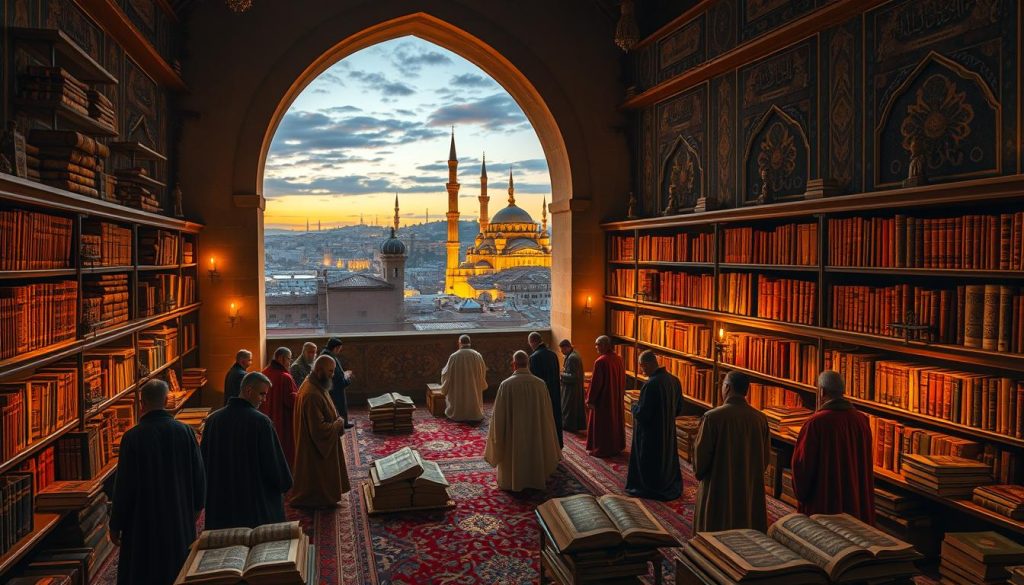
Islamic Golden Age: shelves of books in a historic library

Science: Ibn al-Haytham and Al-Biruni

Ibn al-Haytham (c. 965–1040) wrote the Book of Optics, explaining vision through light entering the eye and testing ideas by experiment. Al-Biruni (973–c. 1050) was a mathematician and astronomer who estimated the Earth’s radius with notable accuracy.

Philosophy: Ibn Rushd

Ibn Rushd (Averroes, 1126–1198), a judge and philosopher from Córdoba, wrote influential commentaries on Aristotle that were widely studied in medieval Europe.

Places of Learning

Learning in the Islamic Golden Age was not confined to Baghdad. Córdoba, Cairo and Fez all became centres of scholarship. In Fez, Fatima al-Fihri founded the al-Qarawiyyin mosque in 859 CE; its school is often described as the oldest continuously operating university in the world.

Islamic Golden Age: a historic library with manuscripts

Why It Flourished

Historians point to several factors: a common language of scholarship (Arabic), paper-making, which spread from the 8th century, generous patronage, busy trade routes, and a strong culture of seeking knowledge rooted in the Qur’an’s repeated call to reflect on creation, as in Qur’an 13:3 (see our guide to Quran stories for more on reflection).

How the Islamic Golden Age Ended

There is no single end date. The Mongol sack of Baghdad in 1258 is often used as a marker, but scholarship continued in Cairo, Istanbul, Isfahan and Delhi for centuries afterwards. See our overview of Islamic history for the wider story.

The Legacy Today

The legacy of the Islamic Golden Age lives on in the words we use (algebra, algorithm, alchemy), in medicine and optics, and in the art of Arabic calligraphy and geometric design that still decorates homes and buildings worldwide.

Frequently Asked Questions

When was the Islamic Golden Age?

Historians usually date the Islamic Golden Age from around the 8th century to the 13th century, though learning continued long after.

Who were the most famous scholars of the Islamic Golden Age?

Well-known names include al-Khwarizmi, al-Razi, Ibn Sina, al-Zahrawi, Ibn al-Haytham, al-Biruni and Ibn Rushd.

A Reminder to Keep Learning

The spirit of the Islamic Golden Age was a love of knowledge. A dua for knowledge on the study wall keeps that spirit alive.

Islamic Golden Age: Dua for Knowledge wall art
Dua for Knowledge (JPEG file; frame not included).

Explore Dua for Knowledge, an instant digital download supplied as a high-resolution JPEG file for printing at home or at a local print shop; no physical item is shipped. Custom designs can be requested.


Leave a Reply